

By the Canada History Society
The Battle of Vimy Ridge, 9–12 April 1917
The Ridge That Became a Nation’s Memorial
There are places where history seems reluctant to surrender its dead. The fields around Vimy Ridge in northern France are among them. Today, the countryside is peaceful. The fertile plains of Artois stretch towards the horizon, villages stand where armies once fought, and the roads wind through landscapes that have largely recovered from the destruction of the First World War. Yet beneath the grass remain the scars of artillery, the remnants of trenches, the unexploded shells of a terrible struggle, and the memory of thousands of young men who never returned to their homes.
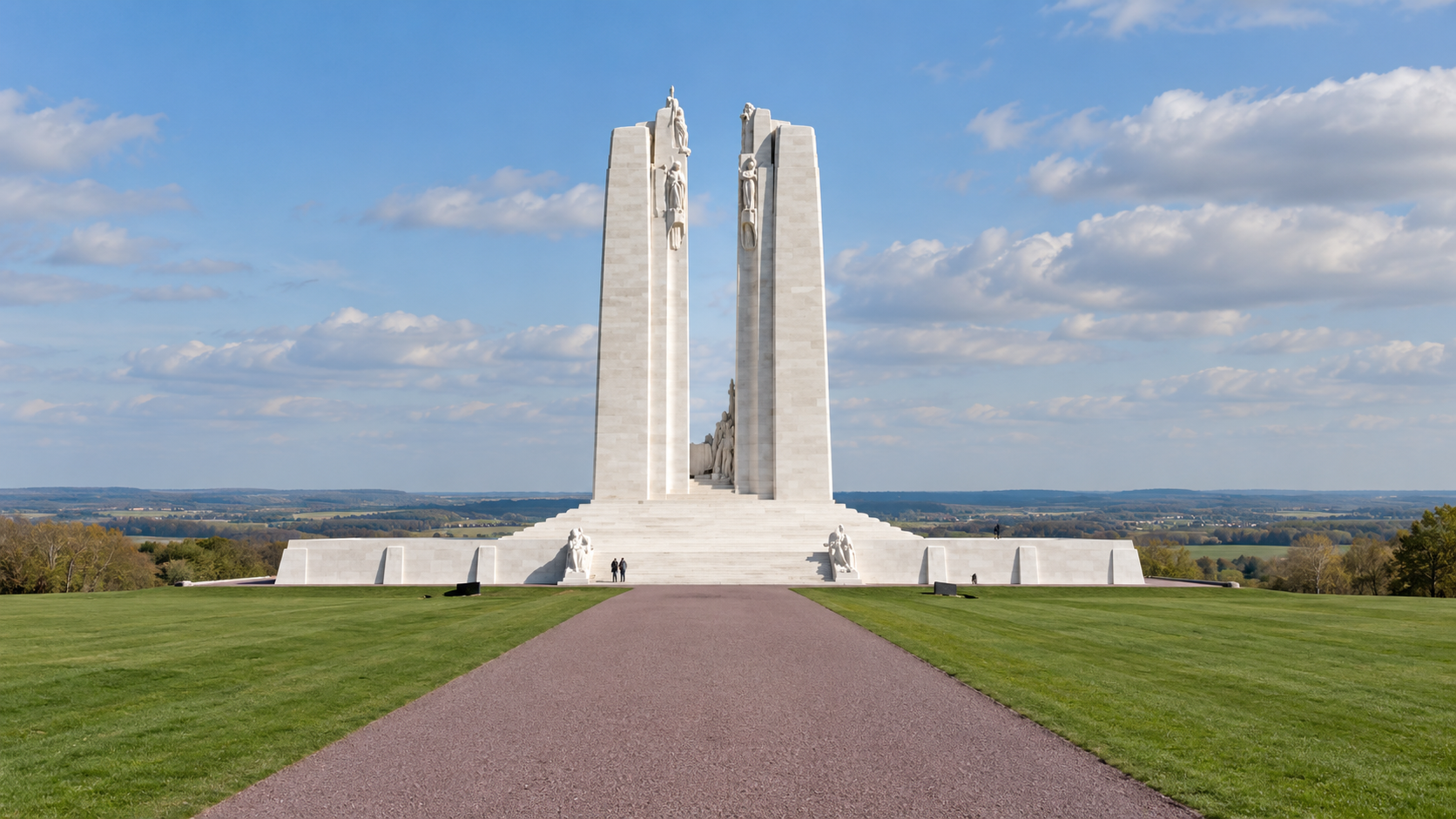
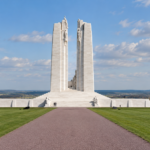
Above this landscape rises the Canadian National Vimy Memorial, its two great limestone pylons reaching into the sky. At its base stands a grieving woman, her head bowed and her eyes directed towards the battlefield below. She represents Canada, a nation mourning its lost sons. Across the monument are carved the names of 11,285 Canadian soldiers who died in France during the First World War and whose remains had not been identified or recovered when the monument was completed.
The memorial is more than a monument to military victory. It is an expression of national grief, a declaration that the dead must not be forgotten, and one of Canada’s most enduring connections to the tragedy of the Great War.
Every November 11, when Canadians gather before cenotaphs, place wreaths beneath memorials, wear red poppies, and stand in silence at the eleventh hour, the memory of Vimy Ridge forms an important part of that national act of remembrance. Although the battle took place in April 1917, eighteen months before the Armistice, its significance reaches far beyond the four days of fighting. It represents both the extraordinary accomplishments of Canadian soldiers and the dreadful human price of modern industrial warfare.
The victory at Vimy became a defining event in the history of the Canadian Corps. Its larger meaning, however, was created not only by what happened on the battlefield, but also by how subsequent generations chose to remember it. In that distinction lies the connection between Vimy Ridge and Remembrance Day: one commemorates a particular battle, while the other embraces the sacrifice of Canadians across generations of conflict. Together, they remind the country that military achievement and national mourning are inseparable parts of its history.[1]
Canada Goes to War
When war engulfed Europe in August 1914, Canada was a young Dominion of fewer than eight million people. Confederation had occurred only forty-seven years earlier, and although Canada possessed domestic self-government, its foreign affairs remained closely tied to Britain. Britain’s declaration of war against Germany therefore brought Canada into the conflict.
The first Canadian volunteers departed with enthusiasm, their departure accompanied by speeches, cheering crowds, military bands, and widespread expectations that the conflict would be short. Many believed they were participating in a great imperial adventure. Others saw the struggle as a defence of Britain, France, Belgium, and the political order that Germany’s invasion had threatened.
The realities of the Western Front soon destroyed those illusions. The armies that had marched across Europe in 1914 disappeared into elaborate systems of trenches stretching from the North Sea towards Switzerland. Artillery, machine guns, barbed wire, and increasingly sophisticated defensive positions transformed the battlefield into a place where even modest advances could demand thousands of casualties.
The Canadians endured their baptism of fire at the Second Battle of Ypres in April 1915, where they faced the first large-scale German chlorine-gas attack on the Western Front. More fighting followed. At the Somme in 1916, the Canadian Corps suffered terrible losses as the British and German armies struggled for months over a devastated landscape.
By the beginning of 1917, the Canadian Corps was a seasoned military formation. Its soldiers had learned the cost of inadequate preparation, the importance of artillery, the necessity of communication, and the grim realities of fighting against an entrenched enemy. These lessons would become essential at Vimy Ridge.
The Canadian military historian Tim Cook has emphasized the importance of that accumulated experience. The Canadians who approached Vimy in late 1916 were not inexperienced volunteers. They were survivors of earlier campaigns who had developed new methods of training, reconnaissance, artillery coordination, and infantry assault. Their success would depend upon this hard-earned military knowledge as much as upon personal courage.[2]
Vimy Ridge: The Fortress Above the Plain
Vimy Ridge was not a mountain, but its commanding position made it one of the most formidable defensive features in northern France. Extending for approximately seven kilometres, the ridge overlooked the Douai Plain and provided excellent observation over Allied positions and the surrounding countryside.
German forces had occupied the heights since 1914. Over the following years, they transformed the ridge into a complicated defensive system of trenches, reinforced concrete positions, machine-gun emplacements, underground shelters, and communications tunnels. From these positions, German artillery observers could direct fire against Allied movements on the lower ground.
Previous French attempts to recover the ridge had failed at an appalling human cost. The ground had already witnessed prolonged and bloody fighting, and by the time the Canadians arrived, much of the surrounding countryside had become a wasteland of shell holes, ruined villages, shattered trees, and abandoned military equipment.
The ridge mattered to the Allied command because of its tactical position. Capturing it would deny the Germans important observation points and strengthen the Allied position during the planned British offensive around Arras.
The task fell to the Canadian Corps under Lieutenant-General Sir Julian Byng, an experienced British officer whose leadership had won the confidence of his Canadian soldiers. Among his principal subordinates was Major-General Arthur Currie of British Columbia, commander of the 1st Canadian Division and one of the most capable Canadian officers to emerge during the war.
The coming battle would be the first occasion on which all four divisions of the Canadian Corps attacked together as a single formation.
Its success would require something more than another courageous advance across open ground. Previous offensives had demonstrated the disastrous consequences of inadequate intelligence, poor artillery coordination, and inflexible command. Byng, Currie, and their staff determined that Vimy would be approached differently.[3]
The Winter of Preparation
During the winter of 1916–1917, the Canadian Corps prepared for the assault with extraordinary thoroughness. The preparation was immense in scale, involving infantry, artillery, engineers, intelligence officers, medical personnel, transport units, and British formations whose specialist support was essential to the operation.
Behind the front lines, soldiers rehearsed their movements over ground marked to resemble the German defences. Models of the battlefield allowed officers and men to study the location of trenches, strongpoints, and defensive positions. Detailed maps were distributed on a scale unusual for the British armies of the period, enabling ordinary infantrymen to understand their own objectives and the broader plan.
This was an important development. Men who understood the purpose of their movements were better prepared to continue an attack when officers were wounded, communications failed, or unexpected resistance interrupted the timetable.
Canadian engineers and British tunnelling companies expanded an underground network of passages, dugouts, and communications facilities. These provided shelter, permitted supplies and personnel to move closer to the front, and offered routes through which soldiers could assemble before the assault.
Artillery preparation was equally important. Allied gunners employed increasingly sophisticated methods of identifying German batteries, including sound-ranging, flash-spotting, and aerial observation. Counter-battery fire was intended to suppress or destroy enemy artillery before it could devastate the advancing infantry.
The Canadians also conducted trench raids to gather intelligence, identify German defensive positions, and capture prisoners. These operations were dangerous and sometimes costly, but they contributed to the information upon which the battle plan depended.
The principal assault would be supported by a carefully timed creeping barrage. Rather than concentrating artillery fire solely upon distant positions, the guns would create a moving wall of explosions immediately ahead of the infantry. As the soldiers advanced, the barrage would move forward according to a predetermined schedule, forcing German defenders to remain under cover until Canadian infantry could approach their positions.
It was a formidable plan, but its success depended upon precise timing. Soldiers who advanced too quickly risked entering their own artillery fire. Those who fell behind could lose the protection of the barrage and become exposed to German machine guns.
The Canadians prepared with relentless attention to detail because the lessons of the Somme had been unmistakable. Courage could not substitute for preparation. Men sent against intact defensive positions without adequate support could be destroyed before reaching their objectives.
Vimy was to demonstrate what disciplined troops, effective staff work, improved artillery methods, and careful training could achieve when brought together in a coordinated operation.[4]
Easter Monday, 9 April 1917
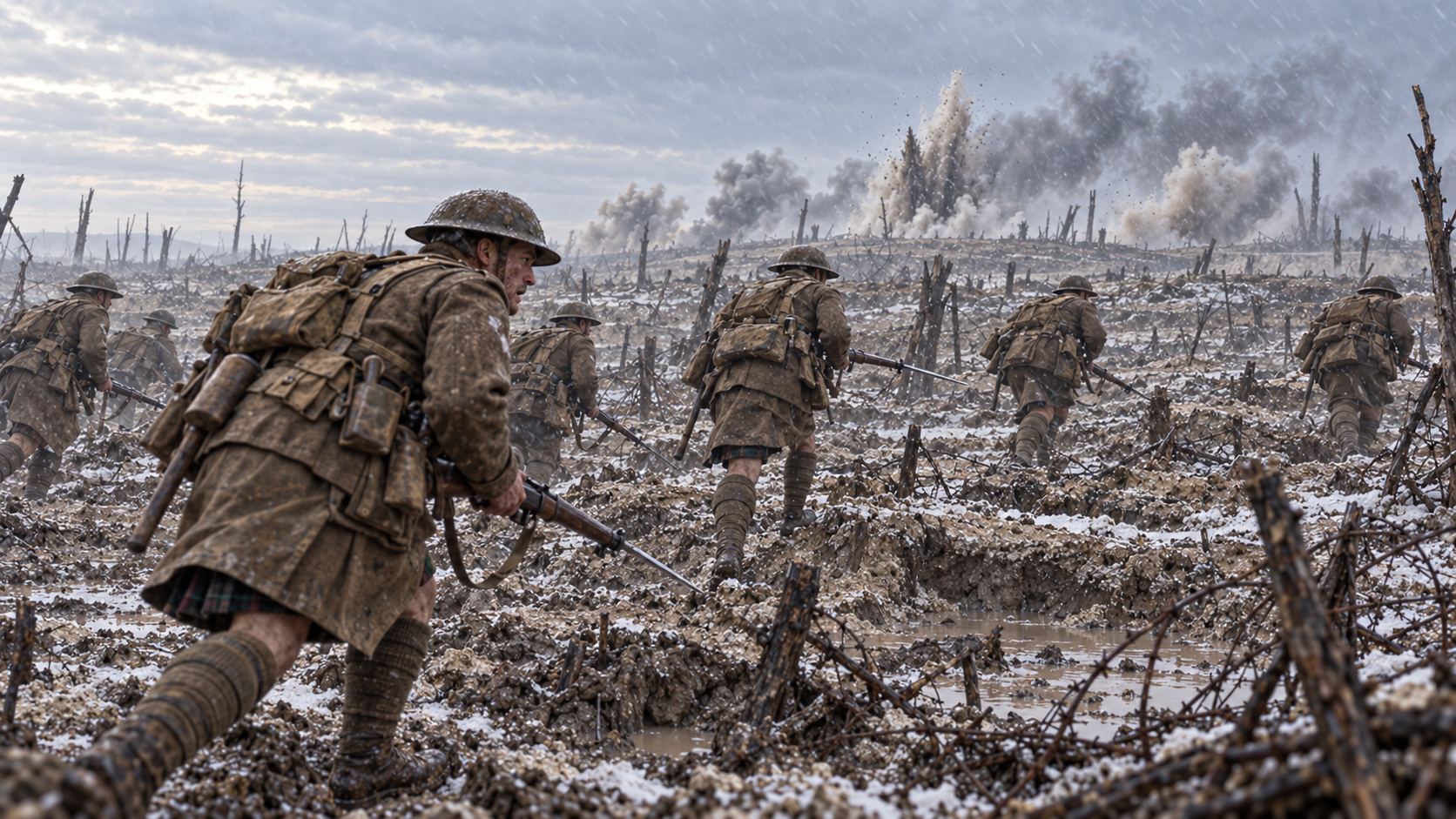
Before dawn on Easter Monday, April 9, 1917, Canadian soldiers gathered in their forward trenches and underground assembly positions. The weather was bitterly cold. Snow and sleet swept across the ground, and the broken landscape ahead was concealed in darkness.
Many of the men carried heavy equipment. They had been instructed in their objectives and knew that a formidable German defensive system lay beyond the parapets. For some, this was their first major assault. Others had survived earlier battles and understood with painful clarity what might happen when the attack began.
At precisely 5:30 in the morning, the artillery opened fire.
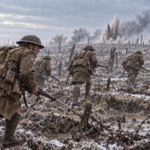
More than a thousand Allied guns supported the operation. The explosion of the barrage transformed the ridge into a landscape of fire, smoke, shattered earth, and falling debris. Under the protection of this bombardment, thousands of Canadians emerged from their positions and moved forward across No Man’s Land.
The first waves encountered determined German resistance. Machine guns swept the approaches, artillery struck the advancing troops, and casualties mounted. In some sectors, German positions were overwhelmed quickly. Elsewhere, strongpoints held out and forced Canadian soldiers to fight their way forward through wire, trenches, and fortified positions.
The assault nevertheless made substantial progress. The painstaking preparations of the preceding months had given the Canadian infantry a degree of coordination and flexibility that proved decisive.
By noon on April 9, much of Vimy Ridge was in Canadian hands. Yet the battle was not finished.
Hill 145, the highest point on the ridge and the location where the great memorial would eventually stand, remained contested. Elements of the Canadian 4th Division encountered particularly determined German resistance. The position was secured on April 10, after further costly fighting.
The final major objective, a fortified northern feature known as the Pimple, was captured on April 12.
After four days of fighting, the Canadian Corps controlled the ridge.
It was one of the most impressive Allied tactical successes of the war. The Canadians had captured a position that had resisted previous major attacks, taken prisoners, seized military equipment, and established themselves on strategically valuable heights.
The battle was also part of a much larger British offensive around Arras. It did not break the German army or bring the war close to an end. Nevertheless, it confirmed the Canadian Corps’ growing reputation as an effective fighting formation capable of carrying out exceptionally difficult military operations.[5]
The Price of Victory
The triumph was bought with blood.
Officially recorded Canadian casualties amounted to 10,602, including 3,598 men killed and 7,004 wounded. In four days, thousands of Canadian families were plunged into mourning, and many others faced the possibility that wounded sons, husbands, fathers, or brothers would never fully recover.
Behind the statistics were individual lives interrupted.
The fallen included farm workers, railway employees, fishermen, miners, clerks, university students, labourers, and men who had left families and occupations behind. Some were Canadian-born; many had been born in Britain or elsewhere. They had enlisted for different reasons, but their wartime experiences had brought them together in the trenches of France.
The wounded returned from battle with injuries that could alter the remainder of their lives. Some lost limbs or suffered permanent disabilities. Others carried wounds that were less visible but no less consequential. The psychological and emotional consequences of prolonged combat would affect soldiers and their families long after the guns fell silent.
Four Canadians received the Victoria Cross for their actions during the battle: Private William Milne, Lance-Sergeant Ellis Sifton, Captain Thain MacDowell, and Private John Pattison. Their deeds exemplified the courage displayed by soldiers confronted with extraordinary danger.
But the history of Vimy Ridge cannot be reduced to decorations or commanding officers. The success of the assault depended upon the collective efforts of tens of thousands of people, including stretcher-bearers who entered dangerous ground to recover the wounded, engineers who maintained communications, artillerymen who supported the infantry, and medical personnel who struggled to save lives amid the terrible consequences of industrial warfare.
For every decorated soldier, there were countless others whose names rarely appeared in official histories.
Victory was measured in captured ground and military achievement. Its human cost was measured in empty chairs, grieving parents, widowed spouses, and children who would grow up without their fathers.
It is this reality that gives Vimy Ridge its deepest meaning on Remembrance Day. The battle cannot be understood only through the movements of divisions or the accomplishments of commanders. It must also be understood through the lives sacrificed to secure those accomplishments.[6]
Was a Nation Born at Vimy Ridge?
One of the most enduring statements associated with Vimy Ridge came from Canadian Brigadier-General Alexander Ross, who later recalled witnessing the assault and declared:
“In those few minutes I witnessed the birth of a nation.”
The phrase became one of the most influential expressions in Canadian historical memory. It suggested that men drawn from communities across the country had fought together, achieved a collective triumph, and discovered in their accomplishment a deeper sense of national identity.
Certainly, Vimy Ridge was an important milestone in Canadian military history. The four divisions of the Canadian Corps operated together, and the achievement received attention both in Canada and abroad. The Corps had demonstrated its effectiveness, and its success strengthened the confidence of its commanders and soldiers.
Yet the popular interpretation that Canada was literally born at Vimy Ridge requires qualification.
Canada had existed as a political federation since 1867. Its national identity had developed through political, economic, cultural, and social processes long before April 1917. The military formation that captured Vimy was also part of the British Expeditionary Force, commanded at corps level by a British officer and supported by substantial British military resources.
The victory itself was a tactical achievement within a wider Allied campaign, not an independent Canadian war or a decisive turning point in the entire conflict.
Military historian J. L. Granatstein has cautioned against exaggerating the battle’s strategic importance. In a 2017 interview, he observed:
“We were a small part in a big war. The impact we had was substantial, but it wasn’t decisive.”
Granatstein’s interpretation does not diminish the courage of the men who fought at Vimy. Rather, it places their accomplishment within the larger military history of the First World War.
Historian Tim Cook has offered another valuable perspective, describing Vimy as an important symbol of Canada’s military past. Cook’s research distinguishes the actual battle from the national legend that developed around it, while recognizing the emotional power that the memorial continues to possess.
Both perspectives illuminate an essential historical truth: the Battle of Vimy Ridge was an extraordinary Canadian military achievement, but its enduring importance is also the result of remembrance, interpretation, and commemoration.
The battle did not create Canada in a single morning. It did, however, become one of the most powerful symbols through which Canadians came to understand their country’s wartime experience and its gradual emergence as a more autonomous nation.[7]
Victory Abroad, Division at Home
The national unity associated with Vimy Ridge must also be considered alongside the political divisions that emerged during 1917.
Canada’s wartime population was not united in its attitudes towards Britain’s war, military service, or the sacrifices demanded by an increasingly costly conflict.
Many English-speaking Canadians strongly supported the war effort. In Quebec, however, substantial opposition developed to compulsory military service, particularly as the conflict continued and voluntary enlistment declined. French-speaking Canadians were not absent from the fighting; the 22nd Battalion and many individuals serving in other formations made important contributions. Nevertheless, language barriers, military institutions, and differing cultural relationships with Britain shaped recruitment and attitudes towards the war.
Prime Minister Sir Robert Borden visited Canadian troops in Europe in the spring of 1917. The growing casualty lists reinforced his concern that voluntary enlistment would no longer provide sufficient reinforcements.
His government’s decision to introduce conscription produced the bitter political struggle known as the Conscription Crisis of 1917.
Thus, the same war that strengthened Canada’s international reputation also exposed profound tensions within Canadian society. National confidence and national division were not contradictory developments. They were simultaneous consequences of a conflict that reached into every province and community.
Nor should the experiences of all those who served be compressed into a single national story. Indigenous volunteers, immigrants, French-speaking Canadians, and men from a wide range of social backgrounds had their own reasons for serving and their own experiences of military life. The history of Canada’s war effort also includes women serving as nurses, workers sustaining the wartime economy, and families bearing the consequences of separation and loss.
A mature understanding of Vimy Ridge must therefore recognize both its unifying symbolism and the divisions that surrounded Canada’s participation in the First World War.
To remember the past faithfully is not to pretend that everyone experienced it in the same way. It is to acknowledge the complexity of the society from which the soldiers came, and the many different forms of sacrifice that the war demanded.[8]
From Battlefield to Sacred Ground
When the First World War ended in November 1918, Canada faced the immense task of commemorating its dead.
More than 66,000 Canadians had lost their lives during the conflict. Many had been buried in military cemeteries scattered across France and Belgium. Thousands had no known grave.
For families in Canada, the absence of a grave close to home created a particular form of mourning. Parents could not easily visit the place where a son had been buried. Widows and children were separated by an ocean from the resting places of those they had lost. In many cases, no identifiable remains had been recovered.
Communities responded by erecting cenotaphs, placing memorial tablets in churches and schools, and establishing monuments in public squares. Names were carved into stone so that the dead would retain a permanent place in the communities from which they had departed.
Vimy Ridge became central to this national movement of remembrance.
In 1922, France granted Canada the use of land at Vimy in perpetuity for memorial purposes. The Canadian government had established the Canadian Battlefields Memorials Commission to oversee the creation of memorials at important sites in France and Belgium.
An architectural competition produced the extraordinary design of Canadian sculptor Walter Seymour Allward. Unlike a conventional monument celebrating military triumph, Allward’s conception emphasized mourning, sacrifice, and the human consequences of war.
Construction began during the 1920s and continued for more than a decade. The work was technically demanding. The foundations had to be established on terrain penetrated by tunnels and damaged by years of fighting, while large quantities of stone were brought to France for the monument.
The result was among the most remarkable commemorative structures of the twentieth century.
Its two pylons symbolize Canada and France. Its sculptural figures express ideals such as peace, justice, hope, faith, and sacrifice. Yet its most emotionally powerful figure is Canada Bereft, sometimes called Mother Canada, standing before the battlefield in silent grief.
She does not raise a sword or celebrate conquest. She mourns.
The historian Jonathan F. Vance, in Death So Noble: Memory, Meaning, and the First World War, examines how Canadians transformed the experience of war into a shared culture of memory. Monuments, literature, ceremonies, and symbols provided ways of interpreting the destruction of the Great War and giving meaning to the sacrifices of the dead.
Vimy Ridge became one of the most important places where that work of national remembrance took physical form.[9]
The Great Pilgrimage of 1936
On July 26, 1936, King Edward VIII formally unveiled the Canadian National Vimy Memorial.
The ceremony was attended by enormous crowds, including Canadian veterans and the families of men who had fought in the war. Historian Tim Cook and Eric Brown have documented the remarkable pilgrimage undertaken by more than 6,200 Canadian veterans and family members who travelled to France for the occasion.
For many participants, the journey was profoundly personal. Some were returning to ground upon which they had fought nineteen years earlier. Others were visiting the country where a husband, brother, father, or son had died.
The monument offered a place where public national remembrance and private grief could meet.
For veterans, the ceremony recalled comrades whose lives had ended in the trenches. For families, the memorial provided a tangible connection with men whose graves were distant or unknown. For Canada, it represented the establishment of a permanent national presence upon a battlefield that had become central to the country’s historical identity.
Historian John Pierce has examined how the memorial and its unveiling helped transform the memory of Vimy Ridge. The ceremonies did not merely recall an event already fixed in the national imagination. They actively shaped how Canadians would understand that event in the decades to come.
Tim Cook has similarly emphasized the emotional character of the site. In a 2025 discussion, he described Vimy as a place of both grief and national pride:
“It is a place of conflicting emotions, grief and sorrow”
Those conflicting emotions explain the memorial’s enduring power. Victory and suffering coexist. The monument honours military accomplishment while refusing to permit visitors to forget its cost.
The structure is imposing, but its message is profoundly human. It stands not simply to proclaim that Canadians captured a ridge, but to remind every generation of the men whose lives were lost in the struggle.
There, military history becomes national mourning.[10]
Remembrance Day and the Meaning of November 11
The origins of Remembrance Day lie in the Armistice of November 11, 1918, when the fighting between Germany and the Allied powers on the Western Front came to an end.
At eleven o’clock that morning, the guns were silenced under the terms of the agreement. After more than four years of devastating warfare, soldiers and civilians confronted the extraordinary reality that the fighting had stopped.
For millions across Europe and the British Empire, the moment brought relief and celebration. Yet the joy of peace was accompanied by the knowledge that vast numbers of the dead would never return.
The following year, on November 11, 1919, ceremonies were held to commemorate the first anniversary of the Armistice. Canadians joined others throughout the British Empire in honouring the soldiers who had died.
For more than a decade, the occasion was known as Armistice Day. In 1931, the Canadian Parliament established November 11 as the permanent date of observance and changed the name to Remembrance Day.
The change was significant.
The new name placed the central emphasis not simply upon the ending of the war, but upon the people whose service, suffering, and sacrifice were to be remembered.
In Canadian towns and cities, ceremonies gradually acquired traditions that remain familiar today. Veterans assembled in uniform, wreaths were placed at memorials, prayers were offered, the Last Post was sounded, and communities paused for silence.
The red poppy became the most recognizable symbol of the occasion. Its association with remembrance came from the famous poem In Flanders Fields, written by Canadian physician and soldier Lieutenant-Colonel John McCrae in 1915.
McCrae had witnessed the destruction of war and the deaths of soldiers in the fields of Belgium. His poem transformed the image of poppies growing among military graves into an appeal to future generations not to forget those who had died.
Beginning in 1921, the poppy became part of Canadian remembrance activities, and it has remained central to the annual observance.
Remembrance Day eventually expanded beyond the First World War. It now honours Canadian military personnel who served and died in the Second World War, the Korean War, Afghanistan, and other conflicts and military operations.
Vimy Ridge occupies a particular place within that broader tradition. April 9 is the anniversary of the battle; November 11 is the national day of remembrance.
The dates commemorate different historical events, but they are joined by the same moral responsibility: to remember the people who served, to recognize the suffering endured by their families, and to reflect upon the cost of war.[11]
The Unknown Soldier: Vimy Comes Home to Canada
The connection between Vimy Ridge and Canada’s Remembrance Day ceremonies became especially powerful in the year 2000.
That spring, the remains of an unidentified Canadian soldier who had died during the First World War were brought home from France. The soldier had been buried in Cabaret-Rouge British Cemetery, near Vimy Ridge.
His identity was unknown.
There was no family name to announce, no hometown to celebrate, and no surviving certainty about the particular circumstances of his death. Yet this anonymity gave his return an exceptional national meaning. He represented not one known individual, but the thousands of Canadians whose remains had never been identified and whose families had been denied the consolation of a named grave.
Following ceremonies in France, the remains were transported to Ottawa, where they lay in state before being interred on May 28, 2000, in the newly created Tomb of the Unknown Soldier at the National War Memorial.
The tomb stands at the centre of Canada’s national Remembrance Day ceremony.
Each November 11, when Canadians gather in Ottawa, the connection with Vimy Ridge is therefore more than symbolic. A soldier brought from the vicinity of that battlefield rests before the nation’s principal war memorial.
The Unknown Soldier links the Canadian landscape with the battlefields of France. His tomb transforms the distant geography of the First World War into a place of remembrance within the capital itself.
The unknown dead have, in a sense, been brought home.
It is one of the most poignant developments in the history of Canadian commemoration, and it demonstrates how Vimy Ridge continues to shape the country’s remembrance traditions long after the last eyewitnesses to the battle have passed away.[12]
What Vimy Ridge Teaches Canadians on Remembrance Day
The passage of time creates a challenge for every nation. As eyewitnesses disappear, historical events can gradually lose their human immediacy. Battles become dates, casualty figures become statistics, and names carved into monuments risk becoming inscriptions whose personal significance is no longer understood.
Vimy Ridge offers an opportunity to resist that process.
The first lesson is that military achievement must be understood alongside human suffering. The Canadian Corps accomplished something important in April 1917, but its success cannot be separated from the thousands who were killed or wounded. The ridge became a place of national pride precisely because Canadians recognized the scale of the sacrifice involved.
The second lesson is that history requires both admiration and critical examination. Canadians can properly honour the skill and courage of their soldiers while recognizing that the battle formed part of a larger Allied operation. They can acknowledge the growth of Canadian national confidence without claiming that the country literally came into existence on the ridge. They can remember moments of unity without ignoring the political divisions and inequalities of wartime Canada.
The third lesson is that remembrance belongs to individuals as well as nations. Public ceremonies honour military formations, campaigns, and national service, but the essential subject of remembrance is always human life.
A name on the Vimy Memorial represents someone who was once a child, a friend, a neighbour, a worker, a son, a husband, or a father. Each possessed a history before the war and, had circumstances been different, might have possessed a future afterwards.
The fourth lesson concerns the responsibility of successive generations. Remembrance cannot depend exclusively upon veterans who personally experienced war. It must be sustained through education, historical research, preservation of archival records, maintenance of cemeteries and memorials, and thoughtful public commemoration.
The historian Tim Cook has described Vimy as an important symbol within Canada’s military history. His work also reminds readers that the meaning of the battle has developed over time. The events of April 1917 belong to history, but the act of remembering them belongs to the present.
That distinction is particularly important for a society that seeks to understand its past without reducing it to patriotic legend or dismissing the significance of genuine accomplishment.
To remember Vimy Ridge properly is neither to glorify warfare nor to deny the achievement of the Canadian Corps. It is to recognize that courage, suffering, leadership, tragedy, and national memory are all parts of the same historical experience.[13]
The Meaning of the Silence
At eleven o’clock on the morning of November 11, Canada pauses.
In Ottawa, at the National War Memorial, wreaths are laid before the Tomb of the Unknown Soldier. Across the country, veterans, serving military personnel, students, families, and ordinary citizens gather at monuments erected by earlier generations. The Last Post sounds, and the ceremonies turn towards silence.
That silence is one of the most eloquent traditions in Canadian public life.
It asks nothing of those who observe it except a moment of attention, reflection, and remembrance. It transcends political differences and does not require every Canadian to interpret every war in precisely the same way.
Within that silence live the memories of Ypres, the Somme, Vimy Ridge, Passchendaele, the Hundred Days, Dieppe, Hong Kong, the Atlantic, Normandy, Korea, Afghanistan, and many other places where Canadians served and sacrificed.
It also embraces the wounded, those who returned with lasting physical and psychological injuries, the families who endured absence and uncertainty, and the communities forever altered by war.
At Vimy Ridge, the names of the missing remain cut into stone. The figure of Canada Bereft still gazes towards the battlefield. Beyond the monument, the land has grown green, but the ground retains the scars of 1917.
The distance between that quiet landscape and the ceremonies of November 11 is measured not simply in geography or years, but in the continuing responsibility of a country to remember those who served.
Canada did not begin at Vimy Ridge. Its history is older, more complicated, and richer than any single battle. Yet Vimy became one of the places where Canadians confronted the meaning of their country’s contribution to a global conflict, the development of its international identity, and the terrible sacrifices demanded by war.
The achievement of the Canadian Corps deserves recognition. The historical circumstances deserve careful examination. Above all, the dead deserve remembrance.
For the generations who fought, the war was an experience of extraordinary hardship, fear, endurance, and loss. For those who came afterwards, its memorials became places where national history and personal grief could meet.
That is why Vimy Ridge continues to matter on Remembrance Day. It represents not merely what Canada accomplished in war, but what the country must remember about the human cost of that accomplishment.
The soldiers who advanced on Easter Monday in 1917 could not know how their actions would be interpreted a century later. Their immediate concerns were survival, comradeship, duty, and the dangerous objectives before them.
History gave their victory a place in Canada’s national story. Remembrance gives their sacrifice a place in the country’s conscience.
And each November 11, when the nation falls silent, the distance between the peaceful fields of Vimy and the Canadians who gather to remember becomes, for two brief minutes, very small.
Lest we forget.
Chicago-Style Notes
- Canadian War Museum, “The Battle of Vimy Ridge, April 9 to 12, 1917,” October 27, 2023, https://www.warmuseum.ca/articles/the-battle-of-vimy-ridge-april-9-to-12-1917; Veterans Affairs Canada, “Canadian National Vimy Memorial,” https://veterans.gc.ca/en/remembrance/memorials/overseas/canadian-national-vimy-memorial.
- Tim Cook, “We Are a Country That Has Been Shaped by War: Vimy Ridge Historian,” interview by Tamara Cherry, CKOM News, April 9, 2025, https://www.ckom.com/2025/04/09/we-are-a-country-that-has-been-shaped-by-war-vimy-ridge-historian/; Veterans Affairs Canada, “Battle of Vimy Ridge,” https://veterans.gc.ca/en/remembrance/military-history/first-world-war/battle-vimy-ridge.
- Department of National Defence, “Vimy, 1917,” https://www.canada.ca/en/department-national-defence/services/military-history/history-heritage/battle-honours-honorary-distinctions/vimy-1917.html.
- Veterans Affairs Canada, “Canadian Preparations for the Battle of Vimy Ridge,” https://veterans.gc.ca/en/remembrance/classroom-materials/lesson-plans/canadian-preparations-battle-vimy-ridge; Canadian War Museum, “The Battle of Vimy Ridge.”
- Department of National Defence, “Vimy, 1917”; Veterans Affairs Canada, “Battle of Vimy Ridge.”
- Veterans Affairs Canada, “Battle of Vimy Ridge”; Canadian War Museum, “The Battle of Vimy Ridge.” The casualty totals of 3,598 killed and 7,004 wounded are reported by Historica Canada, “Vimy Ridge,” March 28, 2015, https://www.historicacanada.ca/en/news-media/president-notes/vimy-ridge.
- Canadian War Museum, “The Battle of Vimy Ridge,” for the Alexander Ross quotation; J. L. Granatstein, interview in “Canadian Historian Looks Back at Vimy Ridge as Moment of Division Rather Than Unity,” CityNews Vancouver, April 8, 2017, https://vancouver.citynews.ca/2017/04/08/canadian-historian-looks-back-vimy-ridge-moment-division-rather-unity/; J. L. Granatstein, “Did Vimy Matter?,” Journal of Military and Strategic Studies 18, no. 2 (2017), https://doi.org/10.55016/t8azsk58.
- Canadian War Museum, “French Canada and Recruitment during the First World War,” https://www.warmuseum.ca/articles/french-canada-and-recruitment-during-the-first-world-war; Rob Rutherdale, “National Myths and Pivotal Battles: The Case of Vimy,” Journal of Military and Strategic Studies 18, no. 2 (2017), https://doi.org/10.55016/78ca6582.
- Veterans Affairs Canada, “Canadian National Vimy Memorial”; Jonathan F. Vance, Death So Noble: Memory, Meaning, and the First World War (Vancouver: UBC Press, 1997).
- Eric Brown and Tim Cook, “The 1936 Vimy Pilgrimage,” Canadian Military History 20, no. 2 (2011), https://scholars.wlu.ca/cmh/vol20/iss2/5/; John Pierce, “Constructing Memory: The Vimy Memorial,” Canadian Military History 1, no. 1 (1992), https://scholars.wlu.ca/cmh/vol1/iss1/2/; Cook, interview with CKOM News, April 9, 2025.
- Canadian War Museum, “Canada Remembers,” https://www.warmuseum.ca/remembrance-day-resources/canada-remembers; Department of National Defence, “Remembrance Day: History of Remembrance Day,” https://www.canada.ca/en/department-national-defence/services/military-history/history-heritage/remembrance-ceremony/2.html; Royal Canadian Legion, “Our History,” https://www.legion.ca/who-we-are/history.
- Veterans Affairs Canada, “Tomb of the Unknown Soldier,” https://veterans.gc.ca/en/remembrance/memorials/canada/tomb-unknown-soldier; Department of National Defence, “Operation MEMORIA,” https://www.canada.ca/en/department-national-defence/services/military-history/history-heritage/past-operations/europe/memoria.html.
- Cook, interview with CKOM News, April 9, 2025; Granatstein, “Did Vimy Matter?”; Rutherdale, “National Myths and Pivotal Battles”; Vance, Death So Noble.
Selected Bibliography
Historical Studies and Scholarly Works
Berton, Pierre. Vimy. Toronto: McClelland & Stewart, 1986.
Brown, Eric, and Tim Cook. “The 1936 Vimy Pilgrimage.” Canadian Military History 20, no. 2 (2011). https://scholars.wlu.ca/cmh/vol20/iss2/5/.
Cook, Tim. Vimy: The Battle and the Legend. Toronto: Allen Lane Canada, 2017.
Granatstein, J. L. “Did Vimy Matter?” Journal of Military and Strategic Studies 18, no. 2 (2017). https://doi.org/10.55016/t8azsk58.
Hayes, Geoffrey, Andrew Iarocci, and Mike Bechthold, eds. Vimy Ridge: A Canadian Reassessment. Waterloo, ON: Wilfrid Laurier University Press, 2007.
Pierce, John. “Constructing Memory: The Vimy Memorial.” Canadian Military History 1, no. 1 (1992). https://scholars.wlu.ca/cmh/vol1/iss1/2/.
Rutherdale, Rob. “National Myths and Pivotal Battles: The Case of Vimy.” Journal of Military and Strategic Studies 18, no. 2 (2017). https://doi.org/10.55016/78ca6582.
Vance, Jonathan F. Death So Noble: Memory, Meaning, and the First World War. Vancouver: UBC Press, 1997.
Government, Museum, and Archival Resources
Canadian War Museum. “Canada Remembers.” https://www.warmuseum.ca/remembrance-day-resources/canada-remembers.
Canadian War Museum. “French Canada and Recruitment during the First World War.” https://www.warmuseum.ca/articles/french-canada-and-recruitment-during-the-first-world-war.
Canadian War Museum. “The Battle of Vimy Ridge, April 9 to 12, 1917.” October 27, 2023. https://www.warmuseum.ca/articles/the-battle-of-vimy-ridge-april-9-to-12-1917.
Department of National Defence. “Vimy, 1917.” https://www.canada.ca/en/department-national-defence/services/military-history/history-heritage/battle-honours-honorary-distinctions/vimy-1917.html.
Veterans Affairs Canada. “Battle of Vimy Ridge.” https://veterans.gc.ca/en/remembrance/military-history/first-world-war/battle-vimy-ridge.
Veterans Affairs Canada. “Canadian National Vimy Memorial.” https://veterans.gc.ca/en/remembrance/memorials/overseas/canadian-national-vimy-memorial.
Veterans Affairs Canada. “Tomb of the Unknown Soldier.” https://veterans.gc.ca/en/remembrance/memorials/canada/tomb-unknown-soldier.
Published Historian Interviews
Cook, Tim. “We Are a Country That Has Been Shaped by War: Vimy Ridge Historian.” Interview by Tamara Cherry. CKOM News, April 9, 2025. https://www.ckom.com/2025/04/09/we-are-a-country-that-has-been-shaped-by-war-vimy-ridge-historian/.
Granatstein, J. L. “Canadian Historian Looks Back at Vimy Ridge as Moment of Division Rather Than Unity.” CityNews Vancouver, April 8, 2017. https://vancouver.citynews.ca/2017/04/08/canadian-historian-looks-back-vimy-ridge-moment-division-rather-unity/.