







The extraordinary story of the Norse explorers who crossed the North Atlantic five centuries before Columbus, established a settlement in Newfoundland and left behind one of the most remarkable archaeological discoveries in Canadian history.
The Strangers from Across the Sea
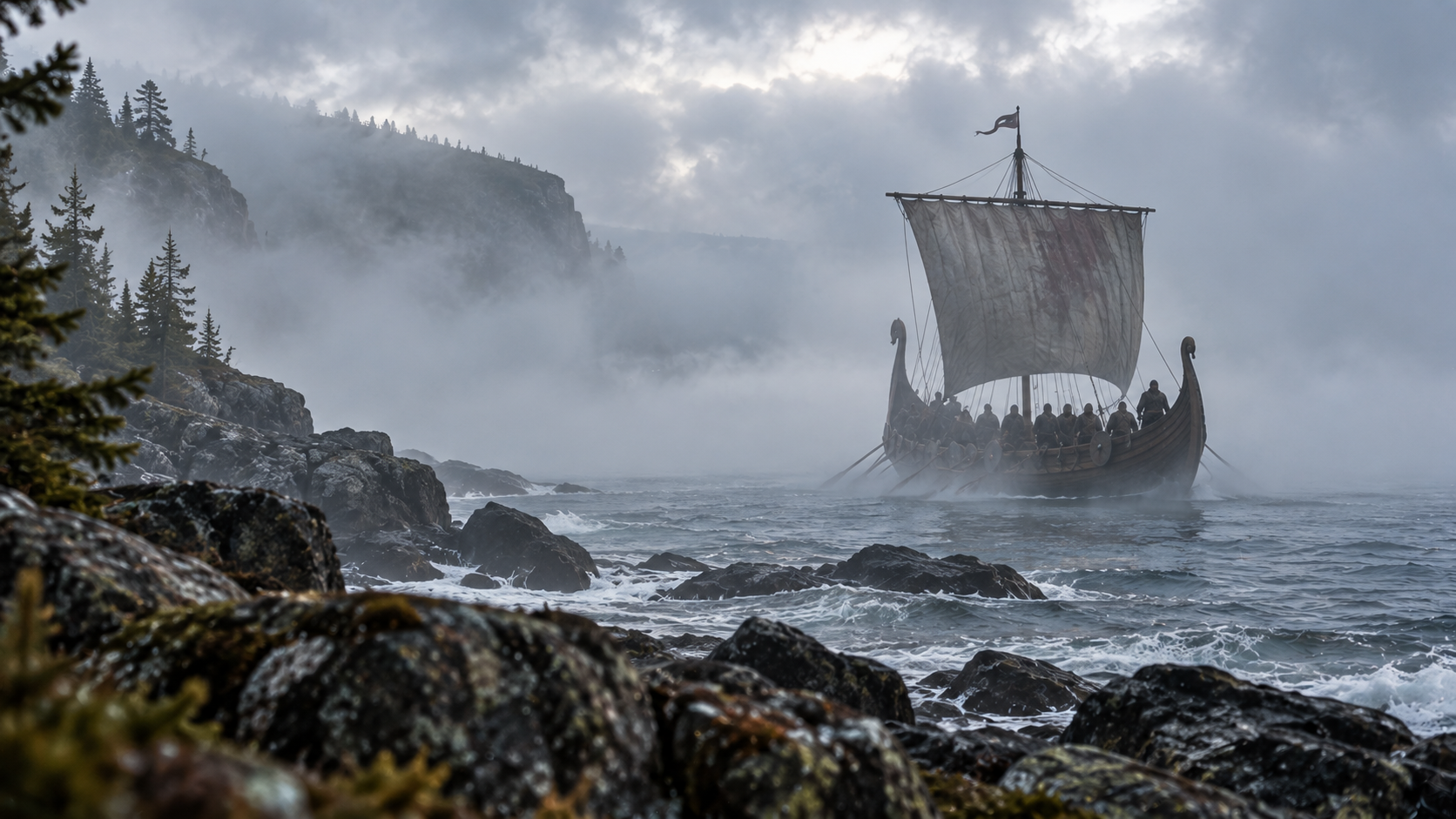
Around a thousand years ago, a wooden vessel approached the northern coast of Newfoundland, its broad square sail carrying it through the restless waters of the North Atlantic. Aboard were men and perhaps women whose lives had been shaped by the dangerous seas of northern Europe. They had travelled westward from Greenland, following routes that their ancestors had gradually extended across the Atlantic from Scandinavia to Iceland and beyond. Their arrival upon the shores of what is now Canada represented one of the most extraordinary achievements of medieval navigation, for these seafarers had crossed the Atlantic nearly five centuries before Christopher Columbus made his famous voyage in 1492.
The sailors belonged to the Norse world, a civilization whose merchants, warriors, farmers and explorers had already transformed the political and commercial geography of northern Europe. Commonly described as Vikings, they were members of societies that possessed sophisticated maritime technology, established legal institutions, extensive trading networks and a remarkable willingness to undertake dangerous journeys across unfamiliar waters. Their arrival in North America was not the discovery of an empty continent, for Indigenous peoples had occupied Newfoundland, Labrador and the surrounding regions for thousands of years. The Norse were newcomers entering an ancient human landscape, one already inhabited by communities with their own histories, political relationships, technologies and traditions of navigation.
The Norse came seeking resources, opportunities for exploration and perhaps the possibility of extending their settlements beyond Greenland. Upon the northern tip of Newfoundland’s Great Northern Peninsula, they constructed substantial buildings, worked iron, repaired ships and established a base from which further voyages could be undertaken. Their presence appears to have been relatively brief, and eventually the settlement was abandoned. Over the following centuries its buildings collapsed, its timbers decayed and the earth gradually concealed almost every trace of its existence. The voyages survived principally in medieval Icelandic stories, preserved and retold long after the participants themselves had disappeared.
For generations, historians debated whether those stories represented genuine historical events or the imaginative traditions of medieval storytellers. That debate changed dramatically in the twentieth century when Norwegian explorer Helge Ingstad and his archaeologist wife, Anne Stine Ingstad, investigated a remote stretch of Newfoundland coastline. Their discoveries transformed the history of Atlantic exploration. Archaeology established beyond reasonable doubt that Norse seafarers had crossed the Atlantic and occupied a settlement in North America centuries before Columbus. What had endured for nearly a thousand years as a mixture of memory, legend and scholarly speculation had become an established chapter in Canadian history.[1]
The Viking World
The peoples commonly described as Vikings emerged from the Scandinavian societies of Norway, Sweden and Denmark during the early medieval period. Between the late eighth and eleventh centuries, their expansion transformed much of northern Europe. Norse raiders attacked monasteries and coastal settlements in the British Isles, while merchants travelled along the river systems of eastern Europe, connecting the Baltic with the Byzantine Empire and the commercial centres of the Islamic world. Scandinavian settlers established communities in Ireland, Scotland, northern England, Normandy and the Atlantic islands, carrying their language, customs and institutions into societies far removed from their original homelands.
Yet the popular image of the Viking as a ferocious warrior armed with an axe represents only one aspect of a much broader civilization. Most Norse people were farmers, fishermen, craftsmen, merchants and householders whose lives depended upon agricultural production, trade and the management of family property. Their communities possessed systems of law, political assemblies, religious traditions and elaborate networks of kinship and obligation. They raised livestock, cultivated crops where climate permitted, manufactured iron tools and constructed vessels capable of navigating both shallow rivers and the dangerous waters of the open Atlantic. The achievements of the Viking Age therefore arose not simply from military aggression, but from the combination of maritime technology, commercial enterprise and an expanding understanding of the geographical world.
At the centre of this expansion stood the Norse ship. Long, narrow warships provided speed and manoeuvrability for coastal expeditions, while broader cargo vessels, known as knerrir, carried livestock, provisions, timber and passengers across the open ocean. Constructed from overlapping wooden planks fastened with iron rivets, these vessels possessed hulls that were both strong and relatively flexible, enabling them to withstand the violence of northern seas. Their square sails could harness Atlantic winds, while oars provided additional control when entering harbours or moving through difficult coastal waters. Although modest in size compared with later European sailing vessels, they represented an extraordinary achievement of practical engineering.
Navigation remained hazardous, for the Norse possessed neither magnetic compasses nor instruments capable of determining longitude. Their mariners relied instead upon knowledge accumulated through generations of seafaring: the direction of prevailing winds, the behaviour of currents and birds, the appearance of clouds, the position of the sun and stars, and the distinctive forms of distant coastlines. Successful navigation required judgement, memory and familiarity with the changing character of the sea. Through these skills, Norse sailors transformed the northern Atlantic from a formidable geographical barrier into a series of maritime routes. Their ships carried them first to Iceland, then Greenland, and eventually to the shores of North America.[2]
Iceland: The First Great Atlantic Settlement
During the ninth century, Scandinavian settlers began establishing permanent communities in Iceland, a volcanic island situated far beyond the northern British Isles. The new land offered opportunities for livestock farming, fishing and the acquisition of property, although the environment presented considerable difficulties. Its climate was demanding, timber resources were limited in many districts, and agricultural success depended upon the careful management of grasslands and animals. Nevertheless, Norse settlement expanded across the island, producing a society whose institutions and literary traditions would become extraordinarily important to the historical record of northern Europe.
Around AD 930, the Icelanders established the Alþingi, a national assembly where laws were proclaimed, disputes considered and political matters debated. During its early commonwealth period, Iceland had no king, and authority was exercised through chieftains, legal institutions and relationships of personal obligation. The system was neither democratic in the modern sense nor free from violence, but it demonstrated the capacity of Norse settlers to construct durable political institutions beyond the Scandinavian kingdoms. The settlement also developed a distinctive literary culture that would eventually preserve some of medieval Europe’s most remarkable narratives.
It was in Iceland that the stories of the Atlantic explorers were later recorded. Generations after the voyages to North America, Icelandic writers assembled narratives concerning the settlement of Greenland, the discoveries of Leif Erikson and the expeditions to a western land called Vinland. These accounts, now known collectively as the Vinland sagas, would become the principal medieval written evidence for the Norse presence in North America. Before those journeys occurred, however, Scandinavian expansion had already reached Greenland, where an ambitious and controversial settler named Erik the Red would establish a new western frontier.[3]
Erik the Red and the Settlement of Greenland
The history of Norse Greenland is closely associated with Erik the Red, a man whose career combined ambition, violence, leadership and a remarkable capacity for persuasion. According to the Icelandic sagas, Erik became involved in disputes that resulted in killings and ultimately his exile from Iceland. During the 980s, he sailed westward toward land that earlier mariners had reportedly sighted, discovering a country dominated by an enormous ice sheet but possessing sheltered fjords and valleys along portions of its southwestern coast. During the brief summer, these valleys offered grazing land, while the surrounding waters provided fish and marine mammals that could sustain a small but determined population.
Erik explored the coast before returning to Iceland, where he encouraged settlers to join him in establishing a new community. Medieval tradition suggests that he deliberately promoted the attractive name Greenland to encourage prospective colonists to undertake the dangerous voyage. Around AD 985 or 986, an expedition sailed westward, although not every vessel reached its destination. Those who survived established farms in the districts later known as the Eastern and Western Settlements. Over the following centuries, Norse Greenlanders raised sheep, goats and cattle, harvested hay, hunted marine mammals and maintained commercial and cultural relationships with Iceland, Norway and the wider European world.
Life in Greenland remained precarious. The growing season was short, agricultural production was vulnerable to climatic variation, and useful resources such as iron and suitable construction timber were difficult to obtain locally. Trade was consequently essential to the survival of the settlements. Walrus ivory, hides and other Arctic products could be exchanged for manufactured goods and materials unavailable in Greenland, while occasional voyages maintained the communities’ connections with the rest of the Norse world. The population was never large, and the establishment of additional settlements farther west would have placed substantial demands upon an already limited society.
Nevertheless, the Greenlanders possessed ships and the maritime knowledge necessary to investigate the western horizon. Reports began circulating of unfamiliar lands beyond the Greenland coast, some apparently possessing the forests and resources that the island’s inhabitants desperately needed. Timber was particularly valuable, for buildings required substantial wooden frameworks and ships could not be maintained indefinitely without replacement planks and structural components. The prospect of accessible forests beyond the western sea was therefore not merely a matter of curiosity. It represented a potentially important economic opportunity, one capable of drawing adventurous Greenlanders into another great voyage of exploration.[4]
Bjarni Herjólfsson and the Lands Beyond Greenland
The Saga of the Greenlanders preserves an account of a merchant named Bjarni Herjólfsson, whose voyage may have provided the Norse settlements with their first important reports of land west of Greenland. According to the narrative, Bjarni intended to visit his father in Iceland but discovered that he had already departed for the newly established Greenland settlements. Determined to follow him, Bjarni sailed westward despite possessing limited knowledge of the route. Adverse weather drove his vessel from its intended course, and after several days the crew sighted an unfamiliar coastline unlike the Greenland described to them.
The land appeared wooded and potentially rich in resources. Bjarni’s companions reportedly urged him to go ashore and investigate, but their commander refused, insisting that his objective remained Greenland. He continued the voyage and eventually reached the settlements, where he described the unfamiliar coasts he had encountered. The story presents Bjarni as an accidental explorer, a man who may have become the first recorded Norse observer of mainland North America but who failed to recognize the full significance of his discovery.
Historians must approach the narrative with caution because the saga was written down generations after the supposed events. Its authors depended upon oral traditions and literary conventions, and no contemporary navigational record survives to establish Bjarni’s precise course. Yet the circumstances are plausible. A vessel driven westward by Atlantic storms might have encountered the coasts of Labrador or another part of northeastern North America, and experienced Norse sailors would have recognized the difference between Greenland’s largely treeless landscape and a heavily forested shore. Reports of such country would have attracted the attention of settlers for whom suitable timber was both scarce and valuable.
Among those who reportedly heard the account was Leif Erikson, the son of Erik the Red. According to the saga tradition, Leif recognized that the unfamiliar western lands deserved further investigation, and he determined to undertake a voyage of exploration. His name would become inseparable from the history of Vinland and the Norse arrival in North America, although separating the historical explorer from the literary figure described in medieval manuscripts remains one of the central challenges confronting scholars of the Viking Age.[5]
Leif Erikson and the Voyage to Vinland
Leif Erikson occupies a remarkable position between documented history and medieval tradition. The sagas portray him as an experienced navigator belonging to one of Greenland’s leading families, a man possessing the resources and determination to investigate the lands reportedly seen beyond the western horizon. In the Saga of the Greenlanders, Leif purchases Bjarni’s ship and deliberately sets out to explore the unfamiliar coasts. The Saga of Erik the Red, however, presents a different sequence of events and associates Leif’s discovery more closely with an accidental voyage. These differences demonstrate why the sagas cannot be treated as straightforward contemporary records, even when they preserve traditions that may contain genuine historical information.
The narratives identify three principal regions visited by Norse explorers. The first, Helluland, is described as a land of flat stones and is commonly associated by modern scholars with Baffin Island. Farther south lay Markland, the land of forests, generally identified with Labrador. Beyond these regions the voyagers reached Vinland, the most famous and controversial destination of the expeditions. The meaning of its name has been debated for generations, with interpretations connecting it to grapevines or wine, although alternative linguistic explanations have also been proposed.
The sagas describe Vinland as a region offering timber, grasslands, useful natural resources and opportunities for settlement. These descriptions are broadly consistent with the interests of the Norse Greenlanders, whose homeland lacked many of the materials found in the wooded regions of North America. Yet the manuscripts do not provide a modern geographical itinerary, and the exact boundaries of Vinland remain uncertain. It may have been understood as a wider geographical region rather than a single settlement, with different expeditions visiting various coastlines over a period of years.
What archaeology has confirmed is that Norse seafarers reached Newfoundland around the beginning of the eleventh century. It has not established the precise identity of the expedition responsible, nor demonstrated that Leif Erikson personally occupied the buildings subsequently discovered at L’Anse aux Meadows. Nevertheless, the surviving saga traditions and the archaeological evidence together reveal a remarkable expansion of the Norse Atlantic world. The explorers had followed a chain of maritime routes from Scandinavia through Iceland and Greenland to the North American coast, carrying their technology, institutions and expectations into a region whose geography and inhabitants were largely unfamiliar to them.[6]
L’Anse aux Meadows: The Settlement in Newfoundland
At the northern tip of Newfoundland’s Great Northern Peninsula lies L’Anse aux Meadows, a landscape of coastal meadows, low hills, peat bogs and cold Atlantic water. Across the Strait of Belle Isle stands Labrador, its rugged coastline forming part of the northern geographical world through which the Norse navigated. The location offered several practical advantages to seafarers arriving from Greenland. Offshore islands and recognizable coastal features assisted navigation, fresh water was readily available, and the surrounding region supplied timber, fish and other resources required by a small maritime settlement.
The Norse constructed their buildings upon a terrace near a stream, employing techniques familiar from Iceland and Greenland. Archaeologists have identified eight structures, including three substantial residential halls and several smaller buildings associated with workshops and other activities. The walls and roofs were formed from thick layers of carefully cut sod supported by wooden frameworks, providing insulation against the cold and wind. Inside the larger halls, hearths supplied heat and facilities for cooking, while the arrangement of interior spaces suggests areas devoted to sleeping, food preparation, storage and ordinary domestic activities.
The settlement was not a town comparable to established Norse communities in Iceland or Greenland. Its buildings could accommodate several dozen occupants, perhaps eighty or ninety people at one time, but the archaeological evidence suggests a comparatively small and possibly temporary operation. Rather than a large agricultural colony, L’Anse aux Meadows appears to have functioned primarily as a base for exploration, resource gathering and the repair of vessels. Its inhabitants possessed the equipment and practical knowledge necessary to maintain ships, work timber, produce iron and survive in an unfamiliar environment far removed from their established settlements.
The significance of the site lies precisely in its combination of modest size and extraordinary geographical achievement. The Norse had not merely sighted the shores of North America before turning homeward. They had established a working settlement, erected substantial buildings and undertaken activities requiring sustained occupation. Their presence demonstrated a remarkable capacity to extend the maritime systems of the North Atlantic world into an entirely different continent. Although the settlement would not endure, its physical remains would eventually provide the decisive evidence needed to confirm the reality of the voyages described in medieval Icelandic literature.[7]
Life Inside the Sod Houses
Life at L’Anse aux Meadows would have been dominated by the demands of work and survival. The Norse possessed no nearby European markets, permanent supply depots or established colonial institutions capable of assisting them. Their security depended upon the provisions brought from Greenland, the resources available locally and the condition of the ships that connected them with their homeland. Timber had to be gathered and prepared, tools repaired, clothing maintained and food acquired and cooked. Buildings required constant attention, while the dangerous Atlantic crossing made the preservation of vessels an essential concern.
The excavations revealed a collection of small but exceptionally important objects that illuminate these activities. Among the discoveries was a bronze ring-headed cloak pin of a form associated with Norse clothing and closely comparable to objects found in Iceland and Greenland. Archaeologists also uncovered a stone spindle whorl, a fragment of a bone needle and a small whetstone. These objects were associated with ordinary domestic activities, including textile production and clothing repair, and have been interpreted as evidence that women were likely among the Norse occupants. The settlement may therefore have included more than sailors and armed explorers, with its population incorporating people responsible for the varied activities of everyday household life.
This evidence is particularly interesting because the medieval sagas describe women accompanying expeditions to Vinland. Among them was Gudrid Thorbjarnardóttir, whose extraordinary travels became a celebrated part of Icelandic literary tradition. No archaeological discovery has established that Gudrid herself lived at L’Anse aux Meadows, nor can the settlement be conclusively identified with the expedition described in her story. Nevertheless, the material evidence is consistent with the presence of women and suggests that the Norse voyages involved a broader cross-section of society than the traditional image of male Viking adventurers might imply.
The archaeological objects are modest, but their historical significance is considerable. A cloak pin, spindle whorl or needle fragment cannot identify its former owner or reveal the conversations once held around the settlement’s hearths. Yet such objects connect the extraordinary history of transatlantic exploration with the familiar realities of human existence. The people who reached Newfoundland were not merely figures in medieval legend. They were individuals who cooked, worked, repaired their possessions and endured the uncertainty of living far from home, dependent upon wooden vessels and the practical skills required to keep them seaworthy.[8]
Iron and the Archaeological Proof
Among the most remarkable discoveries at L’Anse aux Meadows was evidence of iron production. The Norse possessed techniques for obtaining iron from deposits of iron-rich material found in bogs and wetlands, and excavations at the Newfoundland settlement revealed remains associated with a small iron-smelting furnace. Archaeologists also recovered slag, iron-working debris and objects connected with the construction and repair of ships. These discoveries provided compelling evidence that the settlement’s inhabitants possessed the technical knowledge and equipment necessary to produce and work iron in North America.
The importance of this evidence extends beyond the history of Norse metallurgy. Iron fastenings were essential components of clinker-built ships, whose overlapping wooden planks were secured by nails and rivets. A vessel damaged during a transatlantic crossing or while navigating unfamiliar coastal waters might require extensive repairs before it could safely return to Greenland. The ability to produce or rework iron therefore represented an important means of maintaining the expedition’s mobility and security. Without seaworthy ships, a small settlement on the far side of the Atlantic could become dangerously isolated.
The iron-working remains constitute the earliest securely documented evidence of iron smelting in North America. Combined with the settlement’s distinctive architecture and other Norse artefacts, they helped establish an archaeological identification that could not easily be explained by Indigenous technologies or later European activity. The evidence was particularly important because the medieval sagas alone could not demonstrate where the western voyages had occurred. Written traditions might preserve genuine memories, but the remains of a furnace, iron slag and ship fastenings provided physical proof of Norse activity in Newfoundland.
The discovery also revealed something about the practical purpose of the settlement. Its occupants were not simply passing through a temporary campsite. They had established facilities for repairing and maintaining the maritime technology upon which their survival depended. The site therefore appears to have been an organized logistical base supporting a programme of exploration or resource acquisition along the North American coast. Its modest remains preserve evidence of a sophisticated maritime society extending its operations across an ocean.[9]
The Butternuts and the Search for Resources
The archaeological record suggests that the Norse who occupied L’Anse aux Meadows were connected with regions considerably farther south than northern Newfoundland. Among the materials recovered at the settlement were butternuts and butternut wood, objects whose significance arises from the natural distribution of the trees from which they came. Butternut does not grow naturally upon Newfoundland’s Great Northern Peninsula. Its range extends into warmer regions, including parts of the Maritime provinces, and the discovery therefore indicates that the Norse obtained materials originating well beyond the immediate surroundings of their settlement.
There are several possible explanations. Norse crews may have sailed southward into the Gulf of St. Lawrence, perhaps exploring the coasts of present-day New Brunswick, Nova Scotia or neighbouring regions, before returning to their Newfoundland base. Alternatively, the materials may have reached the settlers through exchange with Indigenous inhabitants whose trading networks connected distant coastal and inland communities. The archaeological evidence does not establish which explanation is correct, and it would be misleading to present the discovery as definitive proof that the Norse personally visited any particular southern location.
Nevertheless, the butternuts provide an important clue concerning the wider activities of the settlement’s occupants. They suggest that L’Anse aux Meadows was connected with a geographical world extending beyond the northern tip of Newfoundland and that Norse expeditions may have investigated a considerable portion of the northeastern North American coastline. This interpretation is consistent with the broader geographical interests described in the Vinland sagas, in which explorers sought timber, useful natural products and opportunities for settlement or trade.
The acquisition of timber was especially important to Greenlanders living in an environment where suitable construction wood was difficult to obtain. Forests along the eastern coast of North America would have offered valuable resources for buildings, ship repairs and other purposes. L’Anse aux Meadows may consequently have served as a staging point for seasonal voyages into wooded regions farther south, with its inhabitants collecting materials before returning to Greenland. Whether such expeditions were motivated principally by trade, resource acquisition or the hope of establishing a permanent settlement remains uncertain, but the archaeological evidence demonstrates that the Norse were participating in a much broader Atlantic enterprise than the occupation of one small Newfoundland site.[10]
A Continent Already Inhabited
The arrival of Norse seafarers in Newfoundland must be understood within the much longer history of Indigenous occupation of northeastern North America. Archaeological evidence demonstrates that Indigenous peoples had inhabited Newfoundland, Labrador and adjacent regions for thousands of years, developing technologies and cultural traditions adapted to the environments of the northern Atlantic. Their communities possessed extensive knowledge of coastal navigation, fishing grounds, seasonal animal migrations and the management of resources essential to survival. Long before European ships arrived, these peoples had established enduring relationships with the lands and waters through which they travelled.
The populations occupying the broader region around the time of the Norse voyages likely included communities ancestral or related to peoples later identified as the Innu and Beothuk, although the precise cultural identities and relationships of individual archaeological populations remain subjects of scholarly investigation. It is therefore important not to impose later ethnic descriptions too confidently upon people who lived a thousand years ago. Indigenous societies changed over time, and the available evidence does not permit every settlement or archaeological tradition to be assigned securely to a particular historically documented nation.
The question of direct contact between the Norse and Indigenous peoples at L’Anse aux Meadows requires particular caution. Parks Canada archaeologist Jenneth Curtis has explained that there is no direct archaeological evidence demonstrating that Norse settlers and Indigenous inhabitants met at the site itself. Indigenous peoples occupied the area before and after the Norse presence, but no securely identified occupation of that exact location during the period of Norse activity has established a direct encounter. This limitation does not mean that contact elsewhere was impossible or even unlikely; rather, it illustrates the distinction between a plausible historical interpretation and an event demonstrated through archaeological evidence.
The Norse were entering a landscape already shaped by many generations of human activity. They may have encountered abandoned camps, hearths, tools or other traces of Indigenous occupation, and their voyages into surrounding regions could have brought them into direct contact with established communities. The medieval sagas preserve accounts of such encounters, although their geographical settings and the identities of the Indigenous peoples involved remain uncertain. From a historical perspective, the Norse arrival represents not the discovery of an empty continent, but the meeting of two long-established traditions of human migration: the Indigenous peoples whose ancestors had reached the Americas thousands of years earlier, and Europeans whose maritime expansion had carried them westward across the North Atlantic.[11]
The First Encounters and the Problem of Conflict
The Vinland sagas describe encounters between Norse explorers and Indigenous peoples, portraying meetings marked by curiosity, caution, trade and eventually violence. The Norse used the term Skrælingjar for some of the peoples they encountered in North America and Greenland, but this designation reflects the language and perceptions of the Norse storytellers rather than a precise identification of any particular Indigenous nation. Different encounters may have involved different communities, and the medieval texts provide insufficient evidence to determine their identities with certainty.
Some saga episodes describe relatively peaceful commercial exchanges in which Indigenous inhabitants offered animal skins and other goods while the Norse traded items including pieces of red cloth. Such exchanges are historically plausible, for both groups may have possessed materials that the other valued. Trade could also provide an initial framework for communication between people who did not share a language. Yet relationships between unfamiliar communities could be unstable, particularly when neither side fully understood the expectations, territorial rights or intentions of the other.
The sagas eventually describe conflict, including violent confrontations in which men were killed and the Norse became increasingly aware of their numerical vulnerability. These narratives were written long after the events they purport to describe and contain literary conventions that prevent historians from treating them as literal eyewitness accounts. Nevertheless, their broad depiction of a small expedition encountering established Indigenous societies is consistent with the geographical and political circumstances the Norse would have faced. A settlement maintained by a few dozen people could not easily defend itself against sustained opposition from much larger populations familiar with the surrounding country.
For the Indigenous communities involved, the arrival of unfamiliar seafarers would have presented its own questions of security, diplomacy and territorial control. The surviving sagas describe these encounters almost exclusively from the Norse perspective, leaving the motivations and interpretations of Indigenous participants largely beyond the reach of written history. It is therefore necessary to avoid assuming that the Norse were merely victims of hostility or that Indigenous resistance was an irrational obstacle to exploration. Communities encountering strangers within their territories possessed legitimate interests in determining how those strangers should behave and whether they should be permitted to remain.
If the conflicts described in the sagas reflect genuine events, they may have contributed to the failure of Norse attempts to establish a lasting settlement. Yet the available evidence does not support the conclusion that Indigenous resistance alone caused the abandonment of Vinland. Distance, limited manpower, the costs of maintaining an overseas outpost and the possibility that the settlement was intended only for temporary resource gathering must also be considered. The encounter between the Norse and Indigenous North America was probably a complicated sequence of exploration, exchange, uncertainty and occasional confrontation rather than a single decisive episode.[12]
Gudrid, Karlsefni and the Dream of Settlement
Among the most remarkable personalities preserved in the Vinland sagas is Gudrid Thorbjarnardóttir, a woman whose journeys connect the history of Norse exploration with the possibility of permanent settlement in North America. According to the medieval accounts, Gudrid travelled to Vinland with her husband, Thorfinn Karlsefni, a wealthy merchant and expedition leader who assembled a substantial party of settlers and seafarers. The expedition reportedly carried supplies and livestock, suggesting an undertaking more ambitious than a brief voyage of reconnaissance or resource gathering.
The sagas describe the travellers attempting to adapt to the environment, make use of local resources and establish relationships with the inhabitants of the region. Their activities suggest that at least some Norse explorers considered the possibility of creating a lasting community beyond Greenland. Such a settlement would have represented another stage in the westward expansion that had carried Scandinavian populations first to Iceland and then to Greenland. Yet permanent colonization demanded more than the successful completion of an Atlantic crossing. The settlers needed food, suitable agricultural land, livestock, tools, a dependable supply of materials and the means to defend themselves within an unfamiliar political landscape.
Gudrid is associated with one of the most famous traditions concerning the Norse voyages. According to the sagas, she gave birth in Vinland to a son named Snorri Thorfinnsson. If the story is historically accurate, Snorri would have been among the earliest recorded children of European parentage born on the North American continent outside Greenland. The claim, however, rests upon medieval literary evidence, and no archaeological discovery has identified Gudrid, Karlsefni or Snorri at L’Anse aux Meadows. The Newfoundland settlement cannot therefore be assigned with certainty to their expedition.
The story remains important because it reveals how medieval Icelandic society remembered the western voyages. Vinland was not portrayed solely as a distant land encountered by adventurous sailors, but as a region whose resources and apparent possibilities encouraged serious consideration of settlement. The sagas suggest that these ambitions ultimately failed and that Karlsefni’s party returned to Greenland. Whether the failure resulted principally from conflict, logistical difficulties, disappointment or a combination of factors remains uncertain. What survives is the memory of an attempt to extend Norse settlement beyond Greenland into the world of northeastern North America.[13]
Why the Norse Abandoned Vinland
The failure of the Norse to establish a permanent colony in North America has generated considerable historical debate. Distance was undoubtedly one of the most significant obstacles. Greenland itself was a small and geographically isolated society, dependent upon fragile agricultural production and irregular maritime connections with Iceland and Norway. Maintaining another settlement across a substantial stretch of ocean would require additional ships, crews, livestock, provisions and replacements. Even a comparatively modest outpost could place heavy demands upon a community possessing limited manpower and resources.
Permanent settlement would also create problems that did not confront temporary expeditions. Voyagers seeking timber, fish or other valuable materials could return to Greenland after completing their work, but colonists would have to remain through successive seasons and develop the means to support themselves. Their survival would depend upon reliable food production, secure access to resources, adequate shelter and the establishment of stable relationships with neighbouring Indigenous populations. A settlement that required constant reinforcement from Greenland might offer little practical advantage over periodic voyages undertaken for specific commercial purposes.
The possibility of Indigenous resistance must also be considered. The Norse were entering territories occupied by societies that greatly outnumbered them and possessed far more extensive local knowledge. If the violent encounters described in the sagas reflect actual events, they could have made permanent colonization increasingly unattractive. Yet there is another possibility: the Norse may never have intended L’Anse aux Meadows to become a lasting agricultural colony. Its archaeological character suggests a logistical base designed to support exploration, ship repair and resource gathering. If the Greenlanders could obtain useful materials through occasional voyages, the expense and danger of maintaining a permanent settlement might have appeared unnecessary.
The archaeological evidence suggests deliberate abandonment rather than catastrophic destruction. There is no convincing indication that L’Anse aux Meadows was destroyed in a great battle, nor that its population perished suddenly while leaving valuable possessions behind. Instead, the occupants appear to have removed much of their useful equipment before departing. Their buildings were left to deteriorate, and the wooden frameworks eventually collapsed beneath the weight of their sod roofs. Over the following centuries, grass and peat gradually concealed the settlement, preserving the outlines of structures that later archaeologists would recognize as distinctly Norse.
The evidence is compatible with a relatively brief occupation, perhaps involving several expeditions over a limited period, but it does not establish precisely how long the settlement remained in use. The Norse had succeeded in reaching North America and establishing an organized base. They had not created a durable extension of their Greenland communities. Their departure brought an end to the first securely documented European settlement in what is today Canada, leaving its history to survive principally within the literary traditions of medieval Iceland.[14]
The Voyages Become Legend
The history of the Norse voyages survived through two principal medieval Icelandic narratives, The Saga of the Greenlanders and The Saga of Erik the Red. Both describe exploration westward from Greenland, the discovery of unfamiliar lands and attempts to investigate or occupy a region called Vinland. Yet the accounts differ considerably in their details, particularly concerning the sequence of expeditions, the circumstances of Leif Erikson’s discovery and the roles played by individual explorers. These contradictions present serious difficulties for historians attempting to reconstruct the events of the early eleventh century.
The sagas were written down long after the voyages they describe. Their authors drew upon oral traditions, family memories and earlier stories, but they also employed literary conventions designed to entertain audiences and communicate moral or cultural ideas. Dramatic episodes involving storms, conflict, unusual encounters and personal rivalries are therefore not necessarily straightforward descriptions of historical events. The narratives preserve evidence of how medieval Icelanders understood their past, but they cannot be treated as navigational logs or contemporary official reports.
Nevertheless, the texts contain numerous details consistent with Norse Atlantic exploration. They describe the geographical relationship between Greenland and lands farther west, the presence of valuable forests, the importance of maritime travel and the possibility of encounters with Indigenous inhabitants. Their preservation ensured that the memory of Vinland endured in Icelandic literary culture even after the western expeditions had ceased. Over the centuries, however, European scholars remained uncertain whether the stories described actual voyages or imaginative developments within the saga tradition.
Various writers proposed locations for Vinland extending from Labrador and Newfoundland to New England and farther south. Speculation increased during the nineteenth and early twentieth centuries, sometimes encouraged by doubtful archaeological claims and purported artefacts that failed to withstand scholarly scrutiny. Without securely identified physical remains, it was impossible to determine whether the sagas preserved a genuine account of Norse settlement in North America. The decisive evidence would come not from another manuscript, but from an obscure stretch of Newfoundland coastline where the remains of ancient buildings had survived beneath the grass.[15]
Helge and Anne Stine Ingstad: The Rediscovery of Vinland
In 1960, Norwegian explorer Helge Ingstad arrived in northern Newfoundland after years of studying the Norse sagas and investigating possible locations associated with their western voyages. He believed that the medieval narratives might preserve genuine geographical information and that archaeological evidence of Norse activity could still exist somewhere along the northeastern coast of North America. His search was guided by careful consideration of coastal geography and the practical requirements of Norse navigation, but locating a settlement required more than an interpretation of literary texts. It required the discovery of physical remains.
At the small community of L’Anse aux Meadows, Ingstad met local resident George Decker, who knew of unusual grassy ridges near the coast. These features were familiar to people living in the area, although their historical significance had not been established. Decker guided Ingstad to the location, where low earthen outlines suggested the remains of buildings. The shapes bore a resemblance to the ruined turf structures known from Norse settlements in Iceland and Greenland, but their identity could only be determined through archaeological excavation.
Helge’s wife, Anne Stine Ingstad, was a trained archaeologist who directed the principal investigations beginning in 1961. Working with an international team, she excavated the site over several seasons, uncovering substantial sod-walled buildings, hearths, workshops and objects associated with Norse domestic life and maritime technology. The discoveries included a bronze cloak pin, a spindle whorl and evidence of iron working, all of which strengthened the identification of the settlement as a Norse occupation dating from around the beginning of the eleventh century.
Among the archaeologists who participated in the excavations was Birgitta Wallace, who joined the project in 1964 and later became one of the leading specialists in the archaeology of Norse North America. Wallace recalled recognizing the distinctive form of the buildings because she had previously encountered comparable ruins in Iceland. The excavation results confirmed that judgement and transformed the study of transatlantic exploration. For the first time, archaeologists had identified and examined the physical remains of a Norse settlement in North America.
The achievement of Helge and Anne Stine Ingstad was therefore both archaeological and historical. They demonstrated that the medieval traditions concerning voyages westward from Greenland were rooted in genuine transatlantic activity. Their discoveries did not establish the identity of every explorer or confirm every incident described in the sagas, but they resolved the central question that had troubled historians for generations. Norse seafarers had crossed the Atlantic and established a settlement upon the shores of Newfoundland centuries before Columbus.[16]
The Discovery That Changed History
The identification of L’Anse aux Meadows transformed the history of North Atlantic exploration. Before the excavations, the possibility of Norse voyages to North America remained dependent largely upon interpretations of medieval literary texts. The sagas offered intriguing geographical descriptions and accounts of settlement, but their inconsistencies and uncertain chronology prevented historians from treating them as definitive proof. The archaeological discoveries changed the nature of the debate by providing material evidence that could be independently examined and compared with established Norse sites in Greenland and Iceland.
The buildings, artefacts and iron-working remains demonstrated that Norse people had crossed the Atlantic and occupied a settlement in Newfoundland. Their distinctive construction methods and material culture were consistent with the wider Norse world, while the circumstances of the site indicated activity associated with maritime exploration and resource acquisition. Although archaeology could not identify the individual expedition responsible for the settlement, it established the fundamental historical fact that the Norse had reached North America around the beginning of the eleventh century.
The discovery attracted international attention and became an important element of Canada’s archaeological heritage. L’Anse aux Meadows was designated a National Historic Site of Canada in 1968 and subsequently received recognition as a UNESCO World Heritage Site in 1978. Parks Canada undertook further investigations, protected the surviving archaeological remains and developed facilities for public interpretation. Reconstructions of Norse sod buildings were established to illustrate the settlement’s original appearance, while the authentic foundations remained preserved within the protected historical landscape.
Yet one important question remained unresolved. Archaeologists could place the settlement broadly within the period around AD 1000, but the available dating methods could not establish the precise year of its occupation. The medieval sagas were too uncertain in their chronology to supply a dependable answer, and radiocarbon dating of ordinary archaeological materials provided ranges rather than exact calendar years. It would take a new application of scientific dating methods, combined with a remarkable event in the history of the Earth’s atmosphere, to establish an exact year associated with the Norse occupation.[17]
AD 1021: The Year Written in Wood
On 20 October 2021, an international team of researchers published a remarkable study in the scientific journal Nature entitled Evidence for European Presence in the Americas in AD 1021. The researchers examined pieces of wood recovered from L’Anse aux Meadows, concentrating upon samples that had been cut with metal tools and could be associated with Norse activity. Their objective was to determine whether the annual growth rings of these trees contained a chronological marker precise enough to establish the year in which they had been cut.
The method depended upon an unusual event that occurred in AD 993, when a powerful increase in cosmic radiation produced a measurable change in atmospheric radiocarbon. Trees growing at the time absorbed this radiocarbon, preserving the anomaly within the annual rings of their wood. Because the event occurred at a known point in history, it provided researchers with a distinctive chronological reference. By locating the anomalous ring and counting the subsequent growth rings toward the outer edge of a sample, scientists could establish the calendar year in which the tree had been felled.
The results were extraordinary. Three pieces of wood representing different trees produced the same date: AD 1021. The researchers concluded that Norse people were present in Newfoundland during that year, establishing the first securely dated evidence of European activity in the Americas before the voyages of Columbus. The discovery did not demonstrate that the Norse first arrived in 1021, nor did it establish when the settlement was finally abandoned. It proved something more precise and scientifically defensible: Norse people were cutting trees at L’Anse aux Meadows in that year.
The importance of this achievement extended beyond the history of the Viking Age. It demonstrated the extraordinary potential of combining archaeological evidence with developments in environmental science. A cosmic event nearly a thousand years earlier had left a detectable signature within the wood of living trees, while the cutting of those trees with metal tools had connected that record with human activity. Together, the evidence provided a precise chronological anchor for one of the most remarkable voyages in medieval history. Nearly ten centuries after Norse axes had struck the wood, modern science had recovered the year of their work.[18]
The Legacy of the Norse Voyages
The Norse occupation of L’Anse aux Meadows was comparatively small and short-lived, yet its historical importance is immense. The settlement did not lead to permanent European colonization of Newfoundland, nor did it establish the continuous political and commercial connections between Europe and North America that developed after the voyages of the late fifteenth century. Its inhabitants eventually departed, leaving no surviving European community in the region. Nevertheless, their achievement demonstrated the remarkable maritime capabilities of medieval Scandinavian society and confirmed that the northern Atlantic had been crossed from Europe to North America centuries before Columbus.
The voyages formed the westernmost extension of a remarkable sequence of Norse migrations beginning in Scandinavia and continuing through Iceland and Greenland. Each stage required the development of new maritime routes, the adaptation of farming and settlement practices to different environments, and the maintenance of relationships among communities separated by dangerous stretches of ocean. The settlement in Newfoundland represented the culmination of that westward movement, although it did not produce a lasting extension of Norse society into the North American continent.
The encounter also possessed broader significance within the history of human migration. For thousands of years, Indigenous peoples had occupied and travelled through the Americas, developing civilizations and communities adapted to extraordinarily diverse environments. The arrival of Norse explorers brought representatives of the European world into contact, or at least geographical proximity, with societies whose histories had developed independently for millennia. The Norse did not discover an unoccupied continent; they entered a world already shaped by human activity. Their voyages therefore represent a significant episode in the history of intercontinental movement and possible cultural encounter rather than the beginning of North American history.
The archaeological record also reminds historians of the limits of what can be known. We cannot identify every individual who travelled aboard the Norse vessels, reconstruct the precise routes of all their expeditions or determine with certainty which Indigenous communities they encountered. The reasons for the abandonment of Vinland remain open to interpretation, and the relationship between the Newfoundland settlement and the various expeditions described in the sagas cannot be conclusively established. Yet the evidence that does survive is remarkable. Around the beginning of the eleventh century, Norse seafarers constructed buildings in Newfoundland, worked iron, repaired vessels and carried out activities associated with exploration and resource gathering. Their presence has been established archaeologically, and the year AD 1021 has now been connected directly with their activity.[19]
The Shore and the Silence
Today, L’Anse aux Meadows is a quiet place upon the northern coast of Newfoundland. The Atlantic still breaks against the shoreline, the coastal meadows move beneath the wind, and the distant landscape of Labrador rises beyond the waters of the Strait of Belle Isle. The original Norse buildings have disappeared, but their foundations remain preserved beneath the protected archaeological landscape. Nearby reconstructions demonstrate how the settlers once built their homes from timber and turf, using methods developed over centuries of life in the northern Atlantic. Visitors can stand upon the same coastal terrace and imagine the arrival of a vessel from Greenland, its square sail drawing wind as it approached a shore unfamiliar to its crew but long known to Indigenous peoples.
The site offers an extraordinary opportunity to reflect upon the people who lived there. They were neither mythical figures nor merely characters in the dramatic literature of medieval Iceland. They were men and women whose lives depended upon practical knowledge, maritime skill and the ability to work together in an isolated environment. They built houses, gathered resources, repaired clothing, worked iron and maintained ships capable of carrying them safely across the Atlantic. Their settlement may have endured for only a brief period, but its existence demonstrated a remarkable capacity to travel, adapt and survive at the western edge of the Norse world.
For nearly a thousand years, the evidence of their presence lay concealed beneath the Newfoundland landscape. The buildings collapsed, their wooden frameworks decayed and the earth gradually reclaimed the settlement. What remained were fragments of iron, discarded objects, the outlines of sod walls and pieces of wood that preserved an extraordinary chronological record. Through archaeology and scientific investigation, those modest remains transformed a medieval tradition into an established episode of human history.
The Norse had crossed the Atlantic centuries before Columbus. Their achievement did not create the modern nations of North America, nor did it displace the far older histories of the Indigenous peoples who occupied the continent. But it demonstrated that oceans could become pathways between distant civilizations long before the technologies of the modern age. For a brief period around the year 1000, Norse seafarers entered the coastal world of northeastern North America, bringing with them the skills and ambitions of a maritime civilization that had gradually expanded across the northern seas.
Their voyages became memories. Their settlement returned to the earth. The Atlantic resumed its silence. Yet beneath the grass of northern Newfoundland, the evidence remained, waiting for the archaeologist’s trowel and the scientist’s instruments to recover its meaning. Almost a thousand years after the Norse had departed, the ground surrendered its secrets, and the wood they had cut revealed a date that history would never again forget.
Historical Notes and References
Chicago Manual of Style — Notes and Bibliography.
1. UNESCO World Heritage Centre, “L’Anse aux Meadows National Historic Site,” https://whc.unesco.org/en/list/4; Parks Canada, “Culture and History: L’Anse aux Meadows National Historic Site,” https://parks.canada.ca/lhn-nhs/nl/meadows/culture.
2. Gwyn Jones, The Norse Atlantic Saga: Being the Norse Voyages of Discovery and Settlement to Iceland, Greenland, and North America, 2nd ed. (Oxford: Oxford University Press, 1986).
3. Jones, The Norse Atlantic Saga, chapters concerning Iceland and Norse Atlantic settlement.
4. Jones, The Norse Atlantic Saga, chapters concerning Greenland; The Saga of the Greenlanders and The Saga of Erik the Red, in The Vinland Sagas, translated by Keneva Kunz and edited by Gísli Sigurðsson (London: Penguin Classics, 2008).
5. The Saga of the Greenlanders, in The Vinland Sagas, translated by Kunz; Jones, The Norse Atlantic Saga.
6. The Saga of the Greenlanders and The Saga of Erik the Red, in The Vinland Sagas, translated by Kunz; Parks Canada, “L’Anse aux Meadows National Historic Site,” https://parks.canada.ca/culture/designation/lieu-site/anse-aux-meadows.
7. UNESCO World Heritage Centre, “L’Anse aux Meadows National Historic Site”; Parks Canada, “Culture and History.”
8. Parks Canada, “Culture and History”; Parks Canada, “L’Anse aux Meadows: The Saga of Vinland,” ReCollections podcast and transcript, https://parks.canada.ca/lhn-nhs/nl/meadows/culture/retrouver-recollections.
9. Parks Canada, “Culture and History”; UNESCO World Heritage Centre, “L’Anse aux Meadows National Historic Site.”
10. Parks Canada, “L’Anse aux Meadows: The Saga of Vinland”; Margot Kuitems et al., “Evidence for European Presence in the Americas in AD 1021,” Nature 601 (2022): 388–91, https://doi.org/10.1038/s41586-021-03972-8.
11. Jenneth Curtis, interview in Parks Canada, “L’Anse aux Meadows: The Saga of Vinland”; Parks Canada, “Indigenous Sites,” https://parks.canada.ca/lhn-nhs/nl/meadows/culture/sites.
12. The Saga of the Greenlanders and The Saga of Erik the Red, translated by Kunz; Jones, The Norse Atlantic Saga.
13. The Saga of Erik the Red, in The Vinland Sagas, translated by Kunz. The historical associations of Gudrid, Karlsefni and Snorri with Vinland derive from medieval literary sources and have not been confirmed through archaeology.
14. Parks Canada, “L’Anse aux Meadows: The Saga of Vinland”; Kuitems et al., “Evidence for European Presence.” The duration and number of occupations remain uncertain.
15. Gísli Sigurðsson, introduction to The Vinland Sagas, translated by Kunz; Jones, The Norse Atlantic Saga.
16. Birgitta Wallace, interview in Parks Canada, “L’Anse aux Meadows: The Saga of Vinland”; Helge Ingstad and Anne Stine Ingstad, The Viking Discovery of America: The Excavation of a Norse Settlement at L’Anse aux Meadows, Newfoundland (St. John’s: Breakwater Books, 2000).
17. UNESCO World Heritage Centre, “L’Anse aux Meadows National Historic Site”; Parks Canada, “L’Anse aux Meadows National Historic Site”; Ingstad and Ingstad, The Viking Discovery of America.
18. Kuitems et al., “Evidence for European Presence,” 388–91. Published online October 20, 2021, and in volume 601 of Nature in 2022.
19. UNESCO World Heritage Centre, “L’Anse aux Meadows National Historic Site”; Jones, The Norse Atlantic Saga; Kuitems et al., “Evidence for European Presence.”
Bibliography
Primary Historical Texts
The Saga of the Greenlanders. In The Vinland Sagas. Translated by Keneva Kunz. Edited and introduced by Gísli Sigurðsson. London: Penguin Classics, 2008.
The Saga of Erik the Red. In The Vinland Sagas. Translated by Keneva Kunz. Edited and introduced by Gísli Sigurðsson. London: Penguin Classics, 2008.
Archaeological Reports, Scientific Studies and Historical Scholarship
Ingstad, Helge, and Anne Stine Ingstad. The Viking Discovery of America: The Excavation of a Norse Settlement at L’Anse aux Meadows, Newfoundland. St. John’s: Breakwater Books, 2000.
Jones, Gwyn. The Norse Atlantic Saga: Being the Norse Voyages of Discovery and Settlement to Iceland, Greenland, and North America. 2nd ed. Oxford: Oxford University Press, 1986.
Kuitems, Margot, Birgitta L. Wallace, Charles Lindsay, Andrea Scifo, Petra Doeve, Kevin Jenkins, et al. “Evidence for European Presence in the Americas in AD 1021.” Nature 601 (2022): 388–91. https://doi.org/10.1038/s41586-021-03972-8.
Wallace, Birgitta Linderoth. “Finding Vinland.” Canada’s History, February–March 2018.
Wallace, Birgitta Linderoth. “Viking Farewell.” The Beaver 86, no. 6 (December 2006–January 2007): 16–24.
National Archives and Government Historical Sources
Historic Sites and Monuments Board of Canada. “L’Anse Aux Meadows—An Archaeological Review and Status Report.” Agenda Paper 1967-5, 79–81. Identified in the Parks Canada ReCollections bibliography.
Historic Sites and Monuments Board of Canada. John Rick, “The L’Anse Aux Meadows Site, Newfoundland.” Agenda Paper 1968-40, 109–10. Identified in the Parks Canada ReCollections bibliography.
Library and Archives Canada. Collection Search. Ottawa. https://recherche-collection-search.bac-lac.gc.ca/eng/Home/Search.
National Film Board of Canada. The Vinland Mystery. Directed by William Pettigrew. 1984. Documentary film produced in cooperation with Parks Canada. https://www.nfb.ca/film/vinland_mystery/.
Parks Canada. “Culture and History: L’Anse aux Meadows National Historic Site.” https://parks.canada.ca/lhn-nhs/nl/meadows/culture.
Parks Canada. “Indigenous Sites: L’Anse aux Meadows National Historic Site.” https://parks.canada.ca/lhn-nhs/nl/meadows/culture/sites.
Parks Canada. “L’Anse aux Meadows: The Saga of Vinland.” ReCollections podcast. https://parks.canada.ca/lhn-nhs/nl/meadows/culture/retrouver-recollections.
Parks Canada. L’Anse aux Meadows National Historic Site Management Plan 2019. Government of Canada. https://parks.canada.ca/lhn-nhs/nl/meadows/info/gestion-management-2019.
UNESCO World Heritage Centre. “L’Anse aux Meadows National Historic Site.” World Heritage List, property no. 4. Inscribed 1978. https://whc.unesco.org/en/list/4.