


The North-West Mounted Police- 1869–1875
The origins of the Mounted Police, the ambitions of Sir John A. Macdonald, and the struggle to establish Canadian government across the western Plains.
A Dominion on Paper
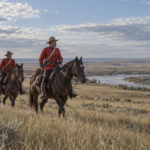
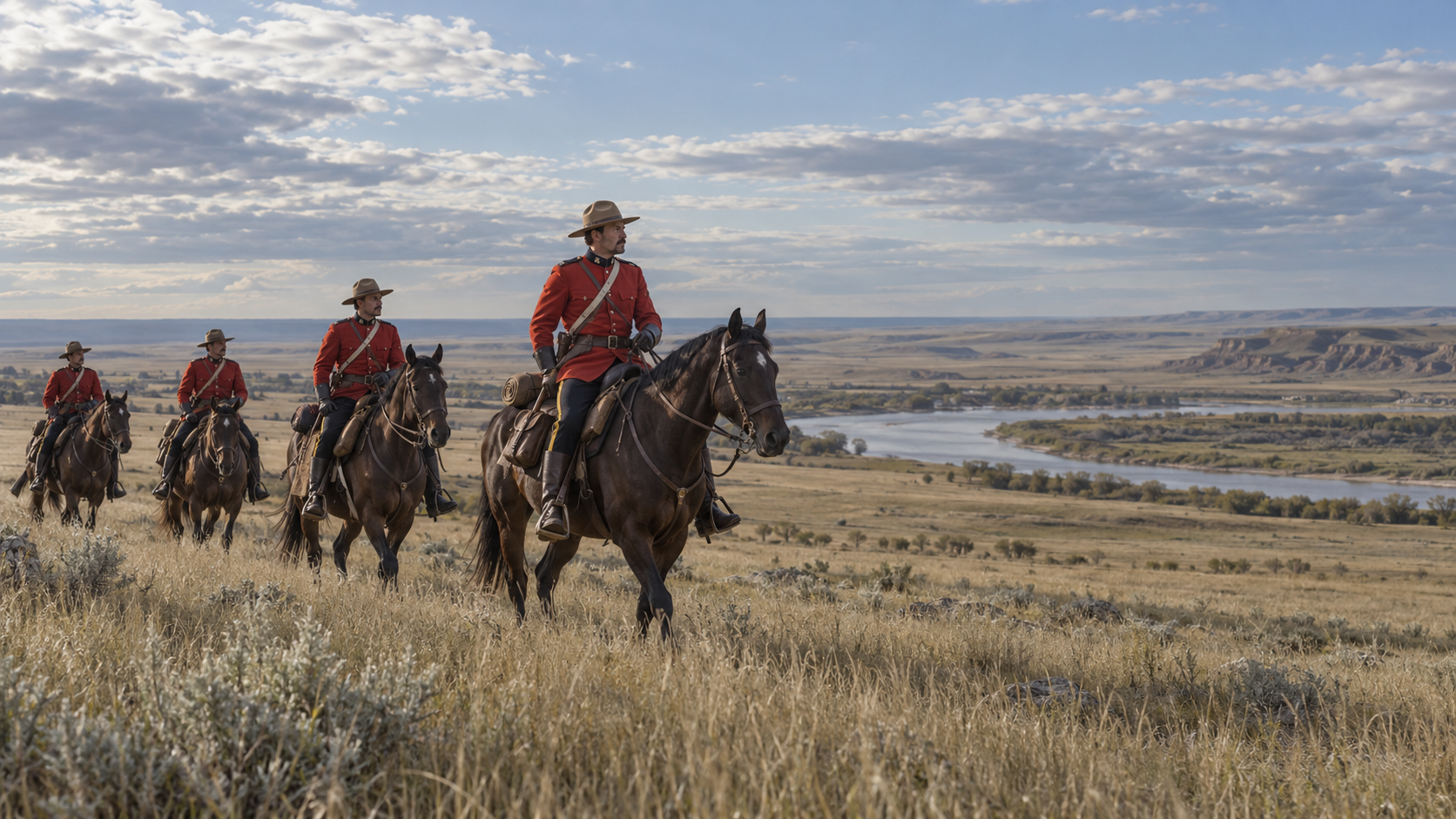
On the morning of 8 July 1874, a remarkable procession began moving westward from Fort Dufferin, Manitoba. There were mounted policemen in military-style uniforms, wagons loaded with provisions, horses, oxen, weapons, field artillery and the cumbersome equipment of an expedition that had been assembled with greater confidence than experience. Ahead lay some 1,300 kilometres of prairie, an immense and imperfectly mapped country of rivers, coulees, grasslands and distant mountains.
The men belonged to the newly organized North-West Mounted Police. Their authorized strength was only 300, and approximately 275 officers and men had assembled for the great expedition. Yet their task was nothing less than the extension of Canadian governmental authority across much of the western interior of North America.
It was a curious enterprise. They were policemen, but they marched with the discipline and equipment of soldiers. They were representatives of an emerging nation, yet most had never seen the country they were being sent to govern. They carried the laws of Ottawa into territories already inhabited, occupied and governed by Indigenous nations whose political traditions extended back many centuries.
The force had been conceived in the calculations of Prime Minister Sir John A. Macdonald, organized amidst political scandal and administrative uncertainty, and dispatched into a country where its survival would depend as much upon diplomacy, Indigenous knowledge and practical judgement as upon horses, rifles and military discipline.
The North-West Mounted Police would eventually become one of the most recognizable institutions in Canadian history. But in the summer of 1874, its future was far from assured.
The question confronting the young Dominion was deceptively simple: Canada had acquired an immense western territory. How was it to govern it?
The answer would profoundly influence the history of the Canadian West.[1]
The Acquisition of the West
When Confederation was established in 1867, the Dominion of Canada consisted of Ontario, Quebec, Nova Scotia and New Brunswick. Beyond its western boundaries lay the vast territories administered or claimed by the Hudson’s Bay Company, together with lands occupied by numerous Indigenous nations and Métis communities.
For Macdonald and his political colleagues, possession of the western interior was essential to Canada’s future.
The United States had emerged from its Civil War with an expanding population, growing industrial power and an increasingly assertive continental ambition. American railways were pushing westward, settlers followed established trails across the Plains, and commercial interests were already reaching north of the international boundary.
Canadian politicians feared that the western territories might eventually fall under American influence, or even become part of the United States.
Macdonald therefore pursued the acquisition of Rupert’s Land and the North-Western Territory, a transfer completed in 1870.
Yet the transaction exposed a fundamental weakness in imperial and Canadian thinking. The Hudson’s Bay Company could surrender its commercial and governmental privileges, and Britain could transfer its jurisdiction, but neither action extinguished the political existence, land rights or authority of the Indigenous peoples who occupied the region.
The new Dominion was claiming a vast country in which it had few officials, almost no police, little infrastructure and limited knowledge of the societies already living there.
The first major confrontation came before the transfer had even been completed.
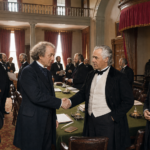
In 1869, the Métis inhabitants of the Red River Settlement, led by Louis Riel, resisted the Canadian government’s attempt to assume control without consulting them or adequately protecting their political and land rights. They established a provisional government and compelled Ottawa to negotiate.
The outcome was the Manitoba Act of 1870 and the creation of a new province. But for Macdonald, the Red River Resistance demonstrated that Canadian sovereignty could not be made effective merely through legislation and proclamations.
The Dominion required the capacity to enforce its authority.
It was during this crisis that the essential idea behind the Mounted Police emerged.[2]
Sir John A. Macdonald’s Vision
Macdonald understood that Western Canada presented problems different from those confronting the established provinces.
An ordinary urban police force could not patrol hundreds of thousands of square kilometres. A conventional army would be expensive, politically provocative and poorly suited to the daily business of administering a sparsely settled frontier. Furthermore, the appearance of military occupation risked intensifying opposition among Indigenous and Métis communities.
Macdonald envisaged an organization combining the mobility and discipline of cavalry with the legal functions of a police force.
In correspondence dated 21 December 1869, he proposed mounted riflemen trained for cavalry service and the use of firearms, while emphasizing that the new organization should not be expressly military. It was to possess the military bearing of the Irish Constabulary.[3]
The distinction was important.
Macdonald was not merely selecting a uniform or deciding how mounted men should be armed. He was attempting to create an instrument of government capable of doing the work of an army without necessarily provoking the consequences of deploying one.
The Royal Irish Constabulary offered an example of an armed, centrally controlled police organization operating under military discipline. Its influence was part of a wider British imperial tradition of colonial policing. Yet the North-West Mounted Police would have to adapt those principles to circumstances almost entirely unlike those of Ireland.
The Canadian force would operate across enormous distances, maintain isolated posts, travel through difficult terrain, negotiate with Indigenous leaders and exercise governmental authority in places where few other Canadian officials existed.
Macdonald’s conception also reflected his wider determination to construct a transcontinental nation.
British Columbia had entered Confederation in 1871 following Canada’s promise to build a railway connecting the Pacific colony with the eastern provinces. The success of that undertaking required far more than engineering and finance. It required political stability, administrative institutions, land surveys, communications and arrangements with the Indigenous nations through whose territories the railway and settlement would advance.
Historian R. C. Macleod, in The North-West Mounted Police and Law Enforcement, 1873–1905, describes the force as an “essential although usually unacknowledged part” of Macdonald’s National Policy.
Although the formal National Policy developed later in the decade, Macleod’s interpretation illuminates the underlying connection. The Mounted Police were not merely intended to combat crime. They were an instrument of Canadian nation-building.
Macdonald sought to transform an immense territorial claim into a functioning political reality.[4]
The Whisky Frontier
While Ottawa debated how the West should be governed, conditions on the southern Plains were becoming increasingly dangerous.
American traders, hunters and merchants were crossing northward from Montana, following routes that connected Fort Benton and other settlements with the buffalo country beyond the international boundary.
Some established trading posts along the rivers and valleys of what is now southern Alberta and Saskatchewan. They brought firearms, ammunition, trade goods and alcohol, exchanging them for buffalo robes, horses and other valuable commodities.
The whisky trade became particularly notorious.
Much of the liquor sold on the frontier was adulterated, sometimes dangerously so. It circulated through an economy already experiencing profound disruption as American expansion, commercial hunting, epidemics and conflict placed increasing pressure upon Indigenous communities.
The consequences could be devastating.
Trade in alcohol aggravated disputes, enabled exploitation and contributed to violence. For communities seeking to defend their people and preserve their economic independence, the presence of unscrupulous traders was an increasingly serious threat.
The most famous establishment was Fort Whoop-Up, near the junction of the Oldman and St. Mary rivers in present-day Alberta. The fort became a powerful symbol of the inability of the Canadian government to regulate commercial activity in the territory it claimed.
Yet the problem went far beyond one trading post.
American commercial networks were extending into territory claimed by Canada, while Ottawa possessed almost no practical means of collecting customs duties, prosecuting offences or protecting communities from predatory traders.
The western Plains also had their own political orders. The Blackfoot Confederacy, Cree, Nakoda, Métis and other peoples maintained laws, diplomatic relationships and methods of resolving disputes. To describe the region simply as lawless would be to confuse the absence of Canadian law enforcement with the absence of government altogether.
Nevertheless, from Ottawa’s perspective, the commercial and political situation was becoming intolerable.
The government required witnesses, magistrates, policemen and a visible representation of Canadian sovereignty.
It needed people capable of making Canadian law effective hundreds of kilometres beyond the nearest established administrative centre.[5]
The Warnings from the West
The demand for some form of mounted police did not arise suddenly in 1873.
Explorers, military officers, traders and colonial officials had been drawing attention to western conditions for years.
One particularly influential observer was the British officer William Francis Butler, who travelled through the North-West in 1870–71 and submitted a report describing the absence of effective Canadian governmental authority across much of the interior.
Butler’s warning was later reproduced in the Canadian Department of the Interior’s annual report for 1875.
“Law and order are wholly unknown in the region of the Saskatchewan,” he declared.
The statement reflected the assumptions of a British military observer, for whom law and order meant enforceable European governmental authority. Yet Butler correctly identified Ottawa’s inability to investigate serious crimes or exercise the jurisdiction it claimed.
Lieutenant-Governor Alexander Morris also pressed the government to act.
Morris understood that Canadian officials could not simply wait for railways and settlers to transform the region. If the government intended to administer the North-West Territories, it required an organization capable of operating there.
The creation of such a force was therefore the product of several years of discussion, correspondence and governmental hesitation.
Macdonald possessed the necessary imagination, but the undertaking was expensive. The Dominion had limited revenues, numerous competing obligations and an enormous western territory whose future administration remained uncertain.
Ottawa continued debating the problem while the dangers on the Plains grew more immediate.[6]
The Birth of the North-West Mounted Police
The decisive legislative step came in the spring of 1873.
On 3 May, Macdonald introduced his proposal in the House of Commons. Parliament subsequently approved legislation entitled An Act respecting the Administration of Justice, and for the Establishment of a Police Force in the North-West Territories.
The Act received Royal Assent on 23 May 1873.
The legislation authorized a force of up to 300 mounted policemen, commanded by a commissioner and organized on military lines, but charged with the enforcement of civil law.
This date has traditionally been celebrated as the birth of the Mounted Police.
There is, however, a distinction between legislative authorization and the formal constitution of an organization.
The Act provided the authority to create the force. The Order in Council that formally brought it into existence was signed on 30 August 1873.
The intervening months were marked by uncertainty, political controversy and an event that would become permanently associated with the history of the police.
That event was the Cypress Hills Massacre.[7]
The Cypress Hills Massacre
On 1 June 1873, violence erupted in the Cypress Hills, in what is now southwestern Saskatchewan.
A party of American wolf hunters and other frontiersmen became involved in a confrontation with a camp of Nakoda people, historically identified in many English-language sources as Assiniboine.
The encounter developed into a massacre.
Many Nakoda men, women and children were exposed to terrifying violence, and numerous people were killed. The precise circumstances, responsibility and number of deaths became subjects of investigation and historical dispute.
The atrocity revealed the vulnerability of Indigenous communities to armed outsiders who believed they could act beyond the effective reach of Canadian law.
It also demonstrated the weakness of Canadian sovereignty.
If armed men could enter territory claimed by the Dominion, kill its inhabitants and retreat across the international boundary, Ottawa’s authority would remain little more than a legal abstraction.
The massacre has frequently been described as the event that brought the North-West Mounted Police into existence.
The chronology, however, does not support that simple explanation.
Parliament had authorized the force nine days before the killings occurred.
Historian Philip Goldring, whose research into the first Mounted Police contingent examined governmental correspondence and contemporary records, challenged the traditional claim that the massacre was the decisive cause of the force’s establishment.
Goldring concluded that it was “perhaps a contributing factor but by no means the indispensable factor” behind Macdonald’s actions.
His interpretation is important because it separates a dramatic historical event from the longer political and administrative processes already underway.
The news from Cypress Hills gave additional urgency to the problem of western law enforcement. Macdonald himself invoked the killings as evidence of the necessity of organizing the police without delay.
But the idea of the force, its legislative authority and much of the planning for its creation preceded the massacre.
The NWMP was born from a wider calculation about sovereignty, security, commerce and the future of Canada in the West.[8]
The Men Who Would Carry the Law West
Once the organization received formal authorization in August 1873, the government began appointing officers, recruiting men and preparing equipment.
Lieutenant-Colonel W. Osborne Smith served as the force’s first interim commissioner.
In October 1873, Lieutenant-Colonel George Arthur French assumed command as the first permanent commissioner.
French was an experienced artillery officer with service in the British Army and experience with the Royal Irish Constabulary. He possessed the military background Macdonald wanted for an organization expected to combine policing with mounted mobility and disciplined field operations.
Recruitment brought together men from several parts of Canada.
Some were veterans of military service. Others were young men from farms, towns, commercial establishments and professional backgrounds who hoped for adventure, employment or a place in the opening of the Canadian West.
In November 1873, the first contingent assembled at Lower Fort Garry, north of Winnipeg.
There the young organization began acquiring the habits of military service.
The recruits drilled, trained with weapons, attended to horses, learned their duties and attempted to adjust to the discipline of barrack life.
Not all proved equal to the challenge.
Goldring’s study of the first contingent found that many were inexperienced horsemen despite the mounted character of the force. Some were physically unsuited to the demands of service. Others discovered that the realities of the western frontier bore little resemblance to the romantic expectations that had encouraged them to enlist.
Recruitment and training were imperfect, supplies had to be assembled, and the organization remained vulnerable to administrative delays.
The men nevertheless represented something novel in Canadian history: a permanent federal police organization created to operate far beyond the established provinces.
By the spring of 1874, the government had resolved to send the Mounted Police west.[9]
The Great March West
The expedition departed Fort Dufferin on 8 July 1874.
Its objective was ambitious: to cross the southern Prairies, locate the principal centres of the whisky trade and establish police posts in a region where the Canadian government had previously possessed almost no effective presence.
The column carried rifles, ammunition, provisions, tents, wagons and artillery. It included horses and oxen and the agricultural equipment necessary to establish permanent stations.
The journey quickly exposed the weaknesses of the undertaking.
Much of the country was inadequately mapped. Reliable water sources were uncertain. The horses, many brought from eastern Canada, were poorly adapted to the grazing conditions of the Plains.
The force also suffered from the sheer difficulty of transporting men, animals and supplies across an enormous landscape.
Wagons lagged behind the mounted column. Animals weakened. Water became scarce or undrinkable. Men suffered from dysentery, exposure, hunger and exhaustion.
The expedition was not an uninterrupted display of military efficiency. It was a prolonged struggle against geography, logistics and imperfect planning.
At times the force came dangerously close to failure.
As the column pushed westward, divisions separated and moved toward different destinations. Commissioner French eventually turned back with part of the expedition, while Assistant Commissioner James Farquharson Macleod led another contingent onward toward the foothills.
The success of this western movement depended increasingly upon men with local knowledge.
Among the most important was Jerry Potts, a Métis and Kainai-connected frontier guide, scout and interpreter whose familiarity with the country and its peoples proved invaluable.
Potts understood trails, rivers, water sources and the complicated political relationships among the peoples of the southern Plains.
His contribution illustrated a reality frequently obscured by later heroic representations of the Mounted Police: the small Canadian force could not have operated effectively without Indigenous and Métis knowledge.
At last, in October 1874, Macleod’s contingent reached Fort Whoop-Up.
The infamous trading post was largely deserted. News of the approaching police had preceded them.
There was no great confrontation or dramatic battle.
Instead, Macleod’s men established a post on the Oldman River. Fort Macleod became one of the first permanent centres of federal authority on the southern Plains.
The journey had been completed, although at considerable cost in hardship, exhausted animals and diminished supplies.
The March West had not conquered the Plains. It had placed a small group of Canadian officials in a position from which they might begin the more complicated work of governing them.[10]
The First Encounters with the Blackfoot Confederacy
The arrival of the Mounted Police created a new political presence in the country of the Blackfoot Confederacy.
For leaders such as Crowfoot, a Siksika chief of growing influence, the development required careful assessment.
The Confederacy was confronting profound changes.
American commercial activity was disrupting traditional trade relationships. The buffalo economy was under increasing pressure. Intertribal warfare, disease and the expansion of settlement south of the international boundary had transformed the political environment.
Crowfoot was not simply a passive observer of Canadian expansion. He was an experienced leader who understood the need to protect his people while preserving as much independence as circumstances permitted.
The suppression of the whisky trade offered one possible advantage.
If the Mounted Police could restrain violent outsiders, regulate predatory commercial practices and reduce disorder, their presence might provide immediate benefits.
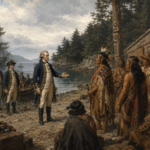
In December 1874, Macleod met with Crowfoot and other Indigenous leaders, including Red Crow of the Kainai.
Jerry Potts helped make such meetings possible and served as an important intermediary between the newcomers and the peoples whose territory they had entered.
Macleod’s conduct contributed to the establishment of relationships based, at least initially, upon a measure of mutual confidence.
The early Mounted Police gained a reputation in some Indigenous communities for attempting to deal fairly with disputes and restrain outsiders who had previously acted with little fear of prosecution.
Yet these relationships must be understood within a larger political context.
Indigenous leaders were making calculated decisions in circumstances of growing uncertainty. Cooperation with the police did not necessarily imply agreement with Canada’s claims to sovereignty or acceptance of future federal policies.
The Mounted Police had arrived without prior authorization from the Indigenous nations whose territories they entered.
Their immediate suppression of the whisky trade could be welcomed, while their longer-term role in imposing an external legal and political system remained deeply consequential.[11]
Law, Sovereignty and the Transformation of the Plains
The early operations of the North-West Mounted Police are frequently remembered as an achievement of peaceful Canadian expansion.
There is substance to the claim that the force helped reduce illegal whisky trafficking and offered a different method of asserting governmental authority from the large military campaigns conducted by the United States against Indigenous nations south of the border.
But this comparison should not obscure the deeper consequences of Canadian expansion.
The Mounted Police were instruments of the federal government.
Their responsibility was to enforce the laws of the Dominion, not to recognize Indigenous political systems as equal authorities.
As Canada’s treaty programme advanced, settlement increased and the buffalo herds declined, the police became involved in a widening range of governmental activities.
They supervised communities, enforced regulations, helped administer federal policies and supported the creation of the institutions through which Ottawa exercised authority over the western interior.
The Canadian government’s vision of orderly expansion depended upon the transformation of Indigenous lands into territory administered under Canadian law.
This process produced both cooperation and resistance.
For some Indigenous leaders, relations with individual police officers offered opportunities for negotiation and protection. For others, the growing reach of Canadian authority threatened established political independence and ways of life.
In subsequent decades, as the federal government increasingly restricted Indigenous mobility and enforced the reserve system and provisions of the Indian Act, relationships that had begun with cautious confidence often deteriorated.
The historian must therefore resist two temptations.
The first is to portray the North-West Mounted Police simply as a heroic band of red-coated guardians bringing civilization into an otherwise lawless wilderness.
The second is to assume that every action taken by the force had an identical motive or effect.
The historical record is more complicated.
The NWMP could protect people from particular crimes while simultaneously extending the authority of a government whose policies would restrict their freedom. Individual officers could act with humanity and restraint while serving a system of colonial expansion.
These were not necessarily contradictions in the minds of nineteenth-century officials. They were part of the workings of an institution intended to establish Canadian rule.[12]
Macdonald’s Larger Achievement
For Sir John A. Macdonald, the creation of the North-West Mounted Police formed part of the immense project of building a Canadian nation across the northern half of North America.
The transfer of western territory in 1870 had given the Dominion an enormous geographical claim. British Columbia’s entrance into Confederation in 1871 committed Canada to a transcontinental railway.
But between eastern Canada and the Pacific stood the immense realities of distance, finance, geography and Indigenous political authority.
A railway required more than rails and locomotives.
It required surveys, supply routes, administrative institutions, access to land, and the protection of workers and settlements. It also required the federal government to establish its authority in a region where that authority was not universally recognized.
The Mounted Police supplied part of that machinery.
The original force of 300 men was far too small to conquer or occupy the West through military force alone.
Its effectiveness rested upon a combination of physical mobility, legal authority, negotiated cooperation, local information and the willingness of the government to support its presence.
Its red tunics became familiar symbols of Canadian authority, but its real significance lay in what those uniforms represented: the extension of a permanent national government across territory where its authority had previously been largely theoretical.
That achievement was important to the building of the Canadian state.
It was also part of a transformation that deeply affected the Indigenous peoples of the West.
Macdonald could regard the force as a practical means of preserving order and securing Confederation’s western future. Indigenous leaders could regard its immediate conduct with approval or suspicion, depending upon their experiences and interests. Later generations would inherit the consequences of both the government’s ambitions and the policies the police were required to enforce.
History cannot be reduced to a single verdict upon those events.
It requires an understanding of why the force was created, what it accomplished, whose interests it served and what its presence meant to the peoples already occupying the Plains.[13]
The Institution and the Legend
The original North-West Mounted Police was a comparatively small organization with uncertain resources and an extraordinary geographical responsibility.
Its officers and constables were neither invincible nor uniformly experienced. Their first great expedition revealed serious deficiencies in planning, supply and leadership.
Yet the organization survived.
It established posts, developed patrol systems, created working relationships with Indigenous communities and became a permanent instrument of Canadian government.
Its responsibilities expanded as the West changed.
In 1904, the force received the designation Royal North-West Mounted Police. In 1920, following its amalgamation with the Dominion Police, it became the Royal Canadian Mounted Police.
The red-coated figure of the Mountie would eventually acquire a place in Canadian mythology that few other national institutions could rival.
There would be paintings, novels, films, commemorations and legends about the lonely policeman on the frontier, enforcing justice against overwhelming odds.
Some of those stories grew from genuine acts of endurance, courage and public service. Others simplified a history far more complicated than the mythology allowed.
The origins of the Mounted Police belong not merely to the history of law enforcement but to the history of Confederation, colonialism, Indigenous diplomacy and the political construction of modern Canada.
On 8 July 1874, the men who rode west from Fort Dufferin could scarcely have imagined the symbolic importance their expedition would eventually assume.
Their immediate concerns were more practical: horses, water, provisions, uncertain trails and the long distance still to be travelled.
But behind that struggling column stood the ambitions of a government determined to make Canada’s territorial claims effective.
The North-West Mounted Police began as an attempt to solve one of the most difficult problems confronting the young Dominion.
Canada had acquired the West on paper.
The Mounted Police were sent to make Canadian authority a reality.
What followed would help determine the future of the country—and profoundly alter the lives of the peoples who already called the Plains their home.
Historical Notes and References
Chicago Manual of Style, notes and bibliography system. Archival references reproduced from published scholarship are identified as such rather than presented as records independently examined.
1. Royal Canadian Mounted Police, “Historically Relevant Dates to the RCMP,” Government of Canada, https://rcmp.ca/en/history-rcmp/historically-relevant-dates-rcmp; Parks Canada, “Creation of the Northwest Mounted Police National Historic Event,” https://parks.canada.ca/culture/designation/evenement-event/police-montee-creation-mounted-police.
2. Philip Goldring, “The First Contingent: The North-West Mounted Police, 1873–74,” in Canadian Historic Sites: Occasional Papers in Archaeology and History, no. 21 (Ottawa: Minister of Supply and Services Canada, 1979), section “The Origins of the Mounted Police Force.” https://parkscanadahistory.com/series/chs/21/chs21-1c.htm.
3. Sir John A. Macdonald to Captain Cameron, Pembina, 21 December 1869, Sir John A. Macdonald Papers, MG 26, A1, vol. 516, 767–68, Library and Archives Canada, cited and transcribed in Goldring, “The First Contingent,” section “The Origins of the Mounted Police Force.” The passage is also reproduced in The Report of the Commission of Inquiry Relating to Public Complaints, Internal Discipline and Grievance Procedure within the Royal Canadian Mounted Police (Ottawa, 1976), section “The Origins of the Force.”
4. R. C. Macleod, The North-West Mounted Police and Law Enforcement, 1873–1905 (Toronto: University of Toronto Press, 1976), 3–6, https://www.jstor.org/stable/10.3138/j.ctvcj2p2v.4.
5. Parks Canada, “Creation of the Northwest Mounted Police National Historic Event”; Philip Goldring, The First Contingent, abstract and section “The Origins of the Mounted Police Force.”
6. Canada, Department of the Interior, Annual Report of the Department of the Interior for the Year Ended 30th June, 1875 (Ottawa: Maclean, Roger & Co., 1876), section “North West Territories,” 1–2, including the reproduced report of William Francis Butler. Digitized by Library and Archives Canada: https://www.collectionscanada.gc.ca/obj/020010/f2/1875-IAAR-RAAI.pdf.
7. Canada, An Act respecting the Administration of Justice, and for the Establishment of a Police Force in the North-West Territories, 36 Vict., c. 35 (1873); Order in Council no. 1134, 30 August 1873, Privy Council records, RG 2, series 1, vol. 6, Library and Archives Canada, archival reference documented in Goldring, “The First Contingent,” endnotes. See also Royal Canadian Mounted Police, “Historically Relevant Dates to the RCMP.”
8. Philip Goldring, “Notes on the Cypress Hills Massacre and the Formation of the North-West Mounted Police,” appendix C in “The First Contingent,” https://parkscanadahistory.com/series/chs/21/chs21-1h.htm; Goldring, “Whisky, Horses and Death: The Cypress Hills Massacre and Its Sequel,” in Canadian Historic Sites, no. 21 (1979); Parks Canada, “History—Fort Walsh National Historic Site,” https://parks.canada.ca/lhn-nhs/sk/walsh/culture/histoire-history.
9. Goldring, “The First Contingent,” sections “Introduction” and “The Force Takes Shape”; Library and Archives Canada, Royal Canadian Mounted Police fonds, RG 18, including early personnel service records, https://recherche-collection-search.bac-lac.gc.ca/eng/Home/Record?app=FonAndCol&idnumber=158709.
10. University of Lethbridge, digitized historical collection, “The March West,” https://www.ulethbridge.ca/lib/digitized_collections/ourheritage/index_page_stuff/Following_Trails/NWMP_Background/NWMPMarchWest.html; Galt Museum and Archives, “Introduction: The March West,” https://nwmp.galtmuseum.com/chapters/introduction-the-march-west.
11. Dictionary of Canadian Biography, entries “Macleod, James Farquharson” and “Potts, Jerry (Ky-yo-kosi),” University of Toronto/Université Laval; Parks Canada, “Creation of the Northwest Mounted Police National Historic Event.”
12. Christie Jefferson, Conquest by Law (Ottawa: Aboriginal Corrections Unit, Ministry of the Solicitor General of Canada, 1994), especially “Prairie Indians and White Law” and “Police Law,” https://www.securitepublique.gc.ca/cnt/rsrcs/pblctns/cnqst-lw/index-en.aspx; Parks Canada, “Creation of the Northwest Mounted Police National Historic Event.”
13. Macleod, The North-West Mounted Police and Law Enforcement, introduction and chapters 1–3; Robert Thacker, “North-West Mounted Police,” Encyclopedia of the Great Plains, University of Nebraska–Lincoln, https://plainshumanities.unl.edu/encyclopedia/doc/egp.law.038.html.
Bibliography
Primary and Archival Sources
Canada. An Act respecting the Administration of Justice, and for the Establishment of a Police Force in the North-West Territories. 36 Vict., c. 35. 1873.
Canada. Department of the Interior. Annual Report of the Department of the Interior for the Year Ended 30th June, 1875. Ottawa: Maclean, Roger & Co., 1876. https://www.collectionscanada.gc.ca/obj/020010/f2/1875-IAAR-RAAI.pdf.
Canada. Privy Council Office. Order in Council no. 1134, August 30, 1873. RG 2, series 1, vol. 6. Library and Archives Canada, Ottawa. Archival locator taken from Philip Goldring’s published notes.
Library and Archives Canada. Royal Canadian Mounted Police Fonds. RG 18. Ottawa. Includes early NWMP administrative and personnel records.
Library and Archives Canada. Sir John A. Macdonald Fonds. MG 26, A1. Ottawa. Relevant correspondence includes Macdonald to Captain Cameron, December 21, 1869, and Alexander Morris to Macdonald, June 2, 1873, as cited by Goldring.
Books, Scholarly Articles and Historical Studies
Goldring, Philip. “The First Contingent: The North-West Mounted Police, 1873–74.” In Canadian Historic Sites: Occasional Papers in Archaeology and History, no. 21. Ottawa: Minister of Supply and Services Canada, 1979. https://parkscanadahistory.com/series/chs/21/chs21-1a.htm.
Goldring, Philip. “Whisky, Horses and Death: The Cypress Hills Massacre and Its Sequel.” In Canadian Historic Sites: Occasional Papers in Archaeology and History, no. 21. Ottawa: Minister of Supply and Services Canada, 1979.
Horrall, S. W. “Sir John A. Macdonald and the Mounted Police Force for the Northwest Territories.” Canadian Historical Review 53, no. 2 (June 1972): 179–200. Cited in Goldring’s archival study.
Jefferson, Christie. Conquest by Law. Ottawa: Aboriginal Corrections Unit, Ministry of the Solicitor General of Canada, 1994. https://www.securitepublique.gc.ca/cnt/rsrcs/pblctns/cnqst-lw/index-en.aspx.
Macleod, R. C. The North-West Mounted Police and Law Enforcement, 1873–1905. Toronto: University of Toronto Press, 1976.
Thacker, Robert. “North-West Mounted Police.” In Encyclopedia of the Great Plains, edited by David J. Wishart. Lincoln: University of Nebraska–Lincoln. https://plainshumanities.unl.edu/encyclopedia/doc/egp.law.038.html.
Government and Institutional Historical Resources
Galt Museum and Archives. A Tradition in Scarlet: North-West Mounted Police. https://nwmp.galtmuseum.com.
Parks Canada. “Creation of the Northwest Mounted Police National Historic Event.” Historical designation reviewed in 2024. https://parks.canada.ca/culture/designation/evenement-event/police-montee-creation-mounted-police.
Parks Canada. “History—Fort Walsh National Historic Site.” https://parks.canada.ca/lhn-nhs/sk/walsh/culture/histoire-history.
Royal Canadian Mounted Police. “Historically Relevant Dates to the RCMP.” https://rcmp.ca/en/history-rcmp/historically-relevant-dates-rcmp.
University of Lethbridge. “The March West.” Digitized historical collection. https://www.ulethbridge.ca/lib/digitized_collections/ourheritage/index_page_stuff/Following_Trails/NWMP_Background/NWMPMarchWest.html.