


13 October 1812
Before daylight on 13 October 1812, boats began pushing away from the American shore of the Niagara River. They carried soldiers from an army that had come to accomplish what another American force had failed to do at Detroit only two months earlier: invade Upper Canada, establish a secure foothold, and demonstrate that British North America could be conquered.
Across the dark water stood the small village of Queenston. Above it rose the Niagara Escarpment. Whoever controlled those heights possessed a commanding position over the river crossing below. By the end of the day, hundreds of men would be dead, wounded or prisoners, an American army would have surrendered, and Major-General Isaac Brock—the British commander whose victory at Detroit had already made him the most celebrated military figure in Upper Canada—would be dead.
The Battle of Queenston Heights was one of the first major land battles of the War of 1812 and one of the most important engagements of the war’s opening year. It was also a complicated victory, won not by Brock alone but through the combined efforts of British regulars, Upper Canadian militia, Black militiamen and Indigenous warriors, particularly Haudenosaunee forces.
An American Army on the Niagara
The United States had declared war on Great Britain on 18 June 1812. American planners expected attacks against British North America to place enormous pressure on Britain, already engaged in its struggle against Napoleon in Europe.
The first major American invasion had come through Detroit. Instead of advancing successfully into Upper Canada, Brigadier-General William Hull surrendered Detroit and his army to Brock on 16 August. Brock’s cooperation with the Shawnee leader Tecumseh and other Indigenous allies had been crucial to that success.
The defeat did not end American plans for invasion.
During September, American forces concentrated along the Niagara frontier under Major-General Stephen Van Rensselaer. The Niagara River represented both an international boundary and an avenue of invasion. Queenston, opposite Lewiston, New York, offered one possible point at which an American army could force its way into Upper Canada. Canada’s Department of National Defence records that the American buildup was intended to resume the offensive that had been halted at Detroit.
The plan looked straightforward on a map. Its execution was anything but.
Crossing the Niagara
In the early hours of 13 October, American regulars and militia began crossing the Niagara River from Lewiston.
Moving an army across a substantial river in darkness, using small boats while facing an alerted enemy, was an inherently difficult military operation. Confusion accompanied the crossing, and not all of the American force could be brought across at once.
Nevertheless, the Americans achieved an important early success.
American troops found a route up the steep escarpment and reached the heights above Queenston. They captured the British artillery position there, reversing the tactical situation. The Americans now possessed the high ground overlooking the river and village. Parks Canada records that the invading force initially succeeded in gaining control of Queenston Heights.
For the British, the situation was suddenly dangerous.
Brock Rides to Queenston
At Fort George, several kilometres downriver, Brock learned that the Americans were crossing.
He hurried toward Queenston.
Brock’s instinct throughout the opening months of the war had been aggressive action. At Detroit that instinct had produced an extraordinary victory. At Queenston it would have a very different result.
On reaching the battlefield, Brock found that the Americans had gained the heights. He assembled troops from the 49th Regiment and militia and attempted to recover the position before the American bridgehead could become firmly established.
The British counterattack moved uphill against an enemy occupying superior ground.
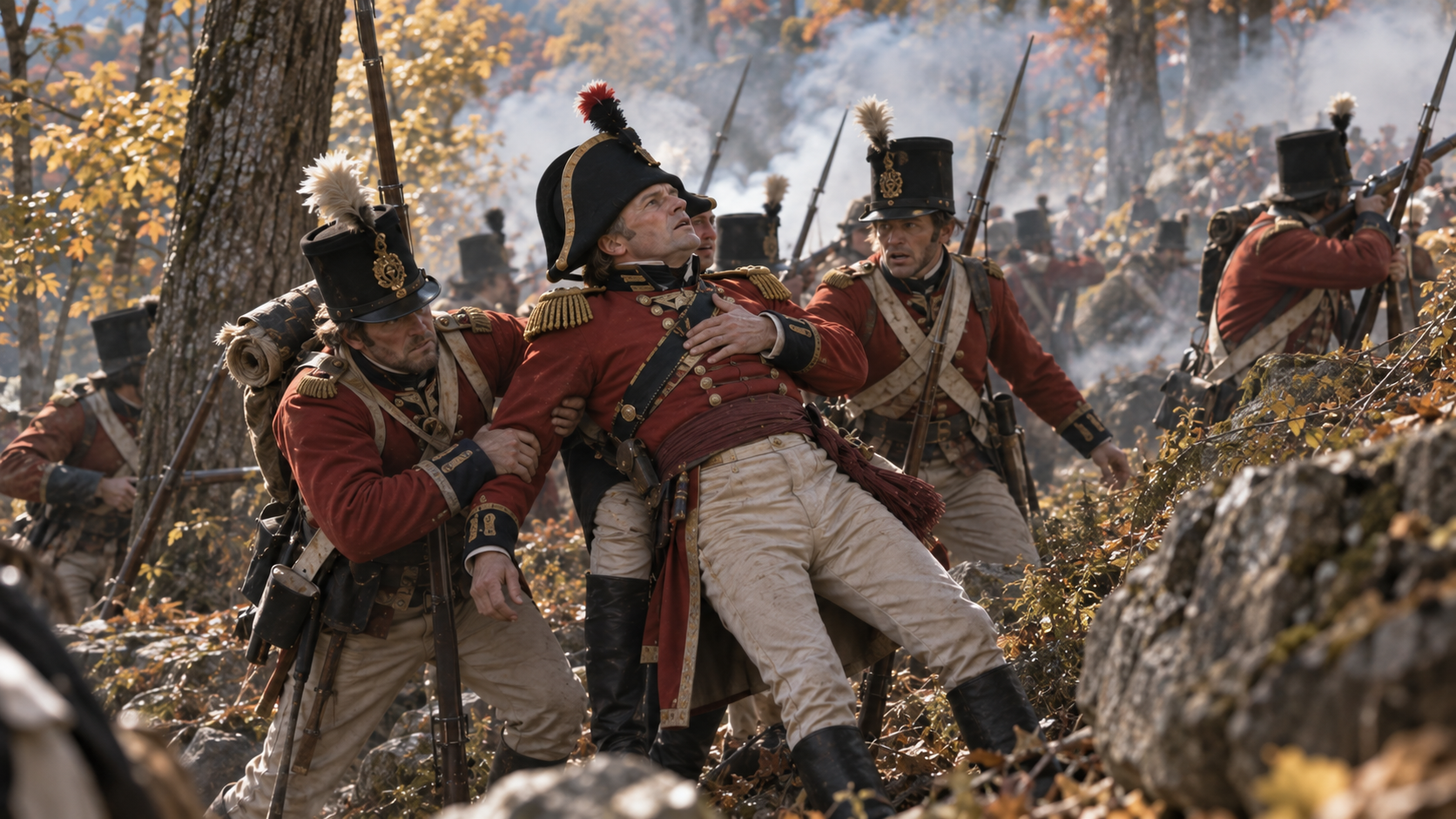
Brock went forward with his soldiers.
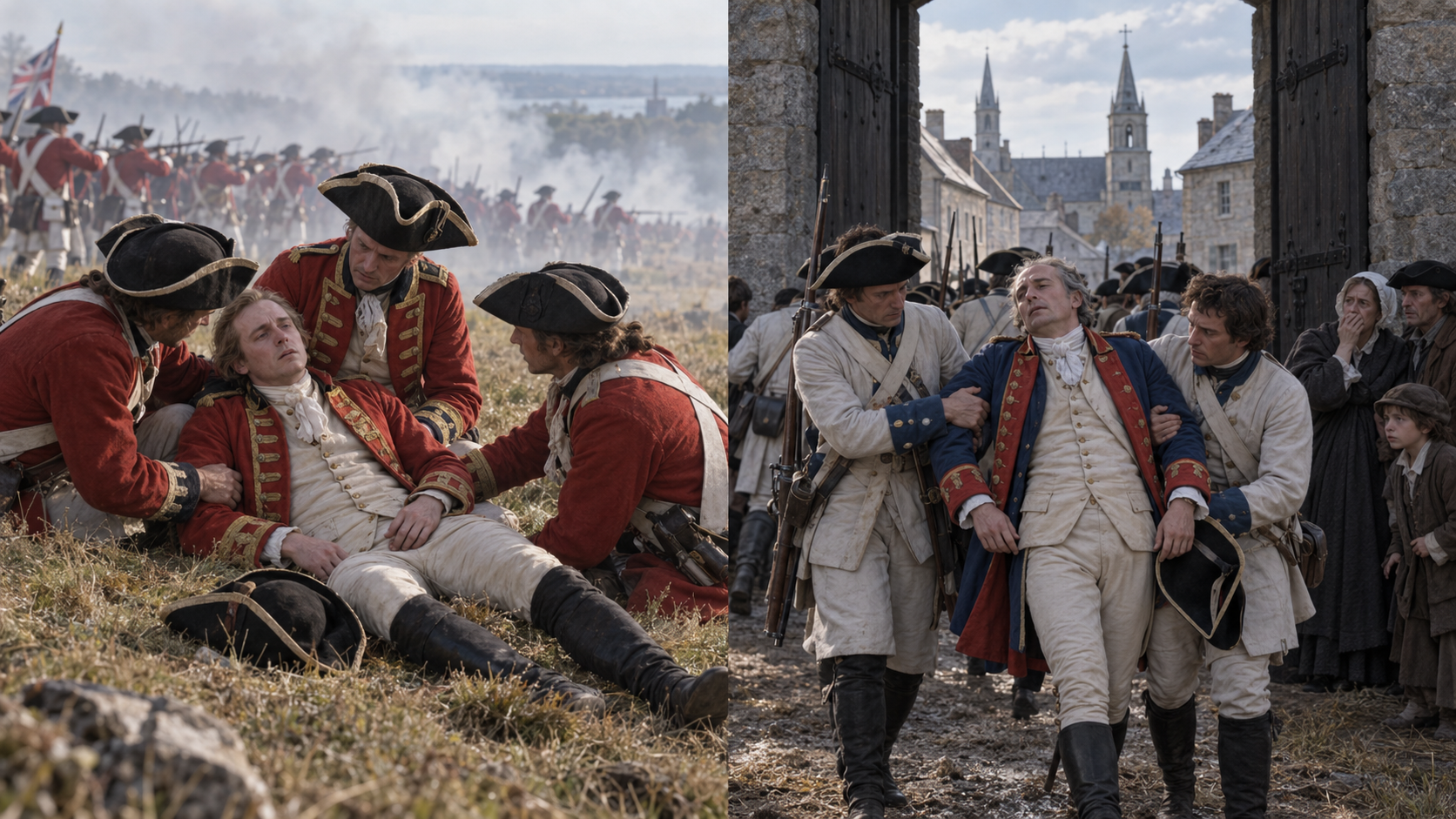
During the attack, an American musket ball struck him. Brock fell and died on the battlefield.
He was forty-three.
Brock’s death quickly became the central image of Queenston Heights in British and later Canadian memory. Nineteenth-century artists portrayed the scene dramatically, and the enormous monument eventually erected above Queenston reinforced his place in the historical landscape.
Yet concentrating exclusively upon Brock can obscure what happened next.
The battle continued for hours.
John Norton and the Indigenous Battle
Among the most important figures in the next stage of the fighting was Teyoninhokarawen, John Norton.
Norton’s background reflected the complex world of the northeastern borderlands. Born in Scotland to an Ani-Yunwiya (Cherokee) father and Scottish mother, he was later adopted by the Kanyen’kehà:ka leader Thayendanegea, Joseph Brant. Norton became an important political and military leader among the Grand River Haudenosaunee.
At Queenston Heights, Norton and Indigenous warriors played a significant tactical role after Brock’s failed counterattack.
Parks Canada specifically credits Norton with leading an Indigenous force that climbed the escarpment and engaged the Americans, helping make the eventual recapture of the position possible.
Government accounts identify approximately 300 Six Nations warriors under Norton and John Brant as participating in the battle.
Their operations in the woods helped keep pressure on the American position while British forces reorganized.
This phase is essential to understanding Queenston Heights. The battle was not simply a sequence consisting of Brock’s charge followed immediately by British victory. There was a critical interval between Brock’s death and the final counterattack during which the American foothold had to be contained.
Indigenous participation helped accomplish that.
Their involvement also reflected objectives of their own. Indigenous nations were not simply auxiliaries without political interests. The war threatened Indigenous territories and communities as American settlement expanded westward, and alliances with Britain were shaped by Indigenous strategic interests as well as British military requirements.
The Americans Become Trapped
Meanwhile, the American tactical position contained a fundamental weakness.
The troops on Queenston Heights depended upon the Niagara River crossing.
More American soldiers remained at Lewiston, but substantial numbers of New York militiamen refused to cross into British territory. The Americans who had already crossed therefore could not be reinforced on the scale their commanders needed.
The Niagara, which had been their route into Upper Canada, was becoming a barrier to escape.
The physical geography of Queenston Heights is therefore indispensable to understanding the battle.
The Americans occupied high ground, but behind and below them lay the river. Their boats were limited. British and Indigenous forces were gathering. Once their position was attacked from the landward side, withdrawal could become extremely difficult.
That was precisely the situation Major-General Roger Hale Sheaffe intended to exploit.
Sheaffe Takes Command
Following Brock’s death, Sheaffe assumed command of the British forces.
His approach was more methodical.
Instead of simply repeating Brock’s frontal attack against the American position, Sheaffe gathered British regulars, militia and other available forces before moving around the American flank.
Parks Canada’s historic-site record describes Sheaffe’s force as including British regulars, militia and Indigenous warriors, strengthened by reinforcements from Chippawa. The force approached the heights from the western flank.
The battle was moving toward its final stage.
An eyewitness account later described Sheaffe’s troops moving through the fields behind Queenston, ascending the heights and remaining in the woods while the American position was assessed. The final advance began at approximately three o’clock in the afternoon.
The British-led force then attacked.
British regulars and militia moved forward while Indigenous warriors fought through the wooded terrain.
The Americans, increasingly isolated and with their backs toward the Niagara, could not maintain their position.
Resistance collapsed.
Surrender on the Heights
The American force surrendered.
Parks Canada’s historic-site designation records 958 American prisoners captured by Sheaffe’s forces.
The invasion had failed.
For the defenders of Upper Canada, Queenston Heights was another important victory during the remarkable opening months of the war. Detroit had fallen in August; the invasion at Queenston had now been stopped in October.
But the victory had come at a considerable price.
Brock was dead, as were other British, Canadian and Indigenous participants. The battlefield’s commemorative plaque records British regulars and Upper Canadian militiamen killed in the engagement alongside named Cayuga, Onondaga and Oneida warriors.
Black Upper Canadians also participated. Men of African descent served in militia formations during the War of 1812, including the segregated Coloured Corps, and fought at Queenston Heights and elsewhere on the Niagara frontier. Parks Canada later designated the service of Black militia units in Upper Canada as an event of national historic significance.
Queenston Heights was therefore not the achievement of a single commander or a single community.
It was a coalition victory.
What Queenston Heights Accomplished
The battle did not decide the War of 1812.
American armies would return.
In 1813, York would be captured and burned. Fort George would fall. Battles would follow at Stoney Creek and Beaver Dams. The struggle for control of the Great Lakes would intensify, and Tecumseh would die at the Battle of the Thames.
In 1814, the Niagara frontier would witness even harder fighting at Chippawa, Lundy’s Lane and Fort Erie.
Queenston Heights nevertheless mattered enormously in the context of 1812.
The American army had succeeded in crossing the Niagara and capturing an important tactical position. It had then been unable to turn that achievement into a sustainable invasion. The defenders contained the bridgehead, assembled a counterattack and ultimately forced the invading force to surrender.
The battle also demonstrated a recurring reality of the war: geography and logistics could be as important as battlefield courage. Rivers, lakes, roads, supply lines and the ability to move reinforcements determined what armies could accomplish.
At Queenston, the Niagara River first enabled the invasion and then helped trap it.
Brock and Canadian Memory
Brock’s death inevitably became the most powerful symbol of the battle.
His reputation was enhanced precisely because he did not survive to experience the reverses and controversies that often complicate the reputations of commanders who fight long wars.
Instead, Brock became associated with Detroit and Queenston—the first a remarkable victory and the second a victory purchased partly with his life.
The monument now dominating Queenston Heights reinforces that memory.
Queenston Heights National Historic Site centres upon the battlefield and Brock’s Monument, a 57.9-metre classical column containing Brock’s grave.
But modern interpretation of the battle has broadened considerably.
Brock remains central, but Queenston Heights can no longer adequately be understood simply as the story of one British general leading red-coated soldiers against an American invasion.
The battlefield included British regulars, Canadian militia, Black soldiers, American regulars and militia, and Indigenous warriors pursuing their own strategic interests.
John Norton’s role is particularly important in restoring that wider history. His surviving writings also provide something unusually valuable: a Haudenosaunee perspective on the period and the war. Parks Canada describes his journals as a rare record of the era.
The Heights Today
More than two centuries later, the geography remains the best introduction to the battle.
Stand at Queenston Heights and look down toward the Niagara River.
The scale of the escarpment becomes immediately apparent. So does the difficulty of crossing the river, climbing the heights, moving artillery and reinforcements through the terrain, and attempting to retreat once an enemy force controlled the landward approaches.
The landscape explains the battle in a way that maps alone cannot.
On 13 October 1812, American troops crossed that river and climbed those heights. Brock rode from Fort George and died trying to retake them. Norton and Indigenous warriors fought through the woods. Sheaffe assembled his forces, manoeuvred around the American position and attacked.
By evening, the shooting was ending.
The Americans who could not escape surrendered.
Above the Niagara today stands Brock’s Monument. Yet the battlefield beneath it commemorates a much larger story: an invasion attempted, a commander killed, Indigenous warriors fighting for their own communities and interests, militia and regular soldiers thrown together in battle, and a precarious colony surviving another attempt to conquer it.
Queenston Heights did not decide the War of 1812.
But on 13 October 1812, it helped determine that the war would continue—and that Upper Canada would remain, for the moment, beyond American control.
Further Reading
For the Canada History Society article, I would recommend these works as a strong mixture of modern scholarship, biography and primary evidence:
- Robert Malcomson, A Very Brilliant Affair: The Battle of Queenston Heights, 1812 (Toronto: Robin Brass Studio, 2003). Probably the most useful book-length study specifically devoted to the battle, particularly valuable for reconstructing troop movements and the sequence of events.
- Wesley B. Turner, The War of 1812: The War That Both Sides Won, 2nd ed. (Toronto: Dundurn, 2000). A useful Canadian overview that places Queenston Heights within the wider strategic course of the war.
- Donald E. Graves, Where Right and Glory Lead! The Battle of Lundy’s Lane, 1814, 2nd ed. (Montreal and Kingston: McGill-Queen’s University Press, 1997). Although centred on Lundy’s Lane, Graves’s work is valuable for understanding the Niagara theatre, armies and battlefield methods of the war.
- J. Mackay Hitsman, The Incredible War of 1812: A Military History, updated by Donald E. Graves (Toronto: Robin Brass Studio, 1999). A standard military history of the conflict and useful reference for placing Queenston within the broader campaigns.
- John Sugden, Tecumseh: A Life (New York: Henry Holt, 1997). Particularly useful for understanding the Indigenous geopolitical and military context within which Detroit and Queenston Heights occurred.
- Carl Benn, The Iroquois in the War of 1812 (Toronto: University of Toronto Press, 1998). Especially important for moving beyond a Brock-centred interpretation and understanding Haudenosaunee participation and objectives.
- John Norton, The Journal of Major John Norton, 1816, edited by Carl F. Klinck and James J. Talman (Toronto: Champlain Society, 1970). An indispensable primary source for Norton, the Grand River Haudenosaunee and the wider Indigenous experience surrounding the War of 1812.