








The Constitutional Birth of a Nation and the Foundations of Canadian Confederation
Canada History Society | Historical Research Article
Introduction: The Autumn That Changed British North America
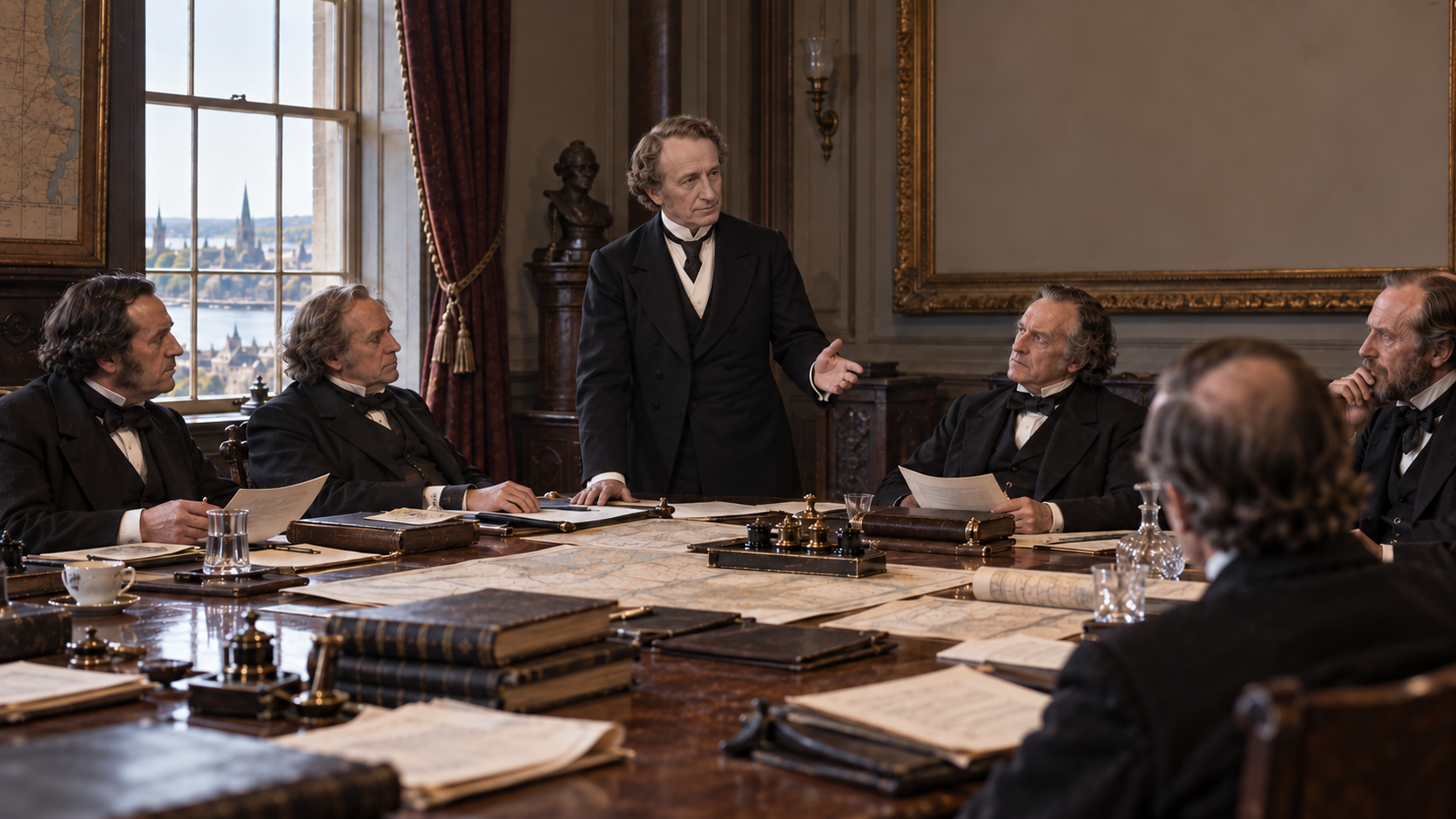
On the morning of 10 October 1864, thirty-three colonial statesmen assembled in the Parliament Building at Quebec City, overlooking the St. Lawrence River. They represented six political and geographical sections of British North America, each possessing its own traditions, ambitions, suspicions and fears. Some had travelled hundreds of miles by railway and steamship to attend. They came neither as revolutionaries nor as representatives of a nation already in existence, but as politicians charged with determining whether a new country could be constructed from colonies that had long regarded one another as neighbours rather than partners.
The task before them was formidable. British North America remained divided into separate colonial administrations. Its political institutions were inherited largely from Britain, its commerce was increasingly affected by the economic power of the United States, and its security was overshadowed by the American Civil War. Within the Province of Canada, parliamentary government had become entangled in a succession of political crises. Farther east, the Maritime colonies feared losing their independence to a larger political union dominated by the Canadas.
Yet beneath these divisions lay a growing conviction that the existing colonial arrangement could not indefinitely endure. The question was whether political union would provide greater security and prosperity without destroying the local institutions that gave each colony its distinctive character.
Historian Ged Martin, writing in The Historical Journal, summarized the importance of the constitutional negotiations by observing that Confederation was “designed in detail at the Quebec conference in October 1864.” His distinction is essential. Charlottetown had established the possibility of union; Quebec would determine its character.[1]
During the eighteen calendar days between 10 and 27 October, the delegates negotiated the constitutional structure of a federal state. They determined the proposed distribution of legislative authority, the composition of Parliament, the financial responsibilities of the two orders of government, and the mechanisms intended to preserve regional and minority interests.
Their final achievement, the Seventy-Two Resolutions, became the principal foundation of the British North America Act of 1867. The conference did not itself establish Canada, but it provided the constitutional architecture through which Canada would be created.
I. British North America Before Confederation: A Political System in Crisis
To understand why the Quebec Conference became necessary, one must examine the mounting political difficulties confronting the British North American colonies during the preceding generation.
The Act of Union of 1840, implemented in 1841, had combined Upper and Lower Canada into a single Province of Canada. Its architects hoped that legislative union would strengthen colonial government and promote political integration. Instead, it created an enduring constitutional problem. Canada West and Canada East possessed markedly different populations, legal traditions and social institutions, yet each received an equal number of representatives in the united legislature.
As the population of Canada West increased, demands for representation according to population became increasingly insistent. George Brown, editor of the Toronto Globe and a leading Reform politician, maintained that a larger population should command correspondingly greater representation. Many political leaders in Canada East resisted this principle, fearing that it would place French Canadians permanently under the political influence of an English-speaking majority.
The difficulty was compounded by the operation of responsible government. Ministries required sufficient parliamentary support to survive, but political coalitions were frequently weakened by conflicts between regional interests. Governments fell, alliances shifted, and legislation became hostage to divisions that could not readily be resolved within the existing constitutional framework.
By 1864, the Province of Canada faced an especially serious impasse. In June, George Brown agreed to cooperate with political opponents including John A. Macdonald and George-Étienne Cartier in a coalition intended to pursue constitutional reform. Their agreement represented a remarkable political compromise. Men who had spent years attacking one another now accepted that ordinary party competition could not solve the structural problems of the Province of Canada.
The coalition created the political circumstances in which Confederation became a practical possibility. Rather than merely redistributing seats within the existing legislature, the reformers could separate Canada West and Canada East into provinces while bringing them together within a larger federation.
Historical scholarship has increasingly emphasized that this agreement was not simply the triumph of one politician or one political philosophy. It arose from a complicated convergence of regional interests, constitutional ideas and practical necessity.
Historian P. B. Waite, in The Life and Times of Confederation, characterized the political culture of the period with the observation that opinions “were held with stubbornness and expounded with conviction.” The surviving debates certainly bear out his assessment. Confederation was neither universally welcomed nor unquestioningly accepted.[2]
II. The American Question: Security, Trade and the Future of the Colonies
The American Civil War exercised a profound influence upon the political environment in which Confederation was considered. Beginning in 1861, the struggle between the Union and Confederacy demonstrated the enormous military power that could be mobilized south of the international boundary.
British North American politicians watched the conflict with anxiety. Relations between Britain and the United States had already been strained by the Trent Affair of 1861, and the possibility of an Anglo-American confrontation could not be dismissed. The immense resources being devoted to the American war raised doubts about whether the scattered British colonies could defend themselves against a determined invasion.
Macdonald and other proponents believed that a united government would permit more effective military organization, greater coordination of resources and the development of transportation links essential to defence.
The American conflict also influenced constitutional thinking. Many Canadian politicians interpreted the Civil War as evidence of the dangers associated with a federation in which constituent states exercised too much independence. They believed that the new British North American union should provide greater authority to its central government than they perceived in the American constitutional system.
This interpretation was not entirely accurate as an explanation of the American conflict, but it influenced the constitutional discussions of 1864.
Economic considerations were equally important. The Canadian colonies had benefited from the Reciprocity Treaty of 1854, which provided reciprocal access for specified natural products in Canadian and American markets. By the mid-1860s, however, the treaty’s future was uncertain. Its eventual termination in 1866 strengthened arguments for developing trade between British North American colonies.
Railways offered the practical means of achieving such integration. An Intercolonial Railway linking the Province of Canada with New Brunswick and Nova Scotia promised to facilitate the movement of goods, people and military forces. Confederation, its proponents argued, could transform separate colonial economies into a larger commercial system.
There was also the question of imperial policy. British governments increasingly encouraged colonial self-reliance, particularly in defence, while remaining receptive to a political federation that would preserve the colonies’ relationship with the Crown.
Thus, the movement towards Confederation was driven not by one cause but by several: political deadlock, strategic insecurity, commercial ambitions, railway development and the changing relationship between Britain and its North American possessions.
III. Charlottetown: From Maritime Union to a Wider Confederation
The immediate predecessor of the Quebec Conference was the gathering at Charlottetown in September 1864.
Representatives of Nova Scotia, New Brunswick and Prince Edward Island had originally intended to discuss the possibility of a Maritime union. When politicians from the Province of Canada learned of the proposed meeting, they requested permission to attend and present a more ambitious scheme for uniting the British North American colonies.
The Canadian delegation included Macdonald, Cartier, Brown, Alexander Tilloch Galt and other leading members of the coalition. Over the course of the meeting, they persuaded their Maritime counterparts to consider a federation extending beyond the Atlantic colonies.
The discussions produced a general agreement that a wider union deserved serious consideration. Yet the participants had not established a detailed constitutional settlement. Critical matters remained unresolved, including representation, provincial authority, taxation, public debts and the protection of local institutions.
Charlottetown was, therefore, a beginning rather than a conclusion.
The delegates agreed to reconvene in Quebec City the following month. Newfoundland, which had not participated in the September proceedings, would also send representatives.
The Quebec Conference would consequently become the first comprehensive attempt to translate the political aspirations expressed at Charlottetown into a workable constitutional arrangement.[3]
IV. The Gathering at Quebec: The Men Who Negotiated Confederation
The Quebec Conference opened on 10 October 1864 in the Province of Canada’s Parliament Building, situated on Côte de la Montagne.
Thirty-three delegates attended: twelve from the Province of Canada, seven from New Brunswick, five from Nova Scotia, seven from Prince Edward Island and two from Newfoundland.
Étienne-Paschal Taché, the experienced French-Canadian statesman who served as premier of the Province of Canada, presided over the discussions. Although advanced in years and originally reluctant to return to political office, Taché possessed the dignity and credibility needed to moderate an assembly of competing personalities.
Among the delegates, several figures exercised exceptional influence.
John A. Macdonald emerged as the principal spokesman for a strong national government. A lawyer of considerable parliamentary experience, Macdonald combined constitutional knowledge with political pragmatism. He favoured institutions based upon British parliamentary traditions and believed that the central government must possess sufficient authority to prevent the federation from fragmenting into competing regional interests.
George-Étienne Cartier was equally indispensable. As the leading political representative of French-Canadian Conservatism, he understood that a broader union could succeed only if French Canadians retained substantial control over institutions central to their language, religion and civil law.
George Brown brought a different perspective. For years he had demanded representation by population, and Confederation offered an opportunity to secure that principle in a new House of Commons while providing separate provincial institutions for Canada West and Canada East.
Alexander Tilloch Galt contributed particularly to the financial discussions, including the distribution of public debts, revenues and taxation responsibilities.
Charles Tupper of Nova Scotia, Samuel Leonard Tilley of New Brunswick, and other Maritime delegates pressed the interests of smaller colonies, demanding arrangements that would prevent their populations from being politically submerged by the Canadas.
Historians J. K. Johnson and P. B. Waite, writing in the Dictionary of Canadian Biography, credited Macdonald with much of the constitutional design, while emphasizing that other delegates made essential contributions. Brown secured representation by population, Galt influenced the financial settlement, and Cartier shaped the linguistic and legal provisions.[4]
The achievement was consequently collective, even though particular personalities exercised disproportionate influence.
Behind the formal debates lay considerable informal negotiation. Delegates encountered one another at dinners and social gatherings, where personal relationships could soften political disagreements. Yet these social occasions must not obscure the seriousness of the proceedings. The delegates were determining whether the institutions of their colonies would survive in their existing form or become components of a new political order.
V. The Central Constitutional Question: A Strong Dominion or a Federation of Provinces?
No question occupied a more fundamental position at Quebec than the distribution of authority between the proposed general government and the provincial governments.
Macdonald preferred a strong central administration. He believed that the United States had demonstrated the dangers of allowing regional institutions excessive constitutional independence. His preferred arrangement approached a legislative union, although he recognized that such a system was politically impossible in British North America.
Cartier and the Maritime delegates insisted that local legislatures must retain meaningful authority. The French-Canadian representatives wished to preserve the institutions of Canada East, while the Maritime politicians were determined to protect their colonies from domination by the more populous provinces.
The resulting agreement established two constitutional orders: a general government responsible for matters of common concern and provincial governments responsible for specified local affairs.
Modern historians have emphasized the importance of this compromise. In Reconsidering Confederation, Marcel Martel, Colin M. Coates, Martin Pâquet and Maxime Gohier begin their study with the striking declaration:
“Confederation happened because of Quebec, not in spite of it.”[5]
Their argument challenges interpretations that treat French-Canadian participation as reluctant acquiescence in a scheme devised elsewhere. Without the support of Cartier and his political allies, the Canadian coalition could scarcely have endured, and a federation acceptable to Canada East would have been difficult to construct.
The Quebec settlement represented an accommodation between the desire for effective common government and the determination to protect local political and cultural institutions.
It also contained a significant centralizing element. The proposed general government would control major sources of revenue, possess the ability to disallow provincial legislation, and exercise powers not expressly reserved to the provinces.
These provisions reflected Macdonald’s concern for national authority. Nevertheless, the recognition of provincial jurisdiction created the constitutional basis for the powerful provincial governments that subsequently emerged.
The federation conceived at Quebec was therefore neither a simple confederation of sovereign colonies nor a completely centralized state. It was a constitutional compromise whose implications would be debated for generations.
VI. The Seventy-Two Resolutions: Designing a New Political Order
The principal achievement of the Quebec Conference was the adoption of the Seventy-Two Resolutions. These provisions constituted a remarkably detailed preliminary constitution, addressing the institutions, jurisdiction, finances and future development of the proposed union.
The first resolution declared that the interests and future prosperity of British North America would be advanced through a federal union under the British Crown, provided its terms were fair to the participating provinces.
The second resolution set forth the essential federal principle: a general government would manage common interests, while local governments would control local matters.
The resolutions then specified a Parliament composed of two chambers: a House of Commons based upon population and a Legislative Council intended to represent regional interests.
They proposed a division of legislative powers between the federal Parliament and provincial legislatures, established the principal financial arrangements of union, and addressed the organization of courts and public offices.
Other resolutions concerned defence, transportation, the location of the national capital, relations with the British government and the prospective admission of additional territories.
Importantly, the resolutions also expressed an intention to preserve the British constitutional model. Confederation was not designed as a republican revolution. The delegates intended to combine colonial self-government with continuing allegiance to the Crown.
The proposed constitutional system retained the principles of responsible government while creating new institutions capable of serving a federation.
As constitutional scholar Rachel Chagnon has emphasized, the Fathers of Confederation “reflected deeply on the project.” Their constitutional proposals were more than improvised political bargains; they represented deliberate choices among competing models of government.[6]
Although several provisions were modified before 1867, the essential federal architecture established at Quebec survived.
VII. Representation by Population and the Protection of Smaller Provinces
The organization of Parliament presented one of the most difficult questions before the conference.
Brown insisted that the House of Commons must reflect population. This principle addressed the longstanding grievance of Canada West, whose increasing population had not translated into a corresponding increase in parliamentary representation under the Act of Union.
The Quebec Resolutions therefore proposed a House of Commons of 194 members, calculated on the assumption that all the participating colonies would enter the union. Canada West would receive 82 seats, Canada East 65, Nova Scotia 19, New Brunswick 15, Newfoundland eight and Prince Edward Island five.
These figures were provisional. Because Prince Edward Island and Newfoundland did not join in 1867, the first federal House of Commons was smaller than the chamber originally contemplated at Quebec.
Population-based representation, however, created a serious concern for the Maritime delegates. Smaller colonies feared that the representatives of the Canadas could dominate the national legislature.
The proposed solution was an upper chamber organized according to regional equality rather than population.
The resolutions divided the federation into three principal sections: Canada West, Canada East and the Maritime colonies. Each was allotted twenty-four seats in the Legislative Council. The Maritime allocation was originally divided among Nova Scotia, New Brunswick and Prince Edward Island, while a separate provision contemplated representation for Newfoundland upon admission.
This arrangement was changed before Confederation took effect, but the underlying principle endured.
Members of the upper chamber would be appointed rather than elected. Their appointment was intended to provide stability and independence from immediate electoral pressures, although critics feared that an appointed chamber would diminish democratic accountability.
The resulting compromise established an enduring feature of Canadian federalism: one chamber principally representing population and another intended to provide a measure of regional balance.
It was an imperfect arrangement. Yet it allowed delegates representing very different populations to negotiate a common institutional framework.
VIII. Cartier, French Canada and the Preservation of Cultural Institutions
For George-Étienne Cartier and his political supporters, Confederation offered the possibility of a constitutional arrangement that would preserve French-Canadian society within a broader political union.
Since the British Conquest, French-speaking inhabitants of the St. Lawrence valley had repeatedly confronted changes in their constitutional position. The Quebec Act of 1774 had recognized French civil law and Catholic rights; the Constitutional Act of 1791 had provided separate legislatures; and the Act of Union had subsequently reunited the Canadas within a single political structure.
Cartier viewed the creation of a separate province of Quebec as an opportunity to secure control over institutions fundamental to French-Canadian society.
Education was particularly important. The Quebec Resolutions assigned education to provincial jurisdiction while providing protections for certain existing denominational school rights.
Provincial control over property and civil rights was equally significant. It helped preserve the distinctive civil-law tradition of Lower Canada, notwithstanding the broader influence of English common law elsewhere in British North America.
Linguistic safeguards were also incorporated into the proposed constitution. Resolution 46 permitted the use of English and French in the federal Parliament, in the legislature of Lower Canada and in specified courts.
When defending Confederation before the Legislative Assembly in February 1865, Cartier argued that the existence of different communities strengthened rather than weakened the case for federation. He maintained that the federal system was appropriate precisely because of the diversity of regional interests, religions and peoples.[7]
His conception of Confederation rested on the belief that political union need not require cultural uniformity.
Yet the agreement was not without limitations. The constitutional protections negotiated in 1864 did not provide equal guarantees to every linguistic minority throughout British North America. Nor did they establish a modern charter of individual or collective rights.
Nevertheless, the provisions concerning provincial authority, civil law, education and the use of French became essential elements of the constitutional settlement.
For French-Canadian Confederation supporters, the new province of Quebec was not merely an administrative district. It was an institution through which a distinct society could preserve and develop important features of its collective life.
IX. Money, Debt and Railways: The Economic Foundations of Union
The delegates understood that constitutional principles alone could not produce a successful federation. A new country required financial resources, transportation systems and an acceptable distribution of public obligations.
The colonies differed considerably in their indebtedness, taxation systems and economic circumstances. Some had invested heavily in railways and canals, while others feared assuming liabilities incurred elsewhere.
Galt therefore played a central role in shaping the financial arrangements.
The Quebec Resolutions provided that the federal government would assume specified colonial debts, subject to negotiated limits and adjustments. In return for transferring major taxation powers to the general government, the provinces would receive annual financial assistance.
One provision proposed an annual provincial subsidy calculated at eight cents per inhabitant on the basis of the 1861 census. Other arrangements addressed differences in colonial indebtedness and particular financial difficulties confronting individual provinces.
The constitutional distinction between federal and provincial finance was of lasting importance. The central government would acquire broad taxation authority and responsibility for major national expenditures. The provinces would retain local responsibilities but depend partly upon revenues transferred from Ottawa.
Transportation was another essential element of the bargain.
The Intercolonial Railway was not an incidental benefit. For the Maritime provinces, it promised improved connections with the St. Lawrence valley and markets farther west. For the Canadas, it offered access to Atlantic ports and a railway route through British territory.
Resolution 68 committed the proposed general government to securing completion of the railway from Rivière-du-Loup through New Brunswick to Truro, Nova Scotia.
The delegates also contemplated future communications with the North-West and the development of trade routes connecting the interior with the seaboard.
These provisions demonstrated that the architects of Confederation envisioned more than the union of established eastern colonies. They anticipated a federation capable of extending across the continent.
Their assumptions about that expansion, however, did not adequately acknowledge the rights and interests of the Indigenous peoples already occupying those territories.
X. The Voices Beyond the Conference Chamber
The traditional account of the Quebec Conference often concentrates upon the thirty-three delegates, celebrating their political ingenuity while treating Confederation as a nearly inevitable progression towards national unity.
Modern scholarship has substantially complicated this interpretation.
The delegates were influential colonial politicians, but they did not constitute a fully representative assembly of the peoples whose futures they were determining.
Women possessed no formal representation at the conference. Although women participated in political life through family networks, public discussion, petitions and social activity, the constitutional negotiations remained entirely under male political control.
Indigenous nations were not invited to participate, despite the fact that the proposed federation would acquire constitutional responsibilities directly affecting their lands, institutions and political relationships with the Crown.
The Quebec Resolutions assigned responsibility for Indigenous affairs and lands reserved for Indigenous peoples to the federal government. Yet there was no comparable effort to secure Indigenous consent to the creation of the new constitutional order.
Martel, Coates, Pâquet and Gohier demonstrate that Indigenous rights received remarkably little consideration during the conference. The transfer of jurisdiction was treated principally as a matter of governmental authority rather than as a question requiring negotiation with Indigenous nations.[8]
This omission had significant consequences.
The new Dominion would subsequently pursue territorial expansion, settlement and policies affecting Indigenous peoples across large regions of British North America. These developments involved relationships and obligations that could not be adequately understood solely through the constitutional settlement of 1864.
The conference must consequently be examined both as a major achievement in colonial constitutional negotiation and as a process reflecting the political exclusions of its time.
Recognizing those exclusions does not diminish the historical importance of the Seventy-Two Resolutions. It permits a more comprehensive understanding of the country that emerged from them.
XI. Opposition to Confederation: The Quebec Scheme Under Attack
The Quebec Conference produced an agreement among the colonial negotiators, but it did not produce universal public acceptance.
Once the proposed terms became known, opposition developed throughout British North America.
In Canada East, Antoine-Aimé Dorion and other members of the Rouge political movement questioned whether the proposed federal structure would provide sufficient protection against central authority. Dorion feared that federal powers of disallowance could be employed to interfere with provincial legislation and undermine the autonomy supposedly guaranteed by Confederation.
Other critics objected to the appointed upper chamber, the cost of establishing new political institutions, the absence of direct popular consultation and the danger that regional interests would be sacrificed to the larger federation.
Henri-Gustave Joly de Lotbinière, another opponent, feared that the proposed settlement could endanger the distinctiveness of French-Canadian society rather than preserve it.
Christopher Dunkin, representing Brome, challenged the assumptions underlying Confederation and questioned whether the proposed union could produce a genuinely shared political nationality.
These critics were not necessarily opposed to all forms of cooperation among the colonies. Some favoured a different distribution of powers, a more democratic constitutional process or alternative commercial arrangements.
Their objections illustrate the extent to which Confederation remained contested.
In February and March 1865, the Province of Canada’s legislature debated the Quebec Resolutions at considerable length. The Legislative Assembly ultimately approved the scheme by 91 votes to 33, while the Legislative Council also supported it.
The outcome demonstrated substantial parliamentary support but not unanimity.
In the Maritime colonies, opposition was particularly strong. Many inhabitants of Prince Edward Island believed that Confederation offered insufficient benefits and failed to resolve the island’s longstanding land-tenure problem. Newfoundland, meanwhile, remained hesitant about surrendering its separate political institutions.
The future Dominion could not simply be proclaimed on the basis of the Quebec agreement. It required further political negotiations and, in some colonies, significant changes in public opinion and parliamentary circumstances.
The constitutional bargain had been drafted, but its political acceptance remained uncertain.
XII. From Quebec to London: The Final Road to Confederation
The events following the Quebec Conference demonstrated how precarious the Confederation movement remained.
In New Brunswick, the Confederation government suffered an electoral defeat in 1865. Supporters of union subsequently regained the initiative, aided by changing political circumstances, concern over security and renewed debate over economic development.
Nova Scotia also witnessed determined opposition, although Charles Tupper and his allies succeeded in securing legislative approval.
Prince Edward Island and Newfoundland declined to participate in the original union.
By late 1866, the political circumstances permitted representatives from the Province of Canada, Nova Scotia and New Brunswick to proceed to London for a final constitutional conference.
There the Quebec Resolutions were reviewed, modified and translated into the legal form required for enactment by the British Parliament.
The British North America Act received Royal Assent on 29 March 1867.
On 1 July 1867, the Dominion of Canada came into existence, comprising Ontario, Quebec, Nova Scotia and New Brunswick.
The constitutional settlement created a federal Parliament, provincial legislatures, a national executive operating within the British parliamentary tradition, and a system of divided legislative responsibilities.
The connection between the Quebec Resolutions and the new constitution was unmistakable. Much of the division of powers became embodied in sections 91 and 92 of the British North America Act. The provisions concerning education and language contributed directly to sections 93 and 133.
The institutional framework established at Quebec had survived the difficult journey from political negotiation to constitutional law.
Nevertheless, the final constitution was not identical to the original Quebec scheme. The number and distribution of parliamentary seats changed, financial arrangements were adjusted and particular provisions were refined during the London negotiations.
Confederation was therefore a process of successive compromises rather than the enactment of an unaltered plan.
XIII. The Historians’ Debate: What Did Quebec Actually Achieve?
Historians have long differed in their interpretations of the Quebec Conference and its place in Canadian nation-building.
Earlier accounts, particularly those influenced by a strongly nationalist interpretation, frequently emphasized the vision and determination of the Fathers of Confederation. Donald Creighton’s work placed considerable weight upon political leadership and the development of a transcontinental Canadian nation.
P. B. Waite’s scholarship drew greater attention to the intense political controversy surrounding Confederation, especially the role of newspapers, public opinion and parliamentary debate.
Ged Martin later challenged interpretations that treated the Confederation conferences as isolated moments of national inspiration. His research placed the meetings within a longer history of proposals, imperial interests and political circumstances extending well before 1864.
Christopher Moore’s Three Weeks in Quebec City brought renewed attention to the conference itself, examining its detailed negotiations and the personalities involved in producing the constitutional settlement.
More recent studies have questioned the extent to which Confederation represented a single shared national vision. Scholars such as Eugénie Brouillet, Alain-G. Gagnon and Guy Laforest have stressed the importance of recovering the competing constitutional projects present at Quebec, including differing conceptions of federalism, provincial autonomy and political nationality.[9]
These interpretations need not be regarded as mutually exclusive.
The delegates undoubtedly demonstrated considerable political skill. Their negotiations created institutions that endured and proved capable of adaptation. Yet their achievement depended upon historical circumstances that constrained their choices and upon compromises that satisfied some interests while leaving others unresolved.
The Quebec Conference was a remarkable constitutional accomplishment, but it was neither the inevitable culmination of British North American history nor the final settlement of every question concerning Canadian federalism.
Its significance lies partly in the tensions it institutionalized.
The balance between federal and provincial authority, the relationship between Quebec and the federation, the protection of minorities, and the representation of Canada’s regions all remain subjects of constitutional debate.
In that sense, the Quebec Conference created not simply a governmental framework but a continuing political argument about the nature of Canada.
XIV. Confederation Beyond 1867: A Nation Still to Be Built
The Dominion established in 1867 occupied only part of the territory that would eventually constitute Canada.
Prince Edward Island entered Confederation in 1873, while Newfoundland remained outside the federation until 1949. Manitoba was established in 1870, British Columbia joined in 1871, and the creation of additional provinces and territories gradually transformed the political geography of the country.
The territorial ambitions expressed at Quebec were therefore realized only through subsequent negotiations, political agreements, imperial transfers, settlement policies and Indigenous treaties and relationships.
Historian W. L. Morton offered an essential corrective to accounts that treat Confederation as a completed achievement on Dominion Day. The events of 1867, he wrote, were “a beginning only, not an end.”[10]
This observation captures the difference between the constitutional creation of the Dominion and the longer, often contentious construction of modern Canada.
Confederation did not immediately establish full Canadian independence. The new Dominion remained within the British Empire, and the evolution towards greater legislative autonomy, independent international action and eventual constitutional patriation unfolded over more than a century.
Nor did the British North America Act eliminate regional disagreements. Questions concerning the division of powers, public finance, language rights, provincial autonomy and constitutional change persisted.
Yet the institutions established in 1867 proved sufficiently adaptable to accommodate substantial transformations in government and society.
The Quebec Conference had created a constitutional structure capable of both endurance and dispute.
Conclusion: The Conference That Designed Canada
The Quebec Conference of 1864 occupies an exceptional position in Canadian history because it marked the transition from the political aspiration of Confederation to the practical construction of a federal constitution.
Its delegates faced problems that appeared almost irreconcilable. Canada West demanded representation according to population. Canada East sought protection for its institutions and cultural identity. The Maritime colonies insisted upon safeguards against domination. Political leaders wanted an effective central government without destroying the authority of the provinces.
Economic uncertainty, international insecurity and the changing relationship with Britain added urgency to their negotiations.
The settlement was neither perfect nor universally accepted. It was achieved by a small group of colonial politicians without the direct participation of Indigenous nations, women or the wider populations whose futures would be affected. Several colonies rejected the initial terms, and important constitutional questions remained unresolved.
Nevertheless, the conference produced an institutional design of extraordinary durability.
Its essential principles shaped the British North America Act of 1867 and established the foundations of Canadian federalism. The idea of shared authority within a united political framework became the organizing principle of the new Dominion.
The Seventy-Two Resolutions did not merely describe a country. They established the conditions under which a country could emerge.
On 27 October 1864, as the delegates concluded their deliberations and prepared to return to their respective colonies, the achievement remained uncertain. They possessed neither the authority to proclaim a new nation nor any guarantee that their proposals would survive the political struggles ahead.
What they carried away was a constitutional agreement, carefully negotiated and necessarily imperfect, upon which the future of British North America might be built.
Three years later, the Dominion of Canada came into existence.
The Quebec Conference had not completed the making of Canada. It had performed an equally consequential task: it had determined the constitutional principles through which that undertaking could begin.
References and Historical Notes
The following references use Chicago-style notes. Direct quotations from historians have been checked against accessible publisher material or published scholarly text. Where a source was available only in an extract, no unverified page number has been supplied.
1. Ged Martin, “Launching Canadian Confederation: Means to Ends, 1836–1864,” The Historical Journal 27, no. 3 (September 1984): 575–602, https://doi.org/10.1017/S0018246X00017982. The quotation appears in the article’s published opening extract.
2. P. B. Waite, The Life and Times of Confederation, 1864–1867: Politics, Newspapers, and the Union of British North America (Toronto: University of Toronto Press, 1962), chap. 1, “Newspapers and Political Life.”
3. Parks Canada, “Charlottetown and Québec Conferences of 1864,” historical backgrounder, October 6, 2017, https://www.canada.ca/en/parks-canada/news/2017/10/charlottetown_andquebecconferencesof1864.html.
4. J. K. Johnson and P. B. Waite, “Macdonald, Sir John Alexander,” Dictionary of Canadian Biography, vol. 12, University of Toronto/Université Laval, https://www.biographi.ca/en/bio/6248.
5. Marcel Martel, Colin M. Coates, Martin Pâquet, and Maxime Gohier, “Quebec and Confederation: Gains and Compromise,” in Reconsidering Confederation: Canada’s Founding Debates, 1864–1999, ed. Daniel Heidt (Calgary: University of Calgary Press, 2018), 75–100.
6. Rachel Chagnon, “The Fathers of Confederation and the BNA Act: Constitutional Visions and Models,” in The Quebec Conference of 1864: Understanding the Emergence of the Canadian Federation, ed. Eugénie Brouillet, Alain-G. Gagnon, and Guy Laforest (Montreal and Kingston: McGill-Queen’s University Press, 2018), 29–48.
7. Province of Canada, Parliamentary Debates on the Subject of the Confederation of the British North American Provinces, Legislative Assembly, February 7, 1865 (Quebec: Hunter, Rose & Co., 1865); digital edition, The Confederation Debates, University of Victoria, https://hcmc.uvic.ca/confederation/en/lgPCLA_1865-02-07.html.
8. Martel et al., “Quebec and Confederation,” particularly the discussion of Indigenous rights and the debates over the federal distribution of powers.
9. Eugénie Brouillet, Alain-G. Gagnon, and Guy Laforest, eds., The Quebec Conference of 1864: Understanding the Emergence of the Canadian Federation (Montreal and Kingston: McGill-Queen’s University Press, 2018).
10. W. L. Morton, The Critical Years: The Union of British North America, 1857–1873 (Toronto: McClelland and Stewart, 1964), quoted in Daniel Heidt, “Introduction: Reconsidering Confederation,” in Reconsidering Confederation, 1–18.
Selected Bibliography
Primary Sources
Province of Canada. The Seventy-Two Resolutions of the Quebec Conference. October 1864. Historical transcription available at https://canadahistory.ca/sections/documents/federal/72%20Resolutions.html.
Province of Canada. Parliamentary Debates on the Subject of the Confederation of the British North American Provinces. Quebec: Hunter, Rose & Co., 1865. Digital transcription by The Confederation Debates, University of Victoria.
United Kingdom. British North America Act, 1867. 30 & 31 Victoria, c. 3. March 29, 1867. Now titled the Constitution Act, 1867.
Scholarly Works
Brouillet, Eugénie, Alain-G. Gagnon, and Guy Laforest, eds. The Quebec Conference of 1864: Understanding the Emergence of the Canadian Federation. Montreal and Kingston: McGill-Queen’s University Press, 2018.
Creighton, Donald. The Road to Confederation: The Emergence of Canada, 1863–1867. Toronto: Macmillan of Canada, 1964.
Heidt, Daniel, ed. Reconsidering Confederation: Canada’s Founding Debates, 1864–1999. Calgary: University of Calgary Press, 2018.
Martin, Ged. “Launching Canadian Confederation: Means to Ends, 1836–1864.” The Historical Journal 27, no. 3 (1984): 575–602.
Moore, Christopher. Three Weeks in Quebec City: The Meeting That Made Canada. 2015.
Morton, W. L. The Critical Years: The Union of British North America, 1857–1873. Toronto: McClelland and Stewart, 1964.
Silver, Arthur I. The French-Canadian Idea of Confederation, 1864–1900. Toronto: University of Toronto Press, 1982.
Waite, P. B. The Life and Times of Confederation, 1864–1867: Politics, Newspapers, and the Union of British North America. Toronto: University of Toronto Press, 1962.
Historical and Archival Resources
Dictionary of Canadian Biography. University of Toronto and Université Laval. https://www.biographi.ca.
Parks Canada. “Charlottetown and Québec Conferences of 1864 National Historic Event.” https://parks.canada.ca/culture/designation/evenement-event/conferences-charlottetown-quebec.
The Confederation Debates. University of Victoria. https://hcmc.uvic.ca/confederation/.
University of Calgary Press. Reconsidering Confederation: Canada’s Founding Debates, 1864–1999. Open-access scholarly edition, 2018.