






Henry Dundas: The Forgotten Argument for Abolition
A Historical Examination of Henry Dundas, William Wilberforce, and the British Campaign Against Slavery
History has a curious habit of reducing great controversies to small things. A phrase, a parliamentary division, a single word spoken across the floor of the House of Commons may survive long after the circumstances that gave it meaning have disappeared. Such has been the fate of Henry Dundas, one of the most powerful British statesmen of the late eighteenth century, whose considerable political career has increasingly been judged through the narrow prism of a single intervention in the struggle to abolish the Atlantic slave trade. The word was gradual. The year was 1792. And behind that apparently simple amendment lay a political struggle whose consequences would reach across the Atlantic, through the plantations of the West Indies, and into the lives of hundreds of thousands of enslaved Africans.
Yet the story of Henry Dundas and the abolition of slavery is considerably more complicated than the promoted account of a politician who delayed emancipation. The parliamentary record establishes that Dundas publicly supported ending the slave trade, proposed a definite date for its termination, and accepted an earlier date preferred by the House of Commons. More remarkably, William Wilberforce, the celebrated parliamentary champion of abolition, would subsequently recall that Dundas had advocated an arrangement under which both the slave trade and slavery itself would come to an end. That testimony deserves particular attention, for it came not from Dundas or his political supporters, but from the man whose name would become virtually synonymous with the British abolitionist movement.
Born in Edinburgh in 1742, Henry Dundas rose through the Scottish legal profession to become one of the most influential political figures of his generation. As Lord Advocate of Scotland, a member of Parliament and later a senior minister in the administration of William Pitt the Younger, Dundas occupied a commanding position within Britain’s governing establishment. His influence was so extensive that contemporaries referred to him as the Uncrowned King of Scotland. He served as Home Secretary, Secretary at War and First Lord of the Admiralty, while exercising considerable authority over imperial administration. He was a practical politician, accustomed to navigating competing interests, securing parliamentary majorities and translating political objectives into legislation. These were formidable skills in an age when governments depended upon shifting alliances, personal loyalties and the precarious arithmetic of parliamentary votes.[1]
The world in which Dundas exercised this authority was one of extraordinary contradiction. Britain celebrated liberty as a defining characteristic of its political institutions, yet its merchants and colonial interests participated extensively in the transportation and enslavement of Africans. British ships carried human beings across the Atlantic, while the plantations of the Caribbean produced sugar and other commodities that enriched merchants, investors and consumers. The commercial interests associated with slavery were powerful, well organized and deeply embedded in the imperial economy. To threaten the slave trade was therefore to confront not simply a commercial enterprise, but an extensive system of wealth, political influence and colonial power.
By the 1780s, however, the moral foundations of this system were being challenged with increasing force. Quakers, evangelical Christians, Black abolitionists, writers, lawyers and ordinary citizens helped create a movement remarkable for its organization and persistence. Thomas Clarkson gathered evidence describing the conditions aboard slave ships. Olaudah Equiano’s published account of his life helped expose the violence and human suffering inherent in slavery. Granville Sharp challenged the legal foundations of enslavement, while organized campaigns drew thousands of people into petitions, meetings and consumer boycotts. In Parliament, William Wilberforce became the movement’s most recognizable spokesman. But the struggle was larger than any single individual. It was sustained by generations of resistance among enslaved Africans themselves, whose determination to resist bondage exposed the moral and practical instability of the colonial slave system.[2]
By 1792, the abolition movement had achieved something remarkable. The question was no longer whether the slave trade should be discussed in Parliament, but whether the British political establishment could be persuaded to end it. Wilberforce advocated abolition without the prolonged timetable demanded by defenders of colonial commerce. The opposition was formidable. Merchants warned of economic ruin, colonial proprietors predicted disorder, and many parliamentarians feared that Britain would surrender commercial advantages to foreign competitors. Across the Channel, revolutionary France had already disturbed the political foundations of Europe, while the uprising in Saint-Domingue, beginning in 1791, demonstrated that the enslaved population of the Caribbean would not indefinitely submit to oppression. These circumstances shaped the arguments of those who feared the immediate consequences of abolition.
Into this troubled parliamentary atmosphere stepped Henry Dundas.
On 2 April 1792, the House of Commons assembled to consider the abolition of the slave trade. The debate continued into the following hours and drew interventions from some of Britain’s most accomplished political figures. Dundas did not rise to defend the perpetual existence of the trade. Instead, he declared that he shared the ultimate objective of its opponents while differing over the means by which that objective might be accomplished. In a contemporary published account of the debate, he stated:
“My opinion has been always against the Slave Trade.”
This was a significant declaration from a senior minister closely associated with Pitt’s government. Dundas did not describe the trade as an institution requiring indefinite protection. He distinguished between the principle of abolition and the practical mechanism through which abolition might be secured. In his judgment, the immediate prohibition sought by Wilberforce faced political, colonial and administrative obstacles that could prevent its successful implementation. He therefore proposed that abolition should proceed gradually, through a staged process intended to secure a parliamentary majority and allow time for the necessary colonial adjustments.[3]
The distinction was crucial. Dundas was not alone in believing that reform of a deeply entrenched institution might require a sequence of legislative measures. Eighteenth-century British politics was frequently conducted through compromise, incremental legislation and the accommodation of interests that could not simply be swept aside. Whether such political caution was justified in the case of slavery remains a serious historical question. Nevertheless, understanding Dundas requires recognizing the difference between advocating the permanent continuation of the slave trade and proposing an alternative timetable for its abolition.
The House of Commons accepted his amendment. The proposal for gradual rather than immediate abolition carried by 193 votes to 125, and the amended resolution subsequently passed by 230 votes to 85. These results demonstrated both the strength of the abolitionist cause and the political divisions surrounding its implementation. They did not, however, constitute an enacted law abolishing the trade. The difficulties of obtaining agreement between the Commons, the Lords and the colonial interests remained formidable.[4]
Dundas’s intentions can be examined more closely through his subsequent parliamentary actions. On 23 April 1792, less than three weeks after the original debate, he brought forward resolutions intended to establish a definite termination date for the slave trade. His proposed deadline was 1 January 1800. This was not an indefinite postponement. The intention expressed in the proposal was that the British trade in enslaved Africans would legally terminate after a specified period. Other members of the House wished to impose an earlier deadline, and the Commons preferred 1796. Dundas accepted this decision and offered to assist with the legislation necessary to implement the agreed programme.[5]
These events are essential to a fair reconstruction of his position in 1792. Dundas had endorsed the principle of abolition, secured parliamentary acceptance of a gradual approach, proposed a legally defined termination date and accepted the Commons’ preference for bringing that date forward. None of this establishes that his approach was the best possible strategy, still less that it would necessarily have succeeded. It does establish that his parliamentary proposals cannot be adequately described merely by reference to the insertion of the word gradual. They formed part of a more extensive attempt to define a legislative route toward abolition.
But an even more remarkable piece of evidence emerged more than three decades later.
On 18 March 1823, William Wilberforce addressed the House of Commons during a debate concerning the abolition of slavery throughout Britain’s possessions. By then, the British slave trade had been prohibited for sixteen years, yet slavery itself continued across much of the empire. Wilberforce was reflecting upon the early years of the abolition movement, the limited objectives originally pursued by its parliamentary leaders, and the possibility that they had erred in not confronting slavery directly.
In this retrospective account, Wilberforce identified several prominent political figures who had favoured addressing slavery itself, rather than restricting reform to the slave trade. Among them was Henry Dundas, by then deceased and remembered as Lord Melville. Wilberforce recalled that Dundas had proposed to Parliament that “the slave trade and slavery should end together” on 1 January 1800.[6]
The significance of this statement should not be underestimated. Wilberforce was the central parliamentary figure in the long campaign against the British slave trade. His recollection cannot simply be dismissed as the invention of Dundas’s admirers. Indeed, Wilberforce acknowledged that he and his immediate associates had initially confined their legislative ambitions to abolishing the trade, believing that this would provide the most practical beginning for the wider struggle against slavery.
Dundas, as Wilberforce remembered him, had proposed something different: the eventual termination of both institutions within a common timetable. The distinction was fundamental. Abolishing the slave trade prevented the legal continuation of a particular commercial traffic. Abolishing slavery itself required confronting the legal condition of bondage imposed upon hundreds of thousands of people already living in the British colonies. One attacked the supply of enslaved people; the other challenged the institution that sustained their captivity.
Wilberforce’s recollection therefore provides important testimony that Dundas’s stated ambitions were not necessarily confined to ending the transportation of Africans across the Atlantic. It suggests that he contemplated a legislative programme whose ultimate destination was emancipation. At the same time, the 1823 statement was a retrospective recollection rather than proof that a comprehensive emancipation bill had been introduced and enacted in 1792. The historian must distinguish between an objective expressed in parliamentary argument, a proposal subsequently remembered by contemporaries and an operative statute.
That distinction gives the evidence its proper significance. Dundas had not secured emancipation. His timetable never became law. Yet Wilberforce’s testimony demonstrates that Dundas belonged among those politicians who, at least in the parliamentary discussions remembered by Wilberforce, contemplated the abolition of slavery itself. The historical record is diminished when this testimony is overlooked.
There was also a broader political context. Gradual abolition was not a peculiar invention of Henry Dundas. Across the late eighteenth and early nineteenth centuries, reformers debated whether slavery should end immediately or through legislative arrangements that would progressively remove its legal foundations. Even the movement launched in 1823 for the mitigation and gradual abolition of slavery initially adopted a programme of staged reform. Such an approach could be defended as politically practical, though its limitations were profound for those who remained enslaved while legislation was debated.
The historian’s responsibility is therefore twofold: to understand why gradualism appeared reasonable to some contemporaries, and to recognize the human cost of its adoption. The suffering of enslaved Africans did not diminish because legislators spoke of eventual reform. Every year of postponement permitted further captivity, forced labour and, until the trade was prohibited, the continued transportation of Africans into bondage. The political logic of compromise must always be considered alongside these consequences.
The scholarly debate surrounding Dundas has consequently remained vigorous. Historian Michael Fry has portrayed him as a genuine opponent of the slave trade who sought a politically workable compromise. More recently, historian Angela McCarthy, writing in Scottish Affairs, has argued that archival evidence supports the interpretation of Dundas’s gradualist proposals as a genuine attempt to establish a route to abolition. Her research emphasizes that the failure to achieve immediate abolition cannot automatically be attributed to one politician or one amendment.[7]
A different interpretation has been advanced by historian Stephen Mullen, whose study in the Scottish Historical Review characterizes Dundas as a “great delayer” of abolition. Mullen emphasizes Dundas’s subsequent political activities, his relationships with influential West Indian interests, and his opposition to later abolitionist proposals during the wars against Revolutionary France. His argument is that Dundas’s political conduct must be assessed beyond the statements he made during the parliamentary debates of April 1792.[8]
These interpretations disagree about motivation, responsibility and consequences. The existence of that disagreement is itself instructive. Dundas’s expressed support for abolition in 1792 is part of the historical record, as is the failure of the proposed timetable to become law. So, too, are his later actions and the changing imperial interests of the British government. The evidence permits a strong argument that Dundas advocated abolition through a staged process in 1792. Whether he remained consistently committed to that objective, and how much responsibility he bears for the later delay, are questions requiring a wider examination of his political career.
The course of events following the debates of 1792 helps explain why the original parliamentary proposals did not become law. In 1793, Britain entered war against Revolutionary France. European conflict rapidly extended into the Caribbean, where strategic considerations, colonial rivalries and the fear of slave uprisings transformed the political calculations of British ministers. Saint-Domingue became a theatre of military struggle. Britain’s Caribbean possessions assumed heightened importance as strategic and commercial assets. Amid these circumstances, the abolition movement encountered increasingly difficult parliamentary resistance.
The records identified in The National Archives at Kew demonstrate the breadth of the surviving evidence concerning this era. Colonial Office, Foreign Office, Admiralty, War Office and Treasury collections preserve material relevant to Britain’s colonial administration, the Caribbean conflicts, the slave trade and the abolition movement. The Archives’ research guide specifically identifies the Saint-Domingue revolt and Britain’s war with Revolutionary France as developments that profoundly affected the campaign after 1791. Records in series including CO 137, WO 1, ADM 1, FO 27, FO 72 and T 81 provide avenues for further investigation into the imperial world within which Dundas operated.[9]
The significance of this archival context is considerable. The struggle against the slave trade cannot be explained exclusively through the words of a single parliamentary amendment. It unfolded within an empire at war, governed through complicated institutions, and deeply dependent upon colonial commercial interests. British governments faced competing pressures from abolitionists, slaveholders, merchants, naval authorities and colonial administrators. The decisions made in London were inseparable from developments throughout the Atlantic world.
The abolition campaign nevertheless endured. Wilberforce continued to introduce legislation. Clarkson and other abolitionists renewed their efforts to mobilize public opinion. Religious organizations, local committees and petitioners maintained the pressure. But the parliamentary defeats accumulated. According to the United Kingdom Parliament’s historical account of the campaign, an abolition measure failed again in 1805, marking the eleventh failure in fifteen years.
The following year brought a more promising development. The Foreign Slave Trade Abolition Act of 1806 restricted British participation in carrying enslaved Africans to foreign colonies. It was an important legislative step, demonstrating that carefully constructed measures could weaken the trade before comprehensive abolition. By this time, the political balance had begun to shift decisively.
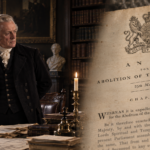
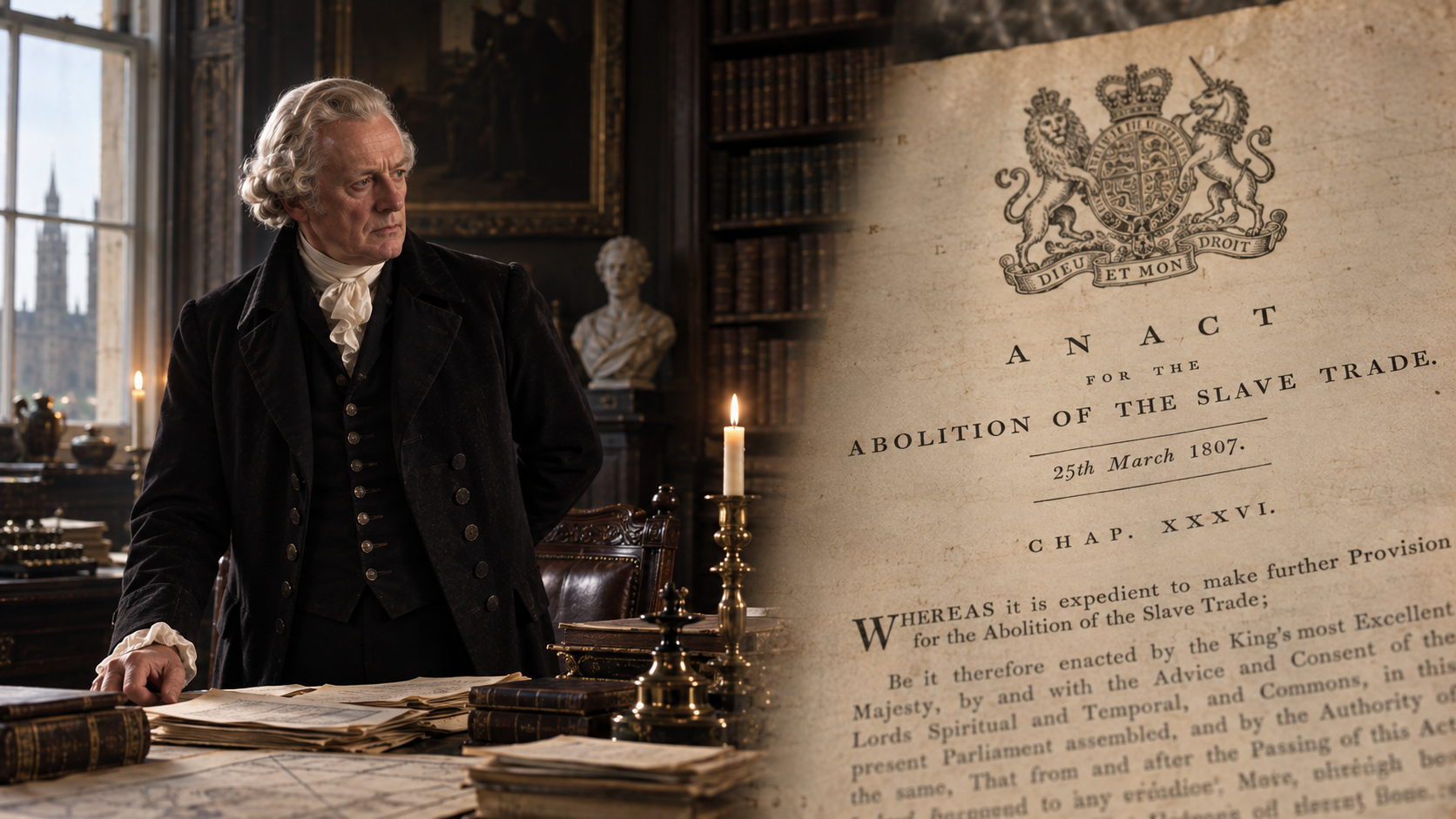
In February 1807, after nearly two decades of sustained campaigning, the House of Commons voted overwhelmingly in favour of prohibiting the British slave trade. The division was 283 votes to 16. On 25 March, the legislation received Royal Assent, and Britain formally prohibited the trade under the conditions established by the Act.[10]
The victory belonged above all to the determined abolitionists who had refused to abandon their campaign despite repeated defeats. Wilberforce, Clarkson, Equiano, Sharp and countless other men and women had helped transform a moral protest into a parliamentary achievement. Their efforts were indispensable. But the parliamentary history of abolition was also shaped by compromises, proposals and arguments advanced by politicians who did not belong to the movement’s most celebrated ranks.
Henry Dundas was one of those figures.
The great task of emancipation, however, remained unfinished. The abolition of the trade did not immediately free the people already held in slavery. Plantation slavery continued in the British Caribbean, and it would require another generation of agitation, political reform and resistance before Parliament enacted the Slavery Abolition Act of 1833. Emancipation began under that legislation in 1834, although the apprenticeship system imposed upon many formerly enslaved people prolonged coercive labour arrangements until 1838. The victory of 1807, monumental though it was, remained only one stage in the larger struggle for freedom.[11]
Dundas did not live to witness that final legislative transformation. He died in 1811, four years after the abolition of the British slave trade and more than two decades before Parliament enacted the general abolition of colonial slavery. His career had been one of extraordinary political influence, encompassing the government of Scotland, the administration of India, Britain’s military establishment and the struggle against Revolutionary France. Yet among the arguments he made across decades of public service, few have provoked greater disagreement than those delivered during the parliamentary debates of 1792.
What, then, does the surviving evidence establish?
It establishes that Henry Dundas publicly professed opposition to the slave trade. It establishes that he supported its abolition through a gradual legislative process. It establishes that he proposed 1800 as a date for its termination and accepted the Commons’ preference for 1796. It establishes, further, that William Wilberforce later recalled Dundas advocating an arrangement under which the slave trade and slavery itself would end together.
These are substantial facts. They do not settle every question concerning Dundas’s motivation, consistency or later political conduct. Nor do they remove the obligation to examine his decisions critically. They do, however, demonstrate why the historical record must extend beyond the single word that has come to dominate his reputation.
For all the immense political power he possessed, Henry Dundas could not dictate the will of Parliament, compel the House of Lords to enact a statute, or remove the colonial interests that resisted abolition. Nor can the full history of the abolition movement be understood without acknowledging the changing priorities of war, commerce and imperial security. The failure of reform in the 1790s arose from a complex struggle in which many individuals and institutions exercised influence.
Perhaps the most revealing evidence remains that supplied by Wilberforce himself in 1823. Looking back over the long battle against the slave trade, the veteran abolitionist acknowledged that some of his contemporaries had advocated a broader objective than he and his immediate associates originally pursued. Among those he identified was Henry Dundas.
There is a striking historical irony in this testimony. The man whose reputation is now so often associated with delaying abolition was remembered by the principal parliamentary champion of that cause as having proposed the simultaneous termination of both the trade and slavery. Whether that proposal was politically achievable is open to debate. That Wilberforce remembered it is not.
The history of abolition was not written in one parliamentary sitting, nor was the destiny of an empire determined by a single amendment. It emerged through decades of argument, resistance, compromise, political defeat and eventual legislative victory. Dundas’s participation in that struggle deserves to be understood within its entire historical setting, neither exempted from criticism nor deprived of the evidence that supports a more complex assessment.
Henry Dundas was not the architect of Britain’s abolitionist movement. That distinction belongs to the reformers, campaigners and enslaved people whose efforts made the destruction of the Atlantic slave trade possible. But he was an influential participant in the parliamentary debate, a statesman who argued for a legislated route to abolition and who, according to William Wilberforce’s later testimony, contemplated the eventual destruction of slavery itself.
His legacy remains contested. The evidence of his stated abolitionist objective in 1792 remains significant.
And that fuller history deserves to be told.
Historical Notes and References
Chicago Manual of Style, notes and bibliography system.
- University of Edinburgh, Edinburgh India Institute, “Henry Dundas and the East India Company,” November 21, 2023, https://india-institute.ed.ac.uk/india-in-edinburgh/leaving-and-arriving/henry-dundas. See also Michael Fry, The Dundas Despotism (Edinburgh: Edinburgh University Press, 1992).
- The National Archives (UK), “Slavery,” educational resources, https://www.nationalarchives.gov.uk/education/resources/slavery/; The National Archives, “Slavery and the British Transatlantic Slave Trade,” research guide, https://www.nationalarchives.gov.uk/help-with-your-research/research-guides/british-transatlantic-slave-trade-records/.
- Great Britain, House of Commons, The Debate on a Motion for the Abolition of the Slave-Trade, in the House of Commons, Monday the Second of April, 1792: Reported in Detail (London, 1792), 95–98. Digitized edition: https://books.google.com/books?id=5xHejAhwH0oC. The quotation attributed to Dundas is preserved in this contemporary account.
- University of Edinburgh, “Henry Dundas and the East India Company”; Great Britain, House of Commons, The Debate on a Motion for the Abolition of the Slave-Trade (1792). The vote of 193 to 125 concerned the gradualist amendment; the subsequent 230-to-85 vote concerned the amended resolution.
- University of Edinburgh, “Henry Dundas and the East India Company,” discussion of the parliamentary proceedings of April 2 and April 23, 1792.
- Great Britain, House of Commons, “Abolition of Slavery,” Parliamentary Debates, March 18, 1823, speech of William Wilberforce, https://hansard.parliament.uk/Commons/1823-03-18/debates/11b94c82-69de-4f5e-96a9-aba2073ef3d8/AbolitionOfSlavery. This is the principal primary source for Wilberforce’s recollection of Dundas’s proposal.
- Michael Fry, The Dundas Despotism (1992); Angela McCarthy, “Henry Dundas and Abolition of the British Slave Trade: Further Evidence,” Scottish Affairs 32, no. 3 (2023): 334–46, https://doi.org/10.3366/scot.2023.0467. McCarthy offers an interpretation of the archival evidence favourable to Dundas’s stated abolitionist intentions.
- Stephen Mullen, “Henry Dundas: A ‘Great Delayer’ of the Abolition of the Transatlantic Slave Trade,” Scottish Historical Review 100, no. 2 (2021): 218–48, https://doi.org/10.3366/shr.2021.0516. This study presents the principal contrary interpretation, emphasizing Dundas’s later conduct and connections with West Indian interests.
- The National Archives (UK), “Slavery and the British Transatlantic Slave Trade,” research guide. The guide identifies relevant record series including CO 137 (Jamaica correspondence), WO 1 (War Office papers), ADM 1 (Admiralty correspondence), FO 27 (France), FO 72, and T 81 (Treasury material). These are archival research leads identified by The National Archives; individual original documents in these series have not been independently examined for this article.
- UK Parliament, “Parliament Abolishes the Slave Trade,” https://www.parliament.uk/about/living-heritage/transformingsociety/tradeindustry/slavetrade/overview/parliament-abolishes-the-slave-trade/; Great Britain, House of Commons, “Slave Trade Abolition Bill,” February 23, 1807, Parliamentary Debates; Abolition of the Slave Trade Act 1807, 47 Geo. III sess. 1 c. 36.
- The National Archives (UK), “Slavery and the British Transatlantic Slave Trade”; Slavery Abolition Act 1833, 3 & 4 Will. IV c. 73. The commencement of emancipation in 1834 must be distinguished from the termination of colonial apprenticeship arrangements in 1838.
Bibliography
Primary Sources and Parliamentary Records
Great Britain. House of Commons. “Abolition of Slavery.” Parliamentary Debates. March 18, 1823. https://hansard.parliament.uk/Commons/1823-03-18/debates/11b94c82-69de-4f5e-96a9-aba2073ef3d8/AbolitionOfSlavery.
Great Britain. House of Commons. The Debate on a Motion for the Abolition of the Slave-Trade, in the House of Commons, Monday the Second of April, 1792: Reported in Detail. London, 1792. https://books.google.com/books?id=5xHejAhwH0oC.
Great Britain. House of Commons. “Slave Trade Abolition Bill.” Parliamentary Debates. February 23, 1807. https://api.parliament.uk/historic-hansard/commons/1807/feb/23/slave-trade-abolition-bill.
Great Britain. An Act for the Abolition of the Slave Trade. 47 Geo. III sess. 1 c. 36. March 25, 1807.
Great Britain. Slavery Abolition Act 1833. 3 & 4 Will. IV c. 73.
Historians and Scholarly Research
Fry, Michael. The Dundas Despotism. Edinburgh: Edinburgh University Press, 1992.
McCarthy, Angela. “Bad History: The Controversy over Henry Dundas and the Historiography of the Abolition of the Slave Trade.” Scottish Affairs 31, no. 2 (2022): 133–53. https://doi.org/10.3366/scot.2022.0404.
McCarthy, Angela. “Historians, Activists and Britain’s Slave Trade Abolition Debate: The Henry Dundas Plaque Debacle.” Scottish Affairs 31, no. 3 (2022): 325–44. https://doi.org/10.3366/scot.2022.0420.
McCarthy, Angela. “Henry Dundas and Abolition of the British Slave Trade: Further Evidence.” Scottish Affairs 32, no. 3 (2023): 334–46. https://doi.org/10.3366/scot.2023.0467.
Mullen, Stephen. “Henry Dundas: A ‘Great Delayer’ of the Abolition of the Transatlantic Slave Trade.” Scottish Historical Review 100, no. 2 (2021): 218–48. https://doi.org/10.3366/shr.2021.0516.
British National Archives and Institutional Sources
The National Archives (UK). “Slavery.” Educational Resources. https://www.nationalarchives.gov.uk/education/resources/slavery/.
The National Archives (UK). “Slavery and the British Transatlantic Slave Trade.” Research Guide. https://www.nationalarchives.gov.uk/help-with-your-research/research-guides/british-transatlantic-slave-trade-records/.
UK Parliament. “Parliament Abolishes the Slave Trade.” Living Heritage. https://www.parliament.uk/about/living-heritage/transformingsociety/tradeindustry/slavetrade/overview/parliament-abolishes-the-slave-trade/.
University of Edinburgh. Edinburgh India Institute. “Henry Dundas and the East India Company.” November 21, 2023. https://india-institute.ed.ac.uk/india-in-edinburgh/leaving-and-arriving/henry-dundas.