


By Barry Gough
“We are Canadians and not Americans because of a foolish war that scarcely anyone wanted or needed, but which, once launched, no one knew how to stop.” — Pierre Berton, The Invasion of Canada: 1812–1813
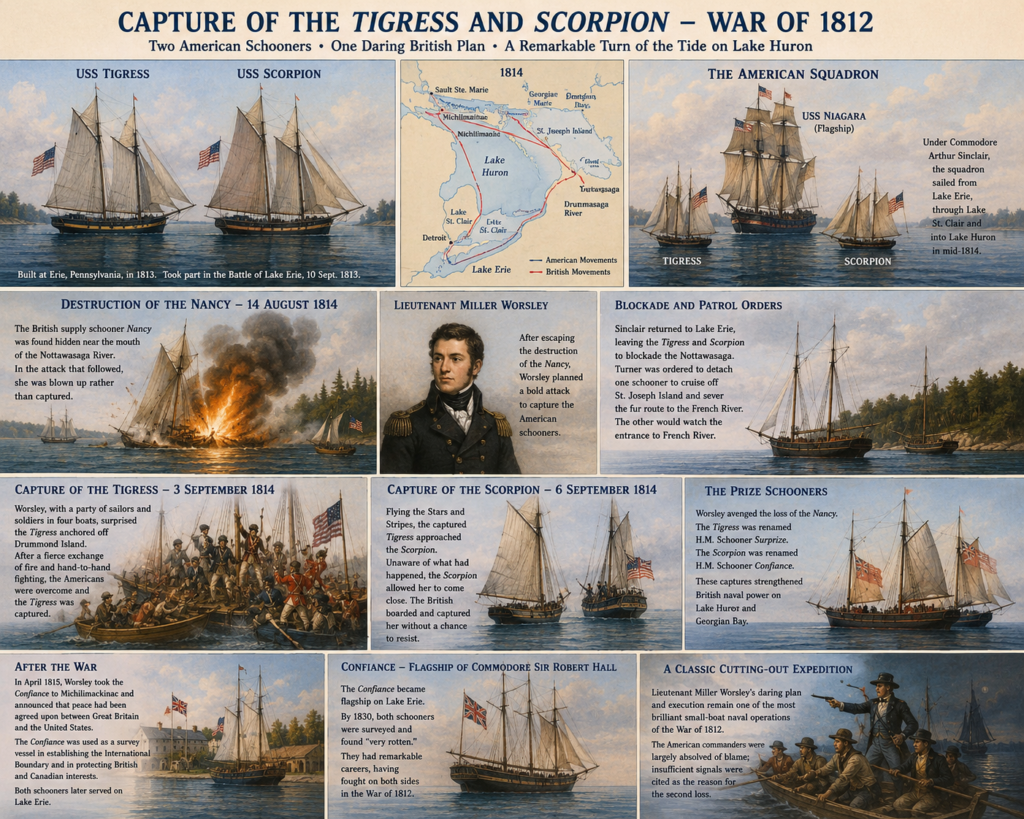
These two schooners of the United States Navy were constructed at Erie, Pennsylvania, in time for naval actions in the Battle of Lake Erie, 10 September 1813, in which they took part. They then formed part of the US naval squadron under Commodore Arthur Sinclair. In mid-1814 they passed upriver, past Detroit and through Lake St. Clair, and into Lake Huron, the first time the Stars and Stripes were flown in these northern waters. Here they had spectacular careers.
Sinclair’s flagship was the Niagara. Sinclair’s duty to find the British shipbuilding establishment at Matchedash, Georgian Bay. He abandoned the search on account of navigational difficulties. He then sailed north to Saint Marys River, where two boats from the Scorpion, under Lieutenant Daniel Turner, had made a devastating attack on the North West Company establishment at Sault Ste. Marie and destroyed a British vessel. On 4 and 5 August they were part of the American fleet that blockaded Michilimacinac. There a military force was landed, and the British repulsed it.
The next requirement of the American force was to find the British schooner Nancy, which had been running supplies, communications and military personnel to Michilimackinac, then in British hands. Sinclair in the Niagara, accompanied by the Tigress and Scorpion, found the Nancy secreted away near the mouth of the Nottawasaga River. In the attack that followed, 14 August 1814, the Nancy blew up, and her young commander, Lieutenant Miller Worsley, and the ship’s company, escaped inland. Regrouping, Worsley planned to use an armada of bateaux and canoes to capture the American schooners, and to use subterfuge and ingenuity to do so.
Sinclair, returning to Lake Erie, left the two American schooners to blockade the Nottawasaga and to prevent additional supplies reaching Michilimacinac. The senior officer, Turner, had discretionary orders to detach one of the schooners to cruise off St. Joseph Island and sever the Canadian fur route to the French River. The other schooner, meanwhile, would watch the entrance to French River. Turner acted accordingly.
With new vessels being built, they were to form the basis of the British naval establishment on Lake Huron and Georgian Bay in 1815. Worsley took the Scorpion to Michilimackinac in late April 1815, and told the British commandant there that peace terms had been agreed to by Great Britain and the United States. The war in the upper Great Lakes and in the interior towards Prairie du Chien had been concluded. The Confiance was used as a British survey vessel in establishing the International Boundary and was used in various duties protecting British and Canadian interests. Both schooners were sent to Lake Erie, where the Confiance became flagship of Commodore Sir Robert Hall. In 1830 they were surveyed and found “very rotten.” They had had remarkable careers, and had fought on both sides in the War of 1812. Worsley’s “cutting out expedition” forms a classic in naval warfare. The American commanders were largely absolved of blame for the loss of the vessels under their command, insufficient signals being specified as the reason for the second loss.
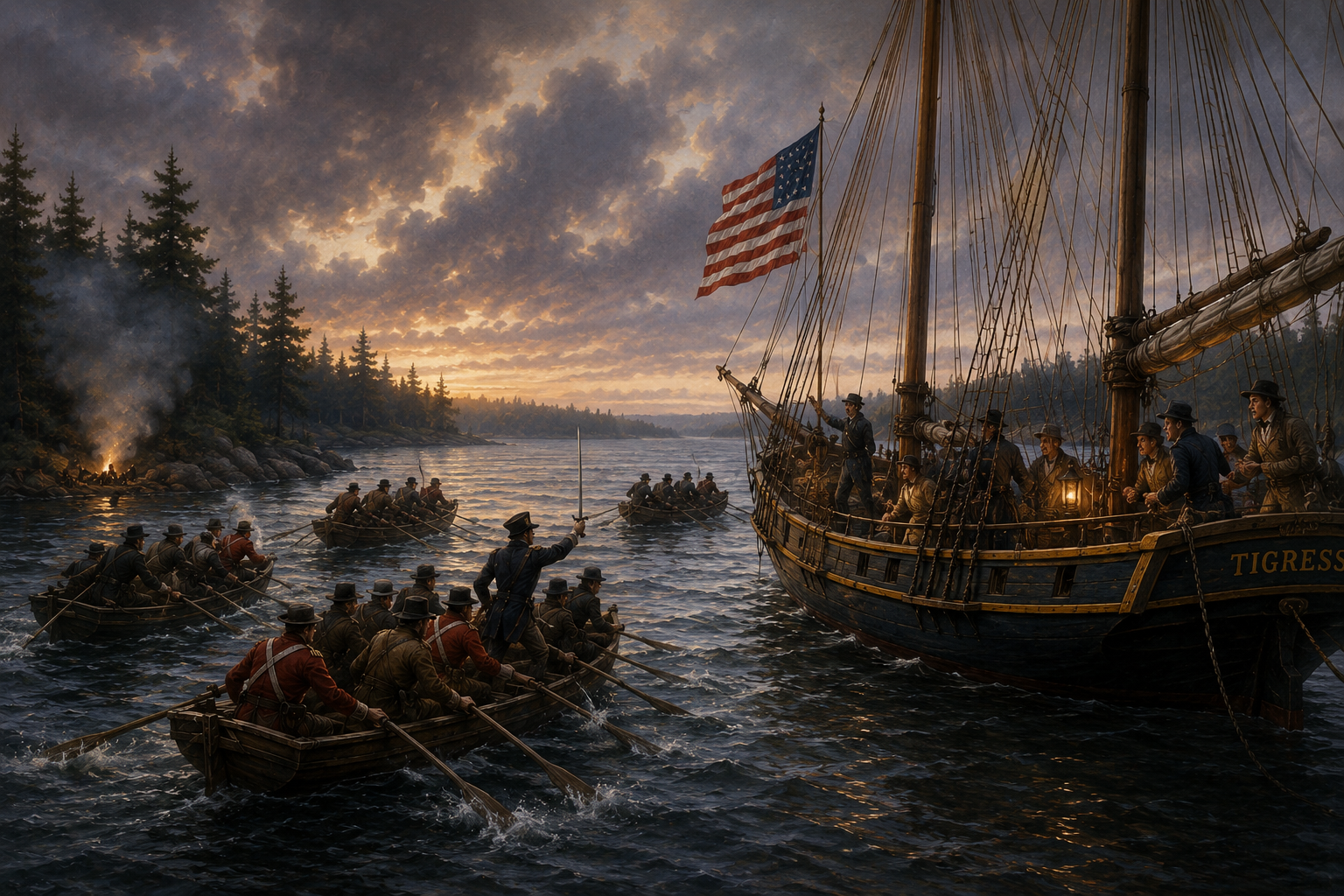
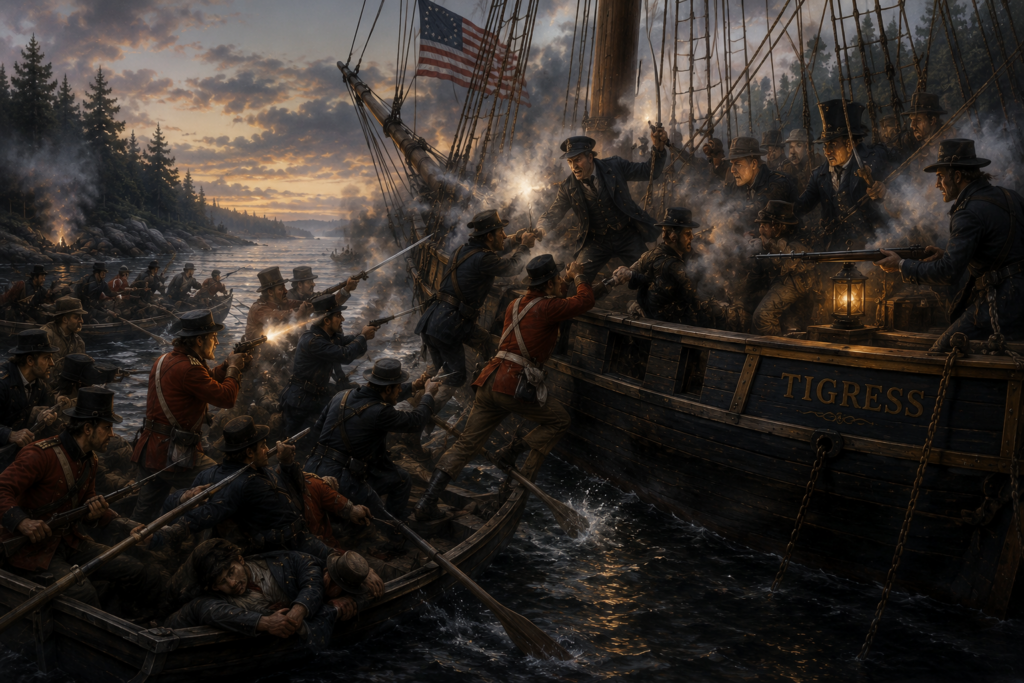
On 3 September, Worsley with a party of sailors and soldiers, all in four boats, spied the Tigress anchored alone off Drummond Island. He got help from the British garrison at Michilimacinac. After a severe action including an exchange of fire, and after sharp hand to hand fighting, they captured that vessel. Worsley continued to fly the Stars and Stripes, and then went in search of the Scorpion. On 6 September, the Tigress approached the Scorpion, the latter unaware of what had transpired. The Scorpion was captured. Worsley had avenged the loss of the Nancy. The captures made the British naval armament stronger at the end of the 1814 fighting season than at its beginning. Worley renamed the Tigress HM Schooner Surprize and the Scorpion HM Schooner Confiance.