

Captain James Cook: The Explorer Who Brought Britain’s Pacific Ambitions to the Shores of Canada
The remarkable voyages of Captain James Cook, his encounters with the Indigenous peoples of the Pacific Northwest, and his lasting influence on the history of British Columbia.
Canada History Society | Historical Feature
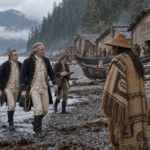
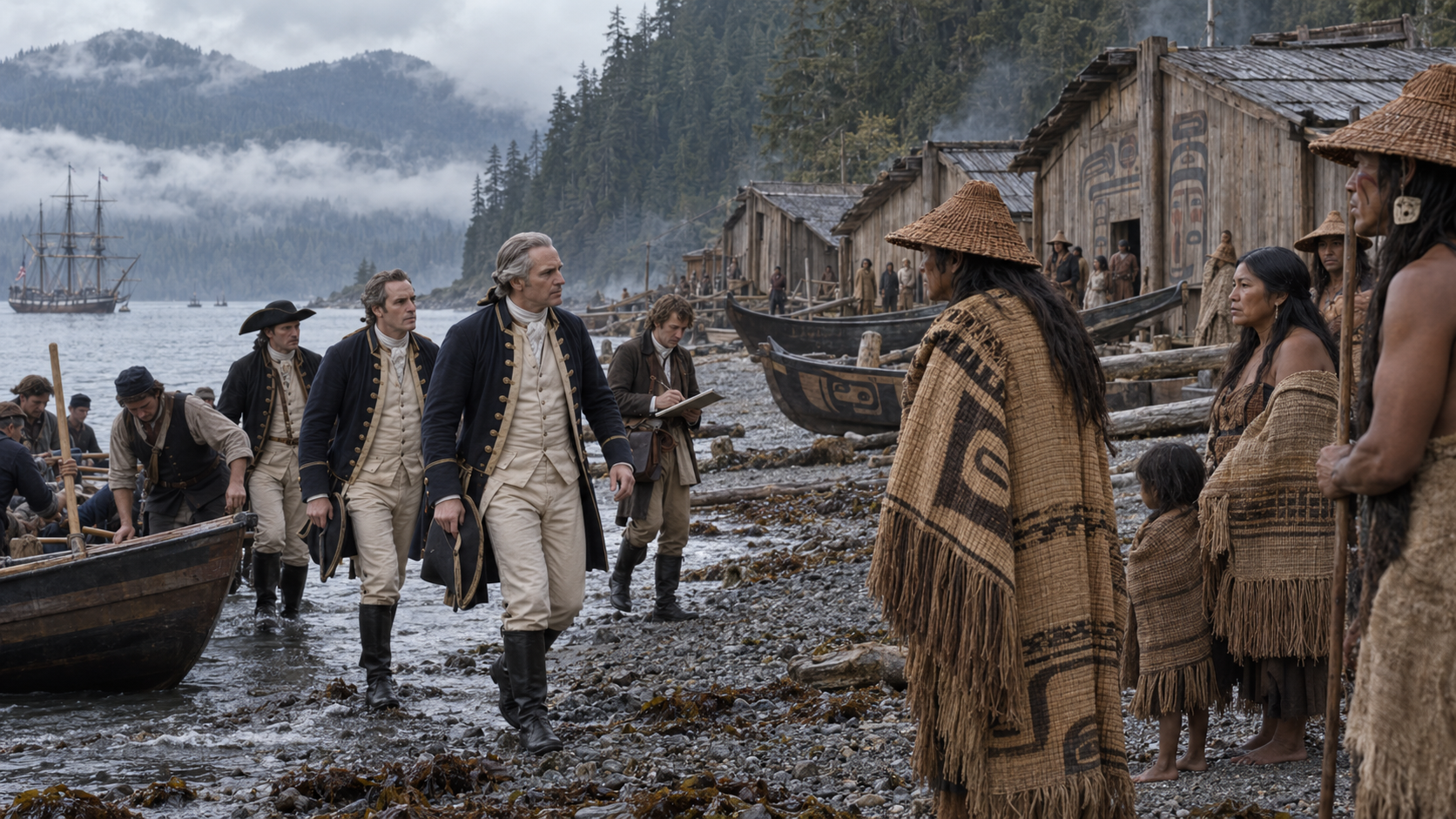
On 29 March 1778, two British Royal Navy vessels appeared off the rugged western coast of Vancouver Island. They were HMS Resolution and HMS Discovery, commanded by Captain James Cook, one of the most accomplished navigators and cartographers of the eighteenth century.
For months, Cook and his crew had crossed the vast Pacific Ocean in search of the western entrance to the legendary Northwest Passage, the elusive maritime route that Europeans hoped would connect the Atlantic and Pacific oceans across the northern reaches of North America.
Before them rose a spectacular and forbidding coastline of forested mountains, rocky headlands, deep inlets and immense stands of cedar and hemlock. Heavy seas and unpredictable winds had battered their vessels, and the expedition urgently required shelter, fresh water and repairs.
The ships entered the sheltered waters of Nootka Sound, where they would remain for nearly a month.
For Cook, this was another episode in an extraordinary career of exploration. For the Indigenous peoples who had occupied the region for thousands of years, it was an encounter with representatives of an expanding European maritime world.
Neither Cook nor the people he encountered could have fully anticipated the consequences of that meeting.
Within a generation, Nootka Sound would become a centre of international commerce and imperial rivalry, bringing Britain and Spain to the brink of war. The sea otter pelts obtained by Cook’s expedition would help reveal to European merchants the enormous commercial possibilities of the North Pacific.
The encounter became an important chapter in the history of British Columbia and the wider Pacific world.
From Yorkshire to the Royal Navy
James Cook was born on 7 November 1728 in Marton, Yorkshire, England, the son of a farm labourer. Unlike many naval officers of his generation, Cook did not begin life among Britain’s privileged classes. His advancement resulted largely from his abilities, persistence and mastery of mathematics, navigation and surveying.
As a young man, he entered the merchant marine, serving aboard vessels engaged in the North Sea coal trade. The demanding conditions of those voyages taught him practical seamanship, ship handling and the importance of accurate coastal navigation.
In 1755, Cook joined the Royal Navy, beginning the career that would eventually make him internationally famous.
His Canadian connection began during the Seven Years’ War.
Serving in British naval operations in North America, Cook developed exceptional skills as a hydrographic surveyor. His work contributed to the mapping of the St. Lawrence River during the British campaign against Quebec in 1759.
Accurate charts were essential to the British fleet, which faced dangerous shoals, shifting currents and unfamiliar waterways while transporting troops and supplies into the heart of New France.
Cook subsequently worked in Nova Scotia and Newfoundland. Between 1763 and 1767, he directed a systematic survey of extensive sections of Newfoundland’s coastline, producing charts that established new standards of accuracy.
These surveys combined careful observations of coastal landmarks, mathematical calculations, triangulation and repeated measurements of water depths.
For nearly a century, Cook’s Newfoundland charts remained essential navigational references.
His Canadian experience transformed him from an accomplished naval officer into one of Britain’s leading practical cartographers and helped secure his selection for voyages of exploration in the Pacific.
Three Great Voyages Across the Pacific
Cook’s international reputation rested upon three major expeditions.
His first voyage, from 1768 to 1771, took HMS Endeavour to Tahiti, where British astronomers observed the transit of Venus across the Sun. The expedition subsequently charted New Zealand and explored the eastern coast of Australia.
The voyage combined scientific investigation with the strategic interests of the British Empire. Cook’s observations greatly expanded European geographical knowledge, while his charts provided information that later navigators and imperial authorities would use.
His second expedition, from 1772 to 1775, carried him into the Southern Ocean. Commanding HMS Resolution, Cook crossed the Antarctic Circle and challenged longstanding European theories about the existence of a vast, inhabited southern continent.
He returned to Britain celebrated for his accomplishments in navigation, exploration and scientific observation.
Yet Cook’s greatest challenge remained ahead.
For centuries, European governments had searched for the Northwest Passage. Such a route promised enormous commercial advantages by reducing the distance between European ports and the markets of Asia.
By the 1770s, Britain hoped that the passage might be approached from the Pacific Ocean.
In July 1776, Cook departed on his third and final expedition. His orders required him to explore the northwestern coast of North America and search for a navigable passage through the continent.
The two ships, Resolution and Discovery, carried experienced officers, sailors, navigators and specialists, including the expedition artist John Webber.
Among those serving aboard Resolution was the young George Vancouver, who would later return to the Pacific Northwest and conduct one of the most important surveys in the geographical history of the region.
The Arrival at Nootka Sound, 1778
After visiting the Hawaiian Islands early in 1778, Cook sailed northeast towards the coast of North America.
His expedition reached the coast of present-day Oregon in March and proceeded northwards through difficult weather.
On 29 March, the vessels entered Nootka Sound on the western coast of what is now Vancouver Island. The following day, Cook moved his ships into a sheltered anchorage known as Ship Cove, later called Resolution Cove.
The surrounding landscape presented formidable challenges to European navigation. The coastline was broken by islands, narrow channels and concealed rocks. Thick forests covered the hillsides, while steep mountains rose beyond the sheltered waters.
Yet the region was neither unknown nor unoccupied.
Cook had entered the territories of the Nuu-chah-nulth peoples, whose communities possessed an intimate knowledge of the coast and its resources.
The Mowachaht people, whose traditional territory included Yuquot, had developed a sophisticated maritime society based upon fishing, whaling, trade and the harvesting of the region’s rich marine resources.
Their settlements were connected through established networks of exchange, diplomacy, kinship and political relationships.
Cook had not discovered an empty wilderness. He had arrived in a place with a long human history.
Spanish explorers had also reached the broader region before him, including the expedition of Juan Pérez in 1774. Cook’s significance lay not in being the first person to encounter the coast, but in the detailed European records, charts and accounts produced by his expedition and the commercial consequences that followed.
The Nuu-chah-nulth: Masters of the Pacific Coast
The society that Cook encountered was among the most accomplished maritime cultures of the Pacific Northwest.
For generations, the Nuu-chah-nulth peoples had developed technologies and social institutions adapted to the demanding conditions of the outer coast.
Their great cedar canoes were constructed with remarkable skill. Some were designed to travel considerable distances across exposed ocean waters, while others served specialized purposes, including fishing, transportation and whaling.
Massive cedar-plank houses provided shelter for extended families and important social gatherings. Carved wooden objects, woven materials, ceremonial traditions and inherited forms of artistic expression reflected a complex cultural world.
Hereditary leadership, political relationships, customary law and the stewardship of territorial resources were fundamental features of Nuu-chah-nulth society.
Whaling held particular importance. It required specialized equipment, experienced crews, detailed knowledge of animal behaviour and maritime conditions, and ceremonies associated with the preparation of whalers.
The sea also provided salmon, halibut, herring, shellfish and marine mammals. The surrounding forests supplied cedar, medicinal plants and materials necessary for daily life.
Yuquot, on Nootka Island, was a centre of political, economic and ceremonial activity. Archaeological evidence demonstrates thousands of years of Indigenous occupation.
Cook’s journals and the observations of his officers provide valuable descriptions of the communities they encountered, although those accounts must be understood as European interpretations of an unfamiliar society.
The people of Nootka Sound were not passive observers of Cook’s arrival. They approached the ships, assessed the strangers, negotiated exchanges and made their own decisions about the developing relationship.
The First Encounters
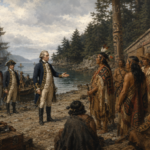
When Cook’s vessels entered Nootka Sound, local inhabitants approached in large cedar canoes.
The British observed skilled canoe handling, elaborate clothing and ornaments, and forms of communication that initially proved difficult for the visitors to understand.
The encounters included gestures, conversation, music and trade.
Members of the expedition recorded Indigenous singing, sometimes accompanied by rhythmic movements or the striking of canoe sides.
Cook’s men obtained fish, other provisions, animal skins and locally manufactured objects. In exchange, they offered iron goods, tools and other European materials.
Metal objects were especially useful in a society whose craftspeople already possessed sophisticated woodworking technologies.
These exchanges reflected more than simple commercial curiosity. Both sides were attempting to establish the intentions, capabilities and expectations of unfamiliar people.
The British depended upon local resources and Indigenous knowledge while repairing their ships. The Mowachaht, in turn, evaluated the potential value of European materials and the advantages and dangers of maintaining relations with the visitors.
The encounter was not without tension. Differences in language, concepts of ownership and customary behaviour created misunderstandings. The balance of power was complicated by the British possession of firearms and large ocean-going vessels, while Indigenous communities controlled access to their own territory, local knowledge and trading relationships.
On 22 April, Cook visited the village of Yuquot, where John Webber made drawings of its buildings and inhabitants.
Those images became some of the best-known early European visual records of Nuu-chah-nulth life.
John Webber and the Historical Record
One of the most important legacies of Cook’s expedition was its visual documentation.
John Webber, an artist trained in Europe, accompanied the third voyage to record landscapes, people, ceremonies, vessels and objects encountered along the route.
His drawings of Nootka Sound captured aspects of the built environment, clothing and daily activities of the Indigenous inhabitants.
Published engravings based upon his work circulated widely following the expedition’s return.
For European audiences, these images provided an introduction to societies that were little known in Britain.
Today, they remain valuable historical evidence, particularly when examined alongside archaeological findings, Indigenous oral histories and surviving cultural objects.
Yet Webber’s work also reflected the limitations of eighteenth-century European observation. The images were shaped by artistic conventions, and their publication involved decisions about what European readers were expected to see.
They should therefore be understood as important historical sources rather than complete or neutral representations of Nuu-chah-nulth society.
The same caution applies to Cook’s journals.
His descriptions were often meticulous, particularly in matters of geography, navigation and material objects. Nevertheless, his interpretations of Indigenous customs were influenced by European cultural assumptions and the difficulties of communication.
Modern historical scholarship increasingly considers these documents alongside Indigenous perspectives, restoring a fuller understanding of the people whose lands the expedition visited.
The Sea Otter Trade and the Transformation of the Coast
One of the most consequential results of Cook’s visit was associated with an animal whose fur would become extraordinarily valuable in international commerce: the sea otter.
During the expedition’s stay at Nootka Sound, members of Cook’s crew acquired sea otter pelts through trade with Indigenous inhabitants.
The sailors initially had little understanding of their potential commercial value.
Later, when the expedition reached Chinese trading markets, the extraordinary prices available for high-quality sea otter furs became apparent.
In China, these luxurious pelts were prized by wealthy consumers, creating opportunities for merchants willing to undertake the dangerous voyage across the Pacific.
News of the profits soon spread.
By the mid-1780s, commercial vessels were arriving on the Northwest Coast to trade metal goods and other merchandise for sea otter skins.
The maritime fur trade rapidly connected Indigenous communities, European merchants, American traders and Chinese markets in an expanding international economic network.
Nuu-chah-nulth leaders and traders were active participants in these exchanges, negotiating prices and using their knowledge of local resources to pursue commercial advantages.
The trade also brought profound changes.
Competition intensified, foreign ships arrived in increasing numbers, and disputes over commercial privileges and territorial authority became more frequent.
Over time, intensive hunting contributed to the depletion of sea otter populations, while expanding foreign involvement introduced new pressures upon Indigenous political and economic independence.
Cook had not set out to establish a fur-trading empire, but his expedition helped reveal the commercial possibilities that drew successive generations of foreign traders to the coast.
The Search for the Northwest Passage
On 26 April 1778, after nearly a month in Nootka Sound, Cook’s ships departed and resumed their northern voyage.
He continued along the coast towards present-day Alaska, recording geographical features and investigating possible openings that might lead through the continent.
The expedition examined parts of the Gulf of Alaska, Cook Inlet and the approaches to the Bering Strait.
Cook’s charts and observations contributed significantly to European knowledge of the North Pacific.
Yet the expedition’s principal objective remained elusive.
As the ships advanced northwards, increasingly severe ice conditions prevented further progress. The hoped-for maritime passage between the Pacific and Atlantic could not be found.
Cook was forced to turn south, intending to renew his search when conditions improved.
His ships returned to the Hawaiian Islands, where the expedition’s final chapter would unfold.
The Death of Captain Cook
On 14 February 1779, Captain James Cook was killed at Kealakekua Bay on the island of Hawaiʻi.
His death followed a deterioration in relations between the British expedition and the local Hawaiian population.
After a boat belonging to Discovery was taken, Cook attempted to secure its return by detaining the Hawaiian ruler Kalaniʻōpuʻu.
The attempt produced an increasingly dangerous confrontation on shore.
As Hawaiians gathered to prevent their ruler from being taken away, violence erupted. Cook and four British marines were killed, along with a number of Hawaiians.
The circumstances of his death have been examined extensively by historians, who emphasize the misunderstandings, cultural differences and coercive actions that contributed to the confrontation.
Cook’s death shocked the British public when news eventually reached Britain.
The expedition continued under other officers and returned home in 1780.
Cook was only fifty years old.
His three great Pacific voyages had transformed European geographical understanding of immense regions of the world. Yet his career also illustrated the dangers and contradictions of exploration during an age of expanding imperial ambition.
From Nootka Sound to Imperial Rivalry
The consequences of Cook’s 1778 visit continued long after his death.
During the 1780s, increasing numbers of British and other European traders entered the waters around Vancouver Island, attracted by the profitability of sea otter furs.
Spain, which had long asserted imperial claims along much of the Pacific coast of North America, viewed the expansion of foreign commerce as a challenge to its interests.
In 1789, Spanish authorities established a military presence at Nootka Sound and seized British merchant vessels.
The resulting confrontation, known as the Nootka Crisis, brought Britain and Spain close to war.
Diplomatic negotiations produced the first Nootka Convention in 1790, followed by additional agreements intended to resolve disputes over navigation, trade and settlement.
In 1792, Captain George Vancouver returned to the region aboard HMS Discovery. He met the Spanish representative Juan Francisco de la Bodega y Quadra at Nootka Sound to discuss the implementation of the agreements.
Vancouver, who had served as a young officer on Cook’s final voyage, was now conducting his own detailed exploration of the Pacific Northwest.
His expedition charted much of the intricate coastline of present-day British Columbia and helped establish an increasingly accurate European understanding of the region’s geography.
The diplomatic struggle between Britain and Spain reflected a larger competition for commercial and strategic influence across the Pacific.
Yet European negotiations about territorial claims generally failed to recognize the existing political authority of the Indigenous peoples whose lands and waters were being contested.
For the Mowachaht and neighbouring communities, these developments brought growing opportunities for trade alongside increasing pressure from foreign powers.
Captain Cook and the Making of British Columbia
Cook’s influence upon the history of British Columbia was indirect but considerable.
His visit preceded the establishment of permanent British colonial government in the region by many decades.
Nevertheless, the geographical knowledge produced by his expedition, the commercial interest generated by the sea otter trade, and the subsequent arrival of European and American vessels helped transform the political and economic environment of the Northwest Coast.
The decades following his voyage witnessed further exploration, the expansion of the fur trade, the development of commercial settlements and increasing British imperial involvement.
The Hudson’s Bay Company eventually emerged as a major institution in the region, establishing Fort Victoria in 1843.
The Crown Colony of Vancouver Island followed in 1849, while the mainland Colony of British Columbia was created in 1858.
In 1871, British Columbia entered Canadian Confederation.
These developments cannot be attributed to Cook alone. They resulted from a long and complex interaction of Indigenous societies, commercial enterprise, imperial competition, migration and political decisions.
Yet his 1778 visit remains an important early episode in the history of those transformations.
The Legacy of James Cook
More than two centuries after his death, Captain James Cook remains a significant and sometimes contested figure in world history.
His achievements in navigation, cartography and scientific observation were exceptional. His work provided information that transformed maritime travel and contributed to the development of modern geographical knowledge.
His Newfoundland surveys demonstrated the extraordinary accuracy that could be achieved through disciplined hydrographic methods, while his Pacific voyages expanded European understanding of the world’s oceans and coastlines.
But Cook also operated within the structures of British imperial expansion.
His expeditions helped make distant territories and their resources more accessible to European commercial and political interests. The historical consequences included new trading relationships, imperial rivalries and, over time, the displacement and marginalization of Indigenous peoples.
Modern assessments of Cook therefore increasingly place his accomplishments within the larger history of colonialism and Indigenous resistance.
In British Columbia, this requires recognition that the region’s history did not begin with the arrival of European ships.
The Mowachaht-Muchalaht and other Nuu-chah-nulth peoples possessed their own political institutions, economies, traditions and territorial relationships long before 1778. Their descendants continue to maintain those histories and cultural connections today.
Yuquot, the ancestral home of the Mowachaht people, is recognized as a National Historic Site of Canada.
It remains a place of extraordinary historical significance, representing both the enduring presence of Indigenous civilization and the profound changes associated with European contact.
Conclusion: A Meeting That Changed the Pacific Northwest
When Captain James Cook sailed into Nootka Sound in March 1778, he was searching for a passage between two oceans.
He found no such passage.
Instead, his expedition encountered a well-established Indigenous maritime society, recorded valuable geographical information and participated in exchanges that would help draw the Pacific Northwest into an expanding international commercial system.
The events that followed transformed the region.
The sea otter trade attracted foreign merchants. Britain and Spain competed for influence. George Vancouver returned to chart the coastline, and subsequent generations of traders, settlers and government officials participated in the establishment of British colonial institutions.
Cook did not create these developments, nor did he discover an uninhabited land. But his visit formed part of a turning point in the history of the Pacific Northwest.
His legacy in Canada extends from the St. Lawrence River and the rugged shores of Newfoundland to the remote harbours of Vancouver Island.
It is a history of remarkable navigational achievement, scientific curiosity, cultural encounters, international commerce and imperial ambition.
Above all, it is the story of how an eighteenth-century voyage brought two maritime worlds into sustained contact and helped set in motion changes that would shape the future of Canada’s Pacific coast.
Selected Bibliography
Chicago Style
Beaglehole, J. C., ed. The Journals of Captain James Cook on His Voyages of Discovery. Vol. 3, The Voyage of the Resolution and Discovery, 1776–1780. 2 parts. Cambridge: Cambridge University Press for the Hakluyt Society, 1967.
Cook, James, and James King. A Voyage to the Pacific Ocean. 3 vols. London: W. and A. Strahan, 1784.
Currie, Noel Elizabeth. Constructing Colonial Discourse: Captain Cook at Nootka Sound. Montreal and Kingston: McGill-Queen’s University Press, 2005.
Parks Canada. “Captain James Cook National Historic Person.” Directory of Federal Heritage Designations. Government of Canada. https://www.pc.gc.ca/apps/dfhd/page_nhs_eng.aspx?i=90108&id=1037.
Parks Canada. “Yuquot National Historic Site of Canada.” Directory of Federal Heritage Designations. Government of Canada. https://www.pc.gc.ca/apps/dfhd/page_nhs_eng.aspx?id=54.
Royal Museums Greenwich. “The Inside of a House in Nootka Sound.” National Maritime Museum Collections. https://www.rmg.co.uk/collections/objects/rmgc-object-154106.
Williams, Glyndwr. “Cook, James.” Dictionary of Canadian Biography. Vol. 4. Toronto: University of Toronto Press, 1979. https://www.biographi.ca/en/bio/cook_james_4E.html.
Published by the Canada History Society
Exploring the people, events and decisions that shaped Canada’s past.