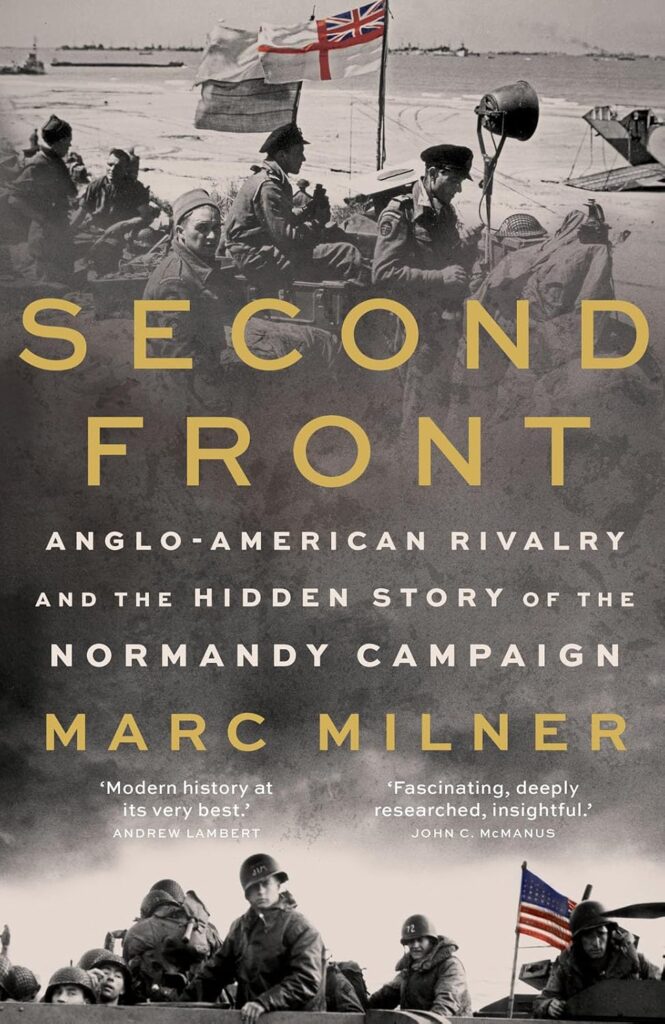





Marc Milner, Second Front: Anglo-American Rivalry and the Hidden Story of the Normandy Campaign. Yale University Press, 2025. 800 pages.
Marc Milner’s Second Front is a magnificent, provocative and deeply important reassessment of the Allied victory in Normandy. Sweeping in its interpretation, formidable in its research and unapologetically Canadian in perspective, it challenges one of the most enduring popular narratives of the Second World War: that the liberation of Western Europe was chiefly an American achievement, supported by increasingly exhausted and militarily ineffective British and Canadian allies.
Milner demonstrates that the truth was considerably more complicated—and far more interesting.
The familiar story of Normandy has been shaped by American films, memoirs, journalism and postwar histories. In this version, the United States provided the energy, leadership and decisive military power, while the British and Canadians became bogged down around Caen under an overly cautious Field Marshal Bernard Montgomery. American forces then broke through in Operation Cobra, swept across France and carried the war toward Germany.
Milner does not diminish the immense American contribution or dispute that the United States would eventually become the dominant power within the Western alliance. Instead, he asks how that dominance influenced the way the war was reported, remembered and ultimately written. His answer is both persuasive and unsettling: the struggle for Normandy was accompanied by another contest—an Anglo-American rivalry over strategy, prestige, political influence and leadership of the postwar world.
The great strength of Second Front is the breadth of Milner’s argument. This is not simply another account of D-Day. The author traces the origins of Anglo-American rivalry back through the First World War and the uneasy interwar decades, when the British Empire remained a global power but the United States possessed the economic strength to replace it. By 1944, Britain and America were indispensable military partners, but they were not selfless companions. They had different national interests, strategic priorities and visions of the world that would follow the defeat of Nazi Germany.
Milner takes his readers behind the reassuring language of Allied unity. He examines the disagreements between political leaders, military commanders, planners and journalists, showing that the alliance was not a harmonious brotherhood but a difficult coalition held together by necessity, diplomacy and the overwhelming need to defeat Hitler. That the alliance survived these tensions becomes, in Milner’s telling, more impressive—not less.
For Canadians, however, the book’s greatest achievement is its restoration of Canada to the centre of the Normandy story.
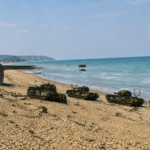
Canada was not a minor auxiliary to Britain or an incidental participant in an American-led crusade. Canadian soldiers landed at Juno Beach on 6 June 1944, fought their way farther inland than most of the Allied assault formations and then confronted some of Germany’s strongest armoured forces. Together with the British, the Canadians held the eastern end of the Allied bridgehead, where the Germans concentrated much of their most dangerous armour.
The fighting around Caen, Carpiquet, Verrières Ridge and the approaches to Falaise was gruelling, costly and strategically vital. The Anglo-Canadian armies did not merely become “bogged down.” They fixed powerful German formations in place and created the conditions under which the Americans could launch their great breakout in the west. The American achievement was real and decisive, but it was made possible in part by the sacrifices of British and Canadian soldiers elsewhere on the battlefield.
Milner is especially effective in explaining how battlefield reality was transformed into historical mythology. Operational setbacks, command disputes and the natural frustrations of coalition warfare were magnified by correspondents seeking dramatic stories and by commanders protecting their reputations. These contemporary accounts became the first draft of history. After the war, America’s enormous cultural influence carried its interpretation into books, television programmes and films watched throughout the world—including in Canada.
The result was not simply that Canada’s contribution was forgotten abroad. Too many Canadians also inherited a version of the war in which their own country appeared on the margins.
Second Front provides a necessary corrective. It does not substitute Canadian mythology for American mythology. Milner acknowledges Canadian mistakes, failures and heavy losses. He does not pretend that every operation succeeded or that every Canadian commander performed brilliantly. What he insists upon is context. Canadian formations were learning the terrible business of modern warfare while facing experienced German troops, including heavily armed Waffen-SS panzer divisions, in exceptionally difficult terrain. Their failures cannot be understood apart from the strength of the enemy they confronted, just as their accomplishments cannot be measured solely by the number of kilometres shown on a map.
This balance gives Milner’s defence of the Canadian record its authority. He is neither sentimental nor blindly nationalistic. He is an accomplished military historian following the evidence, testing inherited assumptions and asking why certain interpretations achieved dominance while others disappeared.
At approximately 800 pages, Second Front is an ambitious undertaking, but its length reflects the scale of its argument. Milner is reconstructing not only a military campaign but also the political, strategic and cultural forces that shaped its memory. The book combines high-level diplomacy with operational analysis and historiographical investigation. It asks readers to understand the fighting in Normandy as part of a much larger transfer of global power from Britain to the United States.
Canadians should read Second Front because it explains something fundamental about their country’s place in the Second World War. Canada entered the conflict as a dominion still closely connected to Britain and emerged as an increasingly independent middle power. Its navy helped secure the North Atlantic, its air force fought in nearly every major theatre, its industries supplied the Allied war effort and its army played a critical role in the liberation of Western Europe. Yet much of this achievement has been obscured beneath histories written from the perspectives of larger powers.
Milner gives Canadians the evidence needed to recover that story without exaggerating it. He reminds us that national memory should not be built upon empty boasts, but neither should Canadians passively accept narratives that diminish their country’s accomplishments.
Above all, Second Front is a book about historical perspective. It demonstrates that even a victory as extensively studied as Normandy can be misunderstood when the sources, assumptions and national interests behind the accepted account are left unexamined. Milner does more than retell the campaign; he explains how our understanding of it was created.
That makes Second Front one of the most important works of Canadian military history published in recent years. It is bold, authoritative and certain to provoke debate. For historians, it offers a major reinterpretation of coalition warfare and the Normandy campaign. For general readers, it provides a compelling account of the rivalries concealed beneath the surface of Allied unity. For Canadians, it restores a vital part of their national inheritance.
Marc Milner has written a book that deserves to be read, discussed and debated across Canada. Second Front does not merely place Canadian soldiers back on the Normandy battlefield. It restores them to the history of the victory they helped make possible. Yale University Press
To purchase – click below