


Benedict Arnold’s Arduous Expedition to Quebec 1775: Visions and Realities
By Barry Gough
The battles of Lexington and Concord brought a military confrontation to a rapidly growing division between Americans and British. After the engagement at Bunker Hill on 17 June 1775 the dogs of war were let loose. General George Washington, the young commander-in-chief, determined on a secret invasion of Quebec upstream via the Kennebec River. This arduous stream drains from the highlands to the Atlantic. Beyond, via the portage of Dead River, lie the headwaters of the Chaudière River at Lac Megantic. This waterway would then lead an invading party to the St. Lawrence’s shores almost opposite the very ramparts of Quebec.
This then was no easy approach, one which would cost the Patriots dear in their attempt to conquer – in their terms, “liberate” – the fourteenth colony and make it one of the emerging United States. Washington planned to send this, the right wing of the invading army, in order that it would coincide with a leftwing assault by way of the easier, and accordingly, more frequently tried invasion approach via Lake Champlain. That force would be commanded by General Philip Schuyler and later by Brigadier General Richard Montgomery. That route has been termed Canada’s Khyber Pass. This two-pronged thrust would join up at Quebec – and complete the mission.
The Harvard historian Francis Parkman encouraged other denizens of Clio, the muse of History, to leave their cozy libraries and get out and see the ground, to sense the space, to evaluate the hazards – in short, to know the geography that lay behind the peoples and the histories that were being recounted in books and other texts. Several summers in Maine allowed the writer to put Parkman’s edict into action, and my sad-to-relate impression of the backwoods of that state and its streams, roads and laneways that lead north to the Province of Quebec became one of depression and despair. Fewer arteries of invasion could have offered such difficult prospects, while the object in view, Quebec, was a fortified anchor of the British Empire in North America. But, as we know, in seething revolutionary days passions invariably burn bright and expectations exceed probabilities. I discovered that the Patriot force that began on this reckless adventure had the environment and the season firmly stacked against the possibility of success. What were they thinking? They were in expectation at their destination of a rising in support. They were to be cruelly disappointed.
+++
The Quebec Act (1774), though not part of the British coercive program, was regarded by some in the Thirteen Colonies as one of London “Intolerable” measures. The act provided a permanent civil government under a central administration. Legislative authority was vested in a crown council. French civil law was affirmed. Catholics were granted religious toleration and civil rights, and the Church’s privileges confirmed. Certain American colonists looked askance at these provisions, for these provisions were so opposite to their own. New England seethed in anger on this matter. Another source of friction was that the Quebec Act extended the boundary of that jurisdiction west and south to the Ohio River and the Mississippi, an area in which Virginia, Connecticut and Massachusetts had claims. Sir Guy Carleton (Lord Dorchester) was chief architect of the Act, and it was adopted, though not without discussion and dissent, by the British Ministry in London. It is the central document of the future Government of Canada, a federation dating from 1867. The Continental Congress denounced the Coercive Acts in its declaration and resolves of 14 October 1774 as unjust, cruel and unconstitutional and criticized various British revenue measures. In addition, the Congress set forth for colonists the prospects of “life, liberty and property.” Economic sanctions against Britain were pledged until Imperial measures were repealed. In London the ministry of Lord North advanced a conciliation plan, while in the colonies, particularly Massachusetts, British military authority under General Thomas Gage struck against an energetically raised militia.
On 26 May 1774 Congress adopted an address to the people of Canada asking them as “fellow-sufferers” to join with them. Noteworthy is the following: “We do not ask you, by this address, to commence hostilities against the government of our common sovereign. We only invite you to consult your own glory and welfare, and not to suffer yourselves to be inveigled or intimidated by infamous ministers so far as to become the instruments of their cruelty and despotism, but to unite with us in one social compact, formed on the generous principles of equal liberty, and cemented by such an exchange of beneficial and endearing offices as to render it perpetual.” The delegates were invited to the continental congress to be held at Philadelphia, 10 May 1775. Quebec sent no delegates. For a number of reasons, on 26 May, Congress resolved to put the colonies in a state of defence.
In the Province of Quebec many of the British subjects were sympathetic to the American cause. They were quite mixed as to their political views, caught up as they were in rebellious chatter and business matters. Some rallied to the flag, others looked for new opportunities with the invaders. As for the Canadians, they too held few ardent sympathies one way or another. To some of them war might be good for business, and so the storms of war would blow overhead while their rights and occupations in agriculture, commerce and church life could continue largely uninterrupted. War caught them unawares.
. +++
In command of the Kennebec-to-Quebec expedition was 34-year-old Colonel Benedict Arnold, a short, stout, florid-of-complexion individual who initially inspired respect because of his energy more than his organizational abilities. He had previously been to Quebec on business, so knew the locale and had an observer’s appreciation of its fortifications and citizenry. A Connecticut Yankee and veteran of the Seven Years’ War, he had earlier won Patriot acclaim by his success at Fort Ticonderoga on the western frontier. He improvised a fleet that controlled that route to Canada. Perhaps Washington knew that in Arnold’s strength of character, bravery and determination could be found the leadership necessary to conquer the overland, backdoor route to Quebec. If on account of audacity alone, Arnold had proven to be a skillful guerilla fighter and innovator. Perhaps the noble objective of Quebec, if it fell to forces under his command, would bring him further power, glory and, not least, advancement as a professional soldier. Here lay a task for a man of ambition: the spoils and dividends might well outweigh the costs and hazards.
The force of 1,200 men – Virginia, Pennsylvania and New England, volunteers all – were first assembled at Cambridge, Massachusetts in early September 1775. They were a rough, fearless group of men, hateful of strict military discipline but firmly believing that in God and in Liberty they possessed a dual mission sufficient to overcome any second thoughts they may have possessed of a retreat to their comfortable hearths. Arnold had been a potent force in their recruitment.
The expedition left Cambridge on 12 September by coastwise shipping , and having disembarked began the ascent of the Kennebec. At Fort Western, now Augusta (now the State Capital), they established their base. It was from here that the following series of disasters commenced. On 23 September Arnold and his men, now divided into four divisions, began the ascent of the Kennebec in flat-bottomed bateaux. This river, as I observed, is no broad, meandering stream, but one whose momentum is not swift to the eye at least but is steady and unrelenting. It lacks a flood plain. Trees and rocks approach right to water’s edge leaving few places for an easy portage or a place of rest. In such conditions as these, means of water transport would have to be of the sturdiest quality and the men of the sternest stuff; as it was, however, the bateaux had been built of green timber and constructed quickly and often by unskilled hands. Arnold was displeased with the vessels not only for their poor quality but because of their small size. Each bateau was poled upstream by a sweating crew, assisted by lines from soldiers tugging from the difficult and irregular banks. Scouts made their way in advance, sending back reports for the bateaux crews. The labours continued while the weather kept fair. One soldier murdered another and was sent home but otherwise the first leg was uneventful.
At Norridgewock, where waterfalls forced a portage, Arnold had a good look at his men and equipment. Here, where the vast mountain wilderness commenced, he saw that the bateaux were in poor condition only ten days into the journey. Moreover, codfish casks and bread dough casks had broached. Peas had to be condemned as bad and so too beef and other supplies. Though carpenters could make some repairs to the bateaux the losses in foodstuffs and provisions could not be made up, and this fearful indication of coming hardship must have made Arnold more impatient still.
Never tolerant of delay, Arnold pressed forward to the Great Carrying Place, a vast swampy ground that led to the appropriately named Dead River. A diet of salt pork and the yellow, stagnant water, drunk in large quantities by the hard-working men, was a potent combination leading to diarrhea in some cases and vomiting in others. A log cabin called “Arnold’s Hospital” was built for the security of the sick who had to be left behind.
At this juncture Arnold took time to write letters to General Washington. He told his commander-in-chief that the greatest difficulty had passed and that his expectation was that he would reach the Chaudière River in eight or ten days. That river would bring him more easily to the St. Lawrence and the objective. He also wrote to his immediate military superior, General Philip Schuyler, asking for intelligence and advice. And, not least, he wrote to John Dyer Mercier, a rebel collaborator within Quebec’s very walls, to the effect that he would soon arrive with 2000 men (an exaggeration), a force he said “designed to cooperate with General Schuyler to frustrate the unjust and arbitrary measures [sic] of the [British] Ministry and restore Liberty to our brethren of Canada, to whom we made no doubt that our exertions in their favour will be acceptable.” He asked collaborator Mercier to send news about what he might be expected to find on arrival at the destination – what the disposition of merchants and Canadians were, how many ships and troops were there, and so forth. This missive, sent by Indigenous courier, was never delivered to its intended receiver; instead, it ended up in British hands, an advance warning that Arnold’s surprise attack could be thwarted.
Now the vast, rugged mountain wilderness began to take its toll. From Dead River to the Height of Land, the men everywhere faced the trials of a landscape made hazardous by inclement conditions. High winds, freezing temperatures and incessant rains made the passage difficult and rest nearly impossible. Early on 22 October Arnold’s camp was swamped by a wall of water from the river that had risen eight feet in nine hours. Before the men could retreat from this liquid advance, their possessions got soaked. The refuge offered by a nearby hill gave them the sad view of a flooded river valley where the main channel was difficult to discern.
In these circumstances morale quickly fell, and on 25 October at a council of war Lieutenant Colonel Roger Enos of Connecticut’s 22nd Regiment, the second in command, argued for withdrawal. Dr Isaac Senter, physician and surgeon to the troops, recorded in his journal of the “melancholy aspects” that were then expressed, and there was widespread talk of the impenetrability of the forest. Others, led by the persuasive Arnold, argued for continuing in spite of the shortage of provisions and the imminence of snow. In the end, the decision was made that the fit would proceed and the unfit return. But even then, Arnold was faced with a mutiny he could not crush. Enos’ men of the rear guard would not advance to a man, whether able or not. They complained of doing more than their share of the hard labour and they feared for their lives in the deep snow known to lie ahead. Arnold was obliged to let them return, taking Enos with them. On reaching home, Enos was called a traitor and coward and was court martialed for “quitting without leave”; however, he defended himself on grounds of early winter weather, lack of boats for transporting men and supplies by river to Quebec, and shortage of food that had brought his men to a state of starvation. He was acquitted. He returned to service in Connecticut’s 16th Regiment. Later a Major General of the Vermont Militia, he died in 1808. All the same, the dark cloud of being a deserter did not disperse.
Picking their way through cedar choked swamps, small lakes, woods and rocks up to the Height of Land, Arnold’s little army now numbered 800. Along the perilous passage batteaux upset and men drowned; hunger, exhaustion and faint hearts all took their toll. Captain Dearborn’s dog had to be shot for food while moosehide moccasins next became the the bill of fare. “For forty days I waded,” one exhausted soldier later recalled, “in freezing weather… an allowance of half a pint of flour a man for a fortnight and a half of that time no meat; climbing hills; passing through morasses, cedar swamps… wading creeks and river.” Still, however, patriot fervour burned bright.
They reached safety at Fort Francois on the Chaudière, having passed the very spot of Woburn, Quebec (on the International Boundary), where the north flowing Riviere Arnold is crossed by the motorist nowadays when entering the Laurentian Valley. Here, today, the writer found the Hotel and Motel Arnold offering hospitality to wayfarers. Another, an auberge, carries the name of Benedict Arnold. Its heritage designation proclqimw the patrimony of the Province of Quebec. Ironically, Arnold and his men found refuge in the farmhouses and outbuildings of people he had come to liberate if possible or conquer if necessary. The kindly Canadians treated Arnold’s advance party with courtesy and care. Supplies and provisions rendered for gold were sent back to the struggling rearguard while plans were made to shelter, clothe and feed them before sending them down river to Ste. Marie where, in the event, habitants feasted them in the seigneury of Taschereau, the latter having gone to Quebec to defend the fortress town.
November 8th found the force on the banks of the River St. Lawrence. The exhausting forty-five-day march now lay behind them. The next object was to blockade the British defenders. At Pointe de Levis on the south shore, near where Wolfe’s conquering army had camped in 1759, Arnold’s force took possession of a farm and mill. The British knew of their approach and had removed all boats from the south shore and kept an hourly patrol of the river. But canoes could be had from the Indians, and on 14 November Arnold crossed the river under cover of snow and darkness. He seized Colonel Henry Caldwell’s house in the Quebec suburb of Sainte-Foy and instructed all his subordinates who crossed the river by the slender means at their disposal to occupy nearby farm buildings. He prepared for the main event.
+++
Arnold tried to get his demand for surrender to the fort but his messengers found musket fire their only welcome. He came to realize that Quebec’s garrison was strong in numbers, equipment and munitions. It is said that Arnold eventually got to Wolfe’s Cove, climbed to the Plains of Abraham, then called loudly on the defenders to surrender. No, was the answer. Arnold reconsidered his options, and they were ones of difficulty (as Wolfe had said in choosing his possible attacks, he himself had faced an option of difficulties.) Fearing that Colonel Allan Maclean and his Royal Highlands Emigrants regiment might come out of the fort and attack, Arnold decided to withdraw to the security of General Montgomery’s approaching army from Montreal. Matters reached a crisis. Just as Arnold was marching along the north shore, a whale boat bearing Sir Guy Carleton completed the governor’s passage from Montreal. There is a widely known story that a river captain, Baptiste Bouchette, known as “the Wild Pigeon,” on the dark night of 16 November slipped the governor and a few trusted officers, all disguised as habitants, past the American sentries in an open whale-boat. The fleet of vessels accompanying Carleton was not so fortunate and was captured by the Americans, surrendering all its cargo. Carleton had been informed of the astonishing arrival of Arnold at Quebec with a tattered force. Both veterans of the British army’s campaign in America during the Seven Years’ War, they were now commanders in the field of opposing forces seeking stronger positions from which to fight the battle for Canada.
Under Carleton’s directing spirit and the military planning of Maclean, Quebec prepared for its fourth siege of its history. The garrison boasted 1,248 and rations which if frugally distributed could last until mid-May, when it was then predicted relief would arrive courtesy of the Royal Navy. By proclamation Carleton ordered “all useless, disloyal and treacherous persons” to quit the town and district or be treated as spies or rebels. Now the garrison could defend, as one put it, “against open and avowed enemies” and not against “those lurking about town.” All who remained “seemed zealous for the public service.” Carleton grouped his forces into four brigades (regulars, British militia, Canadian militia, and seamen). He developed his strategy of letting the invaders come to them, meanwhile bolstering the defences preparatory to the expected assault. The gates remained barred to messengers bringing requests for a British surrender; and the Americans had to content themselves by firing into the fortress arrows to which were attached letters demanding surrender and offering liberty. These missives told of friendly American intentions and painted graphic pictures of of how Quebec would lie in ruins and flames unless the inhabitants overthrew their tyrannical governor. They also boasted of a large army which could easily take what Arnold called “a wretched motley garrison.” In fact, the American force was now about 1000 effectives but it lacked the heavy guns to reduce the battlements and gates. Montgomery occupied Montreal on 13 November, advanced to Trois Rivieres and was at Sainte-Foy on 19 November.
For months in the autumn of 1775 the future of the colony on the St. Lawrence was in serious doubt, its separate identity seriously threatened.
In mere numbers the two rival armies were a near match: Arnold’s force was now under Montgomery, and together it stood at two thousand men; Carleton’s could count 1,800 effective combatants. Various militia groups and volunteers bolstered the defenders. Carleton had a shadow force of only seventy regular volunteers. “I find everything has been done in my absence for the Defence of this Place, the unfortunate Situation of Things would permit,” so he reported. “Could the people in the Town, and seamen, be depended upon, I should flatter myself, we might hold out, till the Navigation opens next Spring, at least till a few Troops might come up the River, for I fear the Delays commonly attending a large armament; but though’ the severe weather is far advanced, we have so many Enemies within a foolish People, Dupes to those Traitors, with the natural Fears of Men unused to war, I think our Fate extremely doubtful to say nothing worse.” But as the strategist Clausewitz proclaimed, in urban and warfare often the advantage lies with the defenders. Stalingrad is an example of that, but here in Canada, at the river narrows with the defenders up on the hill in the Lower Town and further up in the Upper Town the American assault was expected – as indeed it did – to come from three sides. Arnold’s force readied itself near the Charles River. The Americans erected batteries at Sorel, which seemed to command the St. Lawrence.
In the siege and blockade that followed through the winter, the Americans first had to be content to fire their small cannon from several different directions. It is said that the only casualties among the defenders was one non-combatant and a turkey whose leg was broken, but this lacks authenticity. General Montgomery, Arnold’s senior, decided to await falling snow for a cover under which to assault the town.
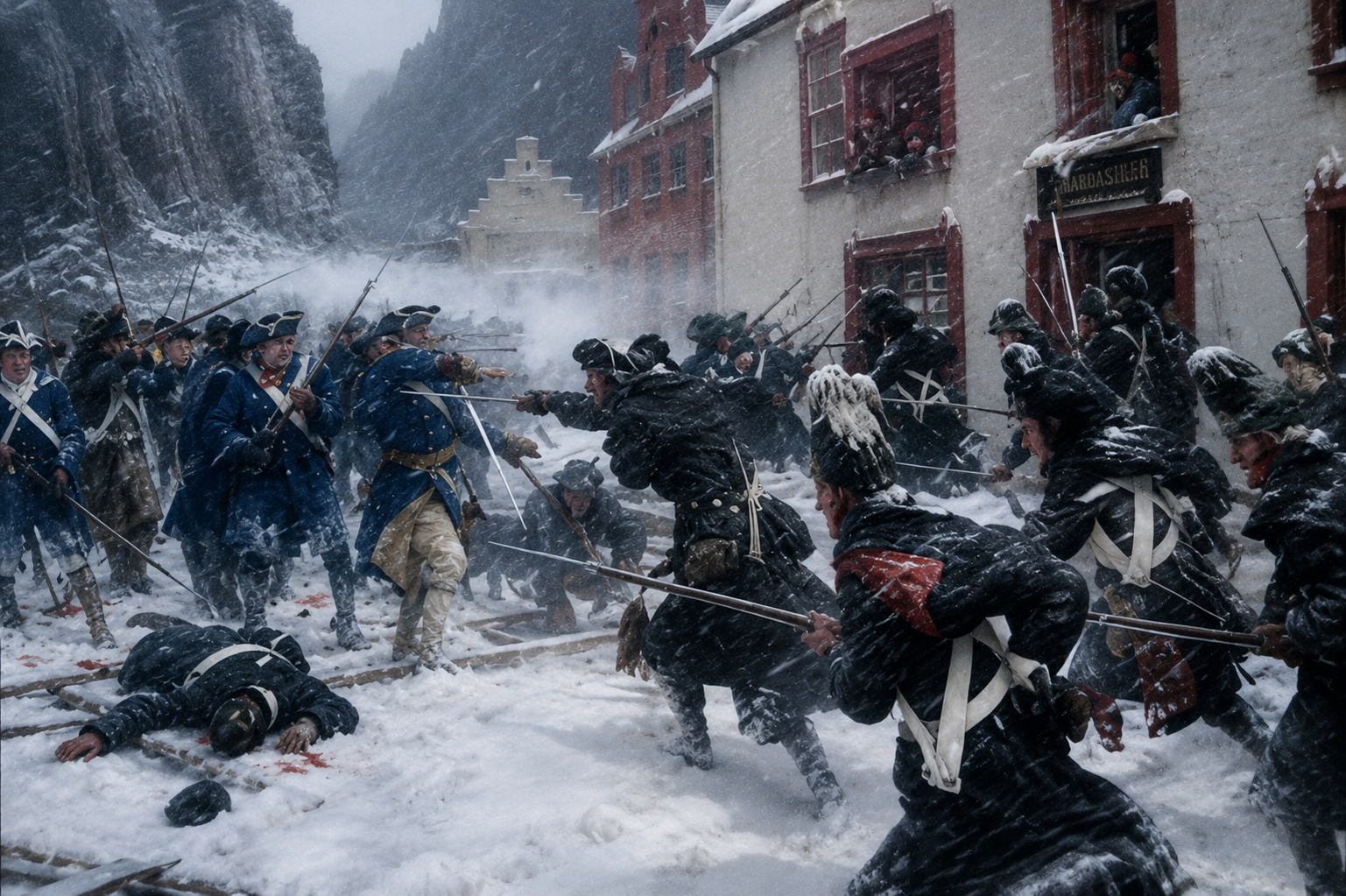
The opportunity afforded by a blinding snowstorm came early in the morning of New Year’s Eve, and the rest is a story in itself. American forces under Arnold made three feints and pressed an attack in the Sault-au-Matelot in the Lower Town. These ended in disaster for the Patriots: 389 of them were made prisoner in what had amounted to a carefully prepared trap in the city streets. Forty-two were wounded and thirty killed. Carleton’s losses were seven killed and eleven wounded. Among the many American bodies lying in the snow was that of General Montgomery; on Carleton’s orders he was buried with full military honors. As for Arnold, he had been disabled by an injury to the leg at the beginning of the action and would have to command the army from his hospital bed in St. Roch.
Throughout the winter Arnold undertook several attempts to fire the town with red hot shot, from batteries set up across both the St. Lawrence and St. Charles rivers. And he sent his men with a fireship into the harbour. None of these efforts succeeded. Meanwhile smallpox and declining morale among the troops made their unrelenting progress.
Carleton knew that time was on his side. He knew that two armies were being sent by the Imperial government to North America: a main force of 25,000 regulars to join the Boston troops and a smaller one of 9,000 to bolster Quebec. This last force was intended to strike via Lake Champlain and then divide the American colonies and their armies by an attack down the Hudson River. Naval forces were also being increased. On 5 May 1776 the British frigate Surprise came in sight of the Quebec ramparts. Ashore, a blue pennant flew over a Union Flag (or Jack) – the agreed signal that the place was still in British hands. Carleton, whose defensive strategy against enemy raids and bombardment was crowned with success, sent units out onto the Plains of Abraham and the Americans quickly withdrew. By mid-June the remnant of what was called the Northern Army was back behind the secure walls of Fort Ticonderoga. Carleton, did not press the advantage that naval reinforcements and a reinforcing ten thousand British soldiers arrived, under Major-General John Burgoyne, who was under orders to lead a counter-invasion and cut the rebel colonies in half. Nothing of this sort came to pass.
In these altered circumstances Arnold began his withdrawal in expectation to fight again. Carleton marched his men out of the fort “to see,” as he reported to London, “what those mighty boasters are about.” “They were found,” he continued, “very busy in their preparations to retreat…. The plains were soon cleared of those plunderers; all their artillery, military stores, etc., were abandoned.” While the Americans passed upriver and then to Lake Champlain, Carleton pursued them slowly enough to allow them to reach Lake Champlain burning Chambly and St. Jean on route. Arnold would deny those places of refuge to Carleton’s force. For a time, Arnold was in command at Montreal. On 18 June Arnold, last of the American invaders, bade farewell to Canada.
+++
In conclusion, Arnold’s march to Quebec in 1775 had been undertaken as part of a two-pronged attack to take the province. Despite hardships of all sorts, the bulk of his party had pressed on. Living off the land, sometimes with the help of the habitants, Arnold’s little army had, with the American army under Montgomery from Montreal, laid siege and blockaded Quebec. It may be speculated that if Arnold had left Cambridge a week earlier the difficulties of climate, weather and environment might have been fewer and his chances of success greater. Perhaps. And whether or not Quebec would have been taken had not Carleton not returned from Montreal before Arnold’s arrival is a matter for further speculation.
We do know, and perhaps this is of most interest, that both commanders were to end the war on the British side where they had been during the Seven Years’ War. In autumn of 1780 while in command at West Point, Arnold took to deliver that post over to the British. When his plot was discovered, he fled to a British warship anchored in the Hudson River, leaving his glamourous wife, the socialite Tory Peggy Shippen of Philadelphia and a young son behind. In England, where he was later joined by his family, he remained for most of his last twenty years in a series of unsuccessful and disheartening ventures – all the while, apparently, being consumed by the acid of his own tarnished image.
Thus did this enigmatic figure – this soldier of fortune – a fellow frequently regarded by his companions as the brightest jewel in the entire military diadem, a soldier and sailor of repute, end his last years. He was, as one of his biographers called him, a hero and a traitor, though in the United States the epithet Benedict is likely to endure forever. In Canada he will always be remembered as a leader of an expedition to conquer Quebec, and it is not likely that this stereotype of this Yankee invader will be forgotten either. Of such stereotypes, for all their faults, is our mythology and national historical consciousness made.